

Reliable LED strip lighting solutions begin with the project—not the product catalog.
A slim light box, a retail shelf, a hotel ceiling, an outdoor storefront sign, and an RGB entertainment space may all use LED strips, but they should not use the same strip, voltage, controller, waterproof structure, or installation method.
For B2B buyers, the goal is to create a complete lighting solution that delivers the required visual effect while controlling installation time, maintenance risk, energy use, and repeat-order consistency.
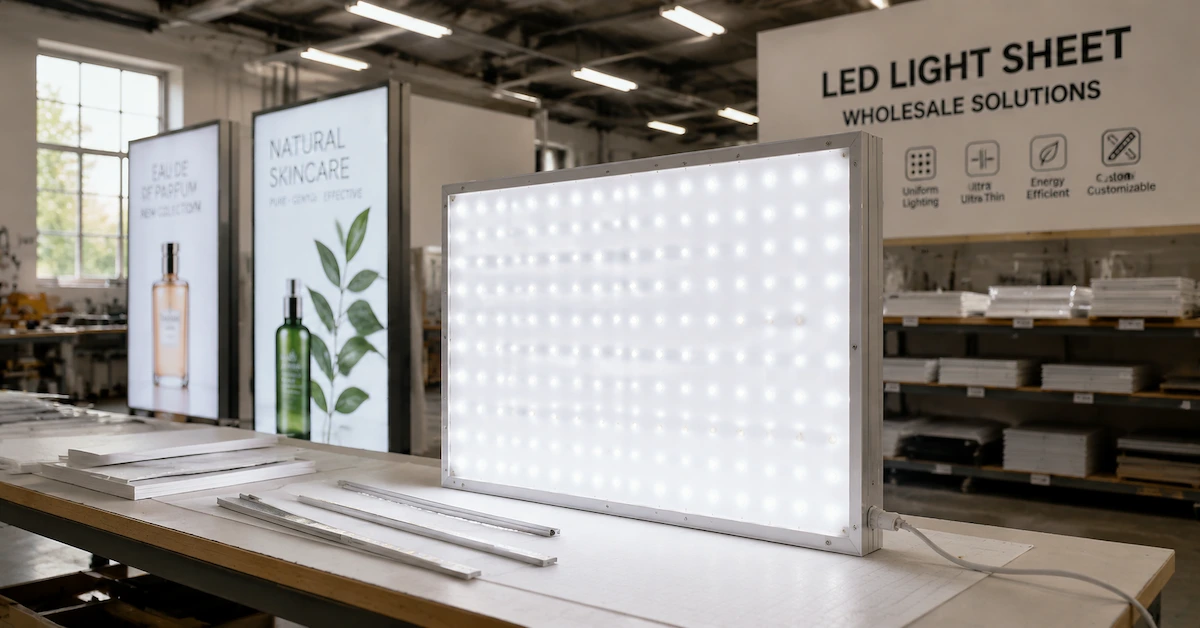
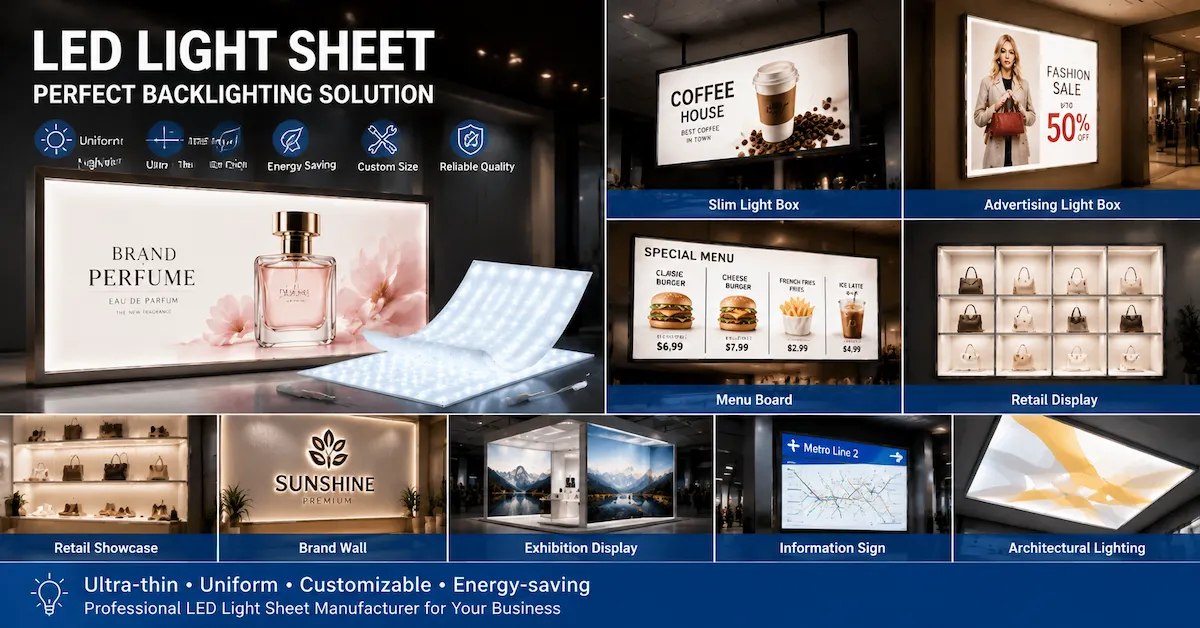
YESUN LED focuses on signage and commercial lighting applications. Its product range includes LED strips, LED modules, LED light sheets, light bars, neon strips, controllers, power supplies, and accessories that can be combined for different project requirements.
What Makes an LED Strip Lighting Solution Project-Ready?
An LED strip is only one component of a commercial lighting project. A project-ready solution must consider how the strip will be installed, powered, controlled, protected, and maintained.
A complete solution may include:
- LED strip type and LED density
- Input voltage
- Color temperature or RGB configuration
- Brightness and beam distribution
- Power supply
- Controller or dimmer
- Connectors and wiring
- Waterproof protection
- Aluminum profiles and diffusers
- Mounting method
- Heat dissipation
- Installation layout
- Spare parts and maintenance access
Ignoring one of these factors can affect the whole system. For example, a high-quality LED strip may still flicker if the power supply is undersized. A waterproof strip may still fail outdoors if its connector or cut point is not sealed correctly.
The best LED strip lighting solution therefore matches every component to the actual installation environment.
Which LED Strip Lighting Solution Fits Each Application?
Different applications require different combinations of product type, voltage, protection, and control.
| Commercial Application | Commonly Selected Solution | Main Buying Priority |
|---|---|---|
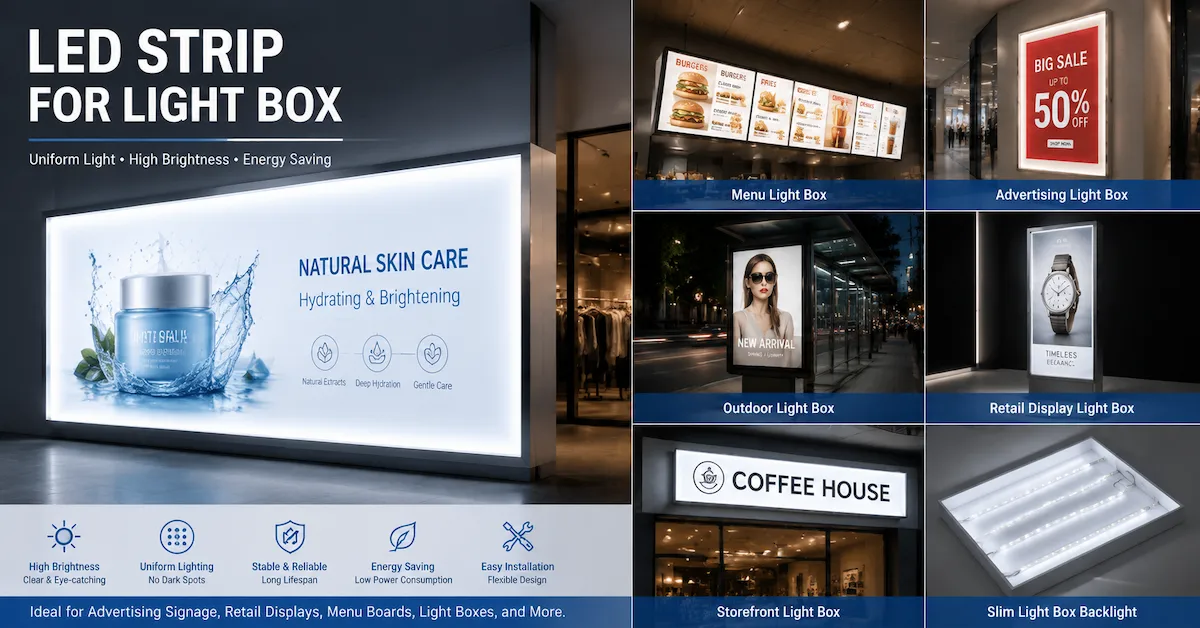
| Slim light boxes | COB or high-density LED strip | Smooth backlighting and fewer visible dots |
| Large advertising light boxes | LED strip with lens or high-efficiency strip | Wide light distribution and stable output |
| Storefront signage | Waterproof 12V or 24V LED strip | Outdoor reliability and easy maintenance |
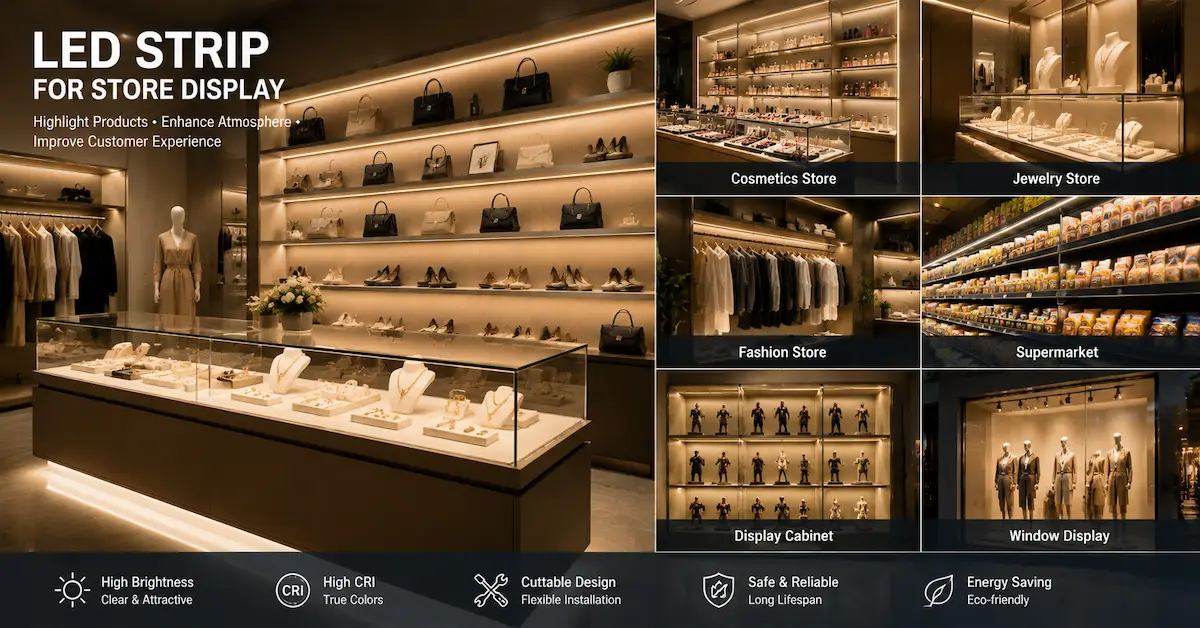
| Retail shelves | COB or high-color-rendering strip | Accurate product presentation |
| Display cabinets | Compact low-voltage strip with aluminum profile | Clean installation and heat control |
| Hotels and restaurants | Warm white or CCT-tunable strip | Comfortable atmosphere and dimming |
| Bars and entertainment spaces | RGB, RGBW, or addressable RGB strip | Dynamic color effects |
| Building outlines | Waterproof strip or silicone neon strip | Weather protection and continuous linear light |
| Curved signs | S-shape strip or flexible neon strip | Flexible routing around irregular shapes |
| OEM product lines | Customized strip, connectors, labels, and packaging | Repeatable specifications and brand consistency |
YESUN LED currently lists COB, high-density, CCT-tunable, RGB, addressable RGB, S-shape, high-voltage, high-efficiency, lens-equipped, waterproof, and special-design LED strip categories, along with neon products, controllers, power supplies, and quick connectors.
Buyers can review these categories on the YESUN LED Products page.
What Should Buyers Define Before Requesting a Solution?
A supplier cannot recommend the right product from the keyword “LED strip” alone. A useful quotation should begin with a clear project brief.
Provide the following information before asking for pricing:
| Project Information | What to Confirm |
|---|---|
| Application | Light box, retail shelf, signage, hotel, facade, or another use |
| Installation dimensions | Total length, width, depth, and available mounting space |
| Operating environment | Indoor, humid, semi-outdoor, or fully exposed outdoor |
| Required visual effect | Uniform white light, tunable white, RGB, pixel effect, or neon appearance |
| Color requirements | CCT, RGB/RGBW configuration, and color-rendering target |
| Voltage preference | 12V, 24V, or another system requirement |
| Control method | On/off, dimming, CCT control, RGB control, or addressable control |
| Operating schedule | Expected hours of use per day |
| Wiring layout | Power supply position and maximum run length |
| Order requirements | Sample quantity, bulk volume, repeat-order plan, and packaging |
| Target market | Required certification, plug, voltage, label, and documentation |
| Installation method | Adhesive, clips, aluminum profile, channel, or embedded mounting |
The YESUN FAQ organizes buyer questions around lumen output, color temperature, color rendering, IP protection, voltage, beam angle, OEM/ODM, samples, pricing, logistics, warranty, certification, and installation support. These are also practical fields to include in a project brief.
How Should Buyers Compare Different LED Strip Technologies?
COB LED Strip
COB LED strips are commonly selected when the project requires a smooth line of light with fewer visible LED points. They are useful for shallow shelves, display cabinets, decorative channels, mirrors, and premium retail interiors.
They may also improve the appearance of slim light boxes when the distance between the strip and diffuser is limited.
However, buyers should still check:
- Lumen output per meter
- Power per meter
- Strip width
- Cutting unit
- Color consistency
- Heat dissipation
- Waterproof option
- Dimming compatibility
YESUN lists COB products with high LED densities, soft output, wide luminous angles, multicolor configurations, and both indoor and waterproof options.
High-Density SMD LED Strip
High-density SMD strips place more individual LEDs along each meter. They can provide strong output and improved uniformity while retaining familiar cutting and connection methods.
They are useful for:
- Advertising light boxes
- Backlit displays
- Commercial shelf lighting
- Linear architectural details
- Projects that require specific SMD packages
LED Strip with Lens
A lens changes how the light is distributed. This can be useful when a project needs wider coverage, controlled projection, or greater spacing between light sources.
Lens-equipped strips may reduce the number of rows needed in some light box layouts, but buyers should test the strip-to-diffuser distance before approving mass production.
CCT-Tunable LED Strip
CCT-tunable strips allow the lighting to move between warmer and cooler white tones. They are suitable for hotels, restaurants, showrooms, retail stores, and multipurpose commercial spaces.
A tunable solution requires a compatible controller and power supply. Buyers should confirm the control protocol and wiring before installation.
RGB, RGBW, and Addressable RGB Strip
Regular RGB strips change color as one zone or circuit. RGBW products add a dedicated white channel, which can provide more useful white light for commercial spaces.
Addressable RGB strips allow individual pixels or sections to create chasing, flowing, or animated effects. They are suitable for entertainment spaces, creative signs, events, and branded displays.
The U.S. Department of Energy notes that full-color tunable systems commonly use red, green, and blue channels, while additional white or other channels may be added for broader lighting functions.
S-Shape and Special-Design LED Strip
Standard flexible strips bend primarily along one direction. S-shape strips are designed for tighter lateral curves, making them useful for logos, mini letters, curved sign structures, and irregular display outlines.
Before selecting one, confirm:
- Minimum bending radius
- Strip width
- Cutting interval
- Adhesive method
- Connector position
- Waterproof protection
Which Technical Decisions Most Affect Reliability?
1. Brightness and Uniformity
More brightness does not automatically create a better result.
For light boxes, the main objective is often uniform backlighting. This depends on:
- LED density
- Beam angle
- Distance to the diffuser
- Number of strip rows
- Interior reflectance
- Light box depth
- Diffuser transmission
- Placement near edges and corners
A sample should be tested inside the actual or simulated structure. Testing a loose strip on a workbench cannot fully predict how it will look behind a printed panel or diffuser.
2. Color Temperature and Color Rendering
Color temperature affects atmosphere. Warm white is often used in hospitality and premium retail spaces, while neutral or cool white may be selected for signs, work areas, and bright commercial displays.
Color rendering affects how accurately merchandise, materials, food, skin tones, and branded colors appear under the light. The U.S. Department of Energy identifies CRI as a measure of color fidelity and notes that lighting products can be specified according to the color-quality needs of the application.
For repeated retail or signage projects, buyers should also ask how the supplier controls color consistency between production batches.
3. Voltage and Power Distribution
Both 12V and 24V LED strip systems are widely used.
A 12V solution can be suitable for short sections, compact signs, and small display fixtures. A 24V solution is often preferred for longer commercial runs because the same power can be delivered with lower current, which can help simplify voltage-drop management.
The final decision should consider:
- Strip wattage per meter
- Total run length
- Cable size
- Feed position
- Number of power injection points
- Power supply distance
- Controller current limit
- Maximum permitted brightness variation
Do not assume one long reel can be powered from one end without calculation.
4. IP Protection
IP ratings classify an enclosure’s resistance to solid-particle and liquid ingress under IEC 60529. However, the strip’s rating alone does not guarantee that the completed installation has the same protection. Connectors, cut ends, wire exits, controllers, and power supplies must also be protected.
A practical selection approach is:
- IP20: dry indoor displays and furniture
- IP65: protected semi-outdoor or splash-prone areas
- IP67: more exposed signage and outdoor installations
- IP68: specialized applications with greater water exposure
The exact rating should be selected according to the complete installation and local safety requirements.
5. Power Supply and Controller Matching
A power supply must match the system voltage and total load. It should also provide an appropriate operating margin rather than running continuously at its overload limit.
The controller must support:
- Strip voltage
- Number of channels
- Total current
- Dimming method
- RGB/RGBW/CCT configuration
- Addressable strip protocol
- Required remote or smart-control function
Power-supply manufacturers recommend selecting drivers according to the electrical characteristics and load of the LED application rather than wattage alone.
6. Mounting and Heat Management
Aluminum profiles can improve appearance, protect the strip, hold a diffuser, and assist with heat dissipation.
They are especially useful for:
- Display shelves
- Cabinets
- Wall recesses
- Ceiling coves
- Stair details
- Long-hour commercial installations
Before production, confirm that the LED strip width, connector, wire exit, diffuser, and profile dimensions are compatible.
When Does a Project Need a Custom LED Strip Solution?
A standard catalog product may be sufficient when the project uses common lengths, standard white light, normal indoor conditions, and readily available connectors.
Customization becomes more valuable when the buyer needs:
- A special PCB width
- A specific cutting interval
- Fixed-length sections
- Preinstalled connectors
- Special wire lengths or exit directions
- Controlled color-temperature bins
- Higher LED density
- Unique waterproof construction
- Branded labels or packaging
- RGB, RGBW, or pixel configuration
- A matched controller and power supply
- Repeatable specifications for multiple locations
YESUN states that its OEM/ODM services can customize size, brightness, color temperature, IP rating, and other product requirements. Its resource center also describes technical consultation, design optimization, and tailored product-selection support for signage and commercial projects.
Technical files, catalogs, certificates, videos, and solution information are available through the YESUN LED Resources page.
What Does a Practical Solution Development Process Look Like?
A structured process reduces misunderstandings before mass production.
Step 1: Define the Application
Confirm what is being illuminated, where the strip will be installed, and what the finished result should look like.
Step 2: Select the Preliminary Configuration
The supplier recommends the strip type, voltage, CCT or color system, IP rating, power supply, controller, connectors, and mounting method.
Step 3: Review the Layout
Calculate total length, power load, wiring paths, feed points, controller zones, and installation spacing.
Step 4: Produce and Test Samples
Test the sample for:
- Brightness
- Uniformity
- Color
- Dimming
- Voltage drop
- Heat
- Fit
- Waterproof sealing
- Connector reliability
Step 5: Approve Specifications
The final product specification should record model, voltage, wattage, dimensions, LED density, CCT, IP rating, wire length, connector, packaging, and labeling.
Step 6: Complete Mass Production and QC
Batch production should be checked against the approved sample, not only a general catalog specification.
Step 7: Package for Installation and Maintenance
Clear labels, compatible accessories, wiring information, and spare parts can reduce installation errors at the project site.
Questions about samples, customization, quotations, delivery, warranty, certification, and after-sales procedures can be reviewed on the YESUN LED FAQ page.
How Can Buyers Reduce Cost Without Increasing Project Risk?
The lowest strip price does not always produce the lowest project cost.
| Short-Term Saving | Possible Long-Term Risk |
|---|---|
| Lower-density strip | Visible dots or additional strip rows |
| Undersized power supply | Flicker, overheating, or early failure |
| Thin wiring | Voltage drop and uneven brightness |
| Indoor strip used outdoors | Moisture-related failure |
| Unmatched controller | Poor dimming or incorrect color control |
| No sample testing | Expensive rework after delivery |
| No batch control | Different colors across repeat orders |
| Inaccessible installation | High labor cost during maintenance |
| Multiple unrelated suppliers | Compatibility and responsibility disputes |
A better cost-control strategy is to optimize the complete solution.
For example, a strip with the correct beam distribution may reduce installation quantity. Preassembled connectors may shorten labor time. A 24V layout with planned power injection may improve consistency. Better access to the power supply can reduce future maintenance cost.
What Should You Check in an LED Strip Solution Provider?
Before choosing a supplier, ask whether it can support the complete project rather than only quote a reel price.
A qualified solution provider should be able to explain:
- Which product fits the application and why
- How the strip should be spaced or mounted
- How voltage drop will be managed
- Which power supply and controller are compatible
- How outdoor connections should be sealed
- How color consistency is controlled
- Whether samples can be tested before bulk production
- Which parts can be customized
- What certifications and documents are available
- How repeat orders and after-sales issues are handled
Why Consider YESUN LED for LED Strip Lighting Solutions?
According to its About Us page, YESUN LED was founded in 2013 and operates a 5,000㎡ production facility with six SMT lines. The company states that it supports monthly production of more than 1.5 million LED products and supplies signage lighting products to over 100 countries.
Its published capabilities include:
- Factory-direct production
- Flexible bulk-order support
- OEM/ODM customization
- LED strips, modules, light sheets, neon strips, controllers, and power supplies
- Sample support
- Full-process quality control
- Optical and environmental testing
- Product-selection assistance
- Global logistics and after-sales support
YESUN also describes integrated production traceability, engineering support, and testing equipment such as integrating spheres, salt-spray testers, and high-temperature humidity chambers.
For additional purchasing and application guides, visit the YESUN LED Blog, which organizes content around LED strips, signage lighting, and commercial LED lighting.
FAQ: LED Strip Lighting Solutions
1. What is the best LED strip lighting solution for a light box?
COB, high-density, or lens-equipped LED strips are commonly considered. The best option depends on the box depth, diffuser, graphic material, target brightness, and strip spacing. A sample layout should be tested before mass production.
2. Is COB LED strip better than SMD strip?
Neither technology is best for every application. COB is useful when a smooth line of light is important. SMD strips provide more options for LED packages, lenses, output levels, and special layouts. The application should determine the choice.
3. Should a commercial project use 12V or 24V LED strips?
12V can work well for short sections and compact signs. A 24V system is often easier to manage for longer runs. The decision should be based on wattage, run length, wiring, power-injection points, and controller limits.
4. Which IP rating is suitable for outdoor LED strip lighting?
Outdoor projects commonly consider IP65, IP67, or IP68 products. The correct selection depends on exposure to rain, water, dust, cleaning, and installation position. Connectors, wire exits, and power supplies also require suitable protection.
5. How can dark spots be reduced in a light box?
Use suitable LED density, beam distribution, row spacing, diffuser distance, and reflective interior surfaces. COB strips or lens-equipped strips may help, but physical sample testing remains important.
6. When is an LED controller required?
A controller is required for dimming, CCT adjustment, RGB/RGBW color control, addressable effects, or programmed scenes. A basic single-color on/off system may not need a separate controller.
7. Can LED strip lighting solutions be customized?
Yes. Typical customization includes strip length, PCB width, LED density, color temperature, IP protection, connectors, wire length, controller configuration, labeling, and packaging.
8. What information should I send for a quotation?
Send the application, drawings or dimensions, total strip length, operating environment, desired color, voltage, control method, installation details, target quantity, and market certification requirements.
Conclusion
Effective LED strip lighting solutions connect the visual objective with the correct strip, power supply, controller, wiring, waterproof protection, mounting structure, and testing process.
Before placing a bulk order, define the installation environment, required effect, dimensions, voltage, IP rating, color quality, control method, and maintenance needs. Then test the proposed configuration under real or simulated project conditions.
For signage makers, retail display manufacturers, lighting contractors, distributors, and OEM buyers, YESUN LED provides LED strip products and project support for light boxes, commercial signs, retail spaces, hotels, restaurants, outdoor installations, and custom lighting applications.