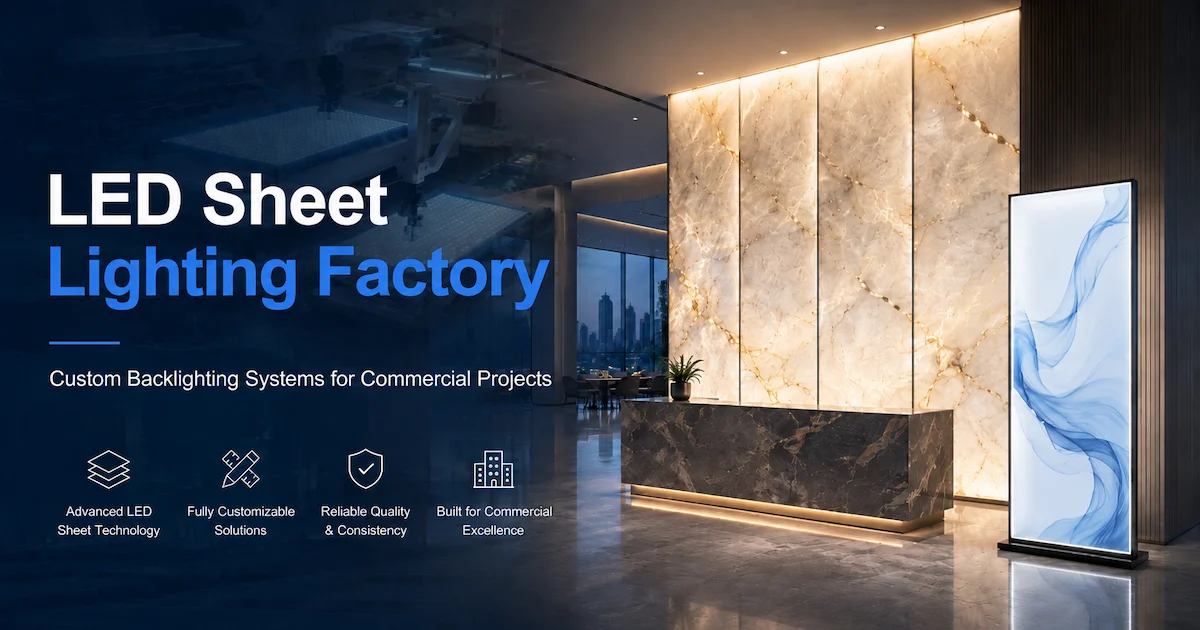


Why Marble Backlighting Requires More Than a Bright LED Source
A successful marble backlighting project is judged by what the viewer does not see: individual LED points, dark zones, wiring shadows, sudden color changes, and uneven brightness between adjacent stone panels.
The lighting system must reveal the natural veins and depth of the stone without making the LEDs behind it obvious.
This is why selecting an LED light sheet for marble should begin with the stone and the finished visual effect—not with wattage alone.
Natural stone also varies significantly from slab to slab. Some materials transmit enough light to create a dramatic illuminated surface, while others are too opaque for effective backlighting. The Natural Stone Institute, for example, specifically describes Namib Bianco marble as a translucent material suitable for backlit natural-stone projects.
For project buyers, this leads to one important rule:
Always test the actual stone sample with the intended light source before approving mass production.
A specification that works behind one white marble or onyx panel may produce a very different result behind another slab with different thickness, density, mineral structure, or veining.
What Is an LED Light Sheet for Marble?
An LED light sheet is a thin lighting panel built around LEDs distributed across a flexible or semi-flexible circuit structure. Instead of creating illumination from several long linear strips, the light sources are spread across a broader two-dimensional surface.
For marble and other translucent stone, this can provide several practical advantages:
- More even LED distribution across the panel
- Less dependence on deep installation cavities
- Easier coverage of large surfaces
- Flexible cutting for irregular project dimensions
- Simpler planning around corners and custom shapes
- Different white, tunable-white, RGB, or RGBW options depending on the product
- Cleaner backlighting for premium decorative surfaces
YESUN offers a dedicated range of LED light sheets for backlighting, signage, display, and decorative applications.
For projects where hotspot control is particularly important, the YS-F001-3105-1T flexible LED light sheet with lens uses SMD2835 LEDs with individual optical lenses. YESUN specifies a beam angle of up to 175°, 105 LEDs per sheet, 12V/24V options, a flexible double-sided FPC structure, and approximately 3200–3500 lm output for this model.
The wider optical distribution is especially relevant behind translucent stone because it helps spread light before it reaches the marble surface.
Start With the Marble, Not the LED Specification
Stone Translucency Determines the Lighting Strategy
Two pieces of marble with the same nominal thickness can transmit light differently.
Before deciding LED quantity or power, evaluate:
- Stone type
- Actual slab thickness
- Vein density
- Background color
- Surface finish
- Resin or backing layers
- Distance between stone and LED source
- Desired daytime and nighttime appearance
A highly translucent onyx panel may require less output than a denser white marble.
Conversely, increasing LED power behind a poorly transmitting stone does not always solve the problem. It can increase heat and energy consumption while still leaving uneven visual zones.
Use a Full-Scale Lighting Mockup When Possible
For commercial projects, a small sample is useful, but a larger mockup is better.
A useful test panel should reproduce:
- The actual stone thickness.
- The intended cavity depth.
- The selected LED light sheet.
- The reflective backing or mounting surface.
- The actual power supply.
- The intended dimming level.
- The surrounding ambient light.
This test helps determine whether the final installation needs more LED density, a wider beam angle, a different CCT, greater cavity depth, or a different stone selection.
How to Reduce Hotspots Behind Marble
Hotspots are one of the most common reasons a premium backlit-stone project looks inexpensive after installation.
They usually occur when individual LED sources remain visually distinguishable through the stone.
Beam Angle Is Often More Important Than Raw Wattage
A narrow beam concentrates light directly above each LED.
A wider beam spreads light laterally before it reaches the stone, allowing neighboring light distributions to overlap.
For example, YESUN's lens-equipped flexible light sheet uses a specified 175° optical distribution specifically to improve uniformity in slim backlighting applications.
That does not mean 175° is automatically required for every stone project. It means beam distribution should be evaluated together with installation depth and stone transmission.
Cavity Depth Changes the Result
Increasing the distance between the LEDs and the marble gives light more room to mix.
However, architectural projects often have very limited space behind:
- Reception counters
- Bar fronts
- Wall panels
- Elevator interiors
- Luxury furniture
- Retail displays
- Countertops
This is where a distributed light sheet can be more practical than widely spaced point modules.
LED Density Should Solve a Visual Problem
More LEDs can improve uniformity, but maximum density is not automatically the best design.
Higher density can also mean:
- Higher power
- More heat
- Larger power supplies
- Higher project cost
- More demanding wiring
The correct target is the lowest practical system density that achieves the required brightness and uniformity with the actual stone.
Choosing the Right Color Temperature for Backlit Marble
Color temperature changes how the stone itself appears.
The same marble can look warm and luxurious under one CCT and cooler or more architectural under another.
2700K–3000K: Warm Hospitality Appearance
Warm white is often considered for:
- Hotels
- Restaurants
- Bars
- Residential luxury interiors
- Warm beige or cream stone
- Decorative furniture
It can emphasize gold, beige, brown, and warmer veins.
Around 4000K: Balanced Commercial Presentation
Neutral white can be useful where buyers want a cleaner appearance without the strong amber effect of warm lighting.
Typical environments include:
- Retail interiors
- Reception areas
- Offices
- Showrooms
- Commercial feature walls
Cooler White: Crisp Contemporary Effect
Higher color temperatures may suit white stone, modern interiors, and cooler architectural palettes.
However, stone color can shift significantly under different CCTs.
Therefore, a CCT should not be selected from a catalog description alone. Test the intended CCT behind the actual slab.
For projects requiring different moods throughout the day, YESUN's LED light sheet range also includes tunable-white products, allowing suitable projects to move between warmer and cooler white light.
White, Tunable White, RGB or RGBW?
The correct choice depends on what the stone surface is supposed to achieve.
| Light Type | Main Purpose | Best Fit |
|---|---|---|
| Single White | Stable architectural backlighting | Marble walls, reception desks, counters |
| Tunable White | Adjustable atmosphere | Hotels, restaurants, premium interiors |
| RGB | Decorative color effects | Bars, entertainment, statement installations |
| RGBW | Color effects plus dedicated white | High-end decorative and multifunction projects |
| Addressable/Dynamic | Animated lighting | Specialized experiential installations |
For classic marble architecture, stable white light is usually the simplest system to commission and maintain.
RGB or RGBW makes more sense when color-changing capability is part of the design brief rather than an unnecessary feature added after product selection.
12V or 24V LED Light Sheet for Marble?
Voltage selection should be made at system level rather than by looking only at the sheet.
Both 12V and 24V configurations are available in YESUN's light-sheet product range.
When 12V Can Be Practical
12V can work well for:
- Compact panels
- Short wiring distances
- Existing 12V systems
- Small independent lighting zones
Why 24V Is Often Considered for Larger Installations
For larger backlit walls or long electrical runs, a 24V design can help reduce current for the same power level, which can make voltage-drop management easier.
However, voltage alone does not solve an oversized circuit.
Large marble installations should still consider:
- Branch wiring
- Cable size
- Maximum connector current
- Circuit zoning
- Power-supply location
- Voltage drop
- Maintenance access
YESUN's installation guidance for its lens-equipped LED light sheet recommends branch connections for larger sheet quantities rather than placing an excessive number of sheets on one long cascade.
How to Size the Power Supply
The basic calculation is:
Total LED load = Quantity × Power per LED sheet
The power supply should then include operating headroom rather than running continuously at its full nameplate rating.
YESUN's current installation guidance for the lens-equipped light sheet advises operating switching power supplies at approximately 80% of rated capacity.
For example, if the connected light sheets require 160 W:
160 W ÷ 0.8 = 200 W
A 200 W class power supply would therefore provide more appropriate headroom than a 160 W unit operating continuously at maximum capacity.
The exact design still depends on:
- Driver model
- Ambient temperature
- Cable length
- Controller load
- Local electrical requirements
- Installation enclosure
For system matching, buyers can also review YESUN's LED power supply range.
Which LED Light Sheet Configuration Fits Different Marble Projects?
There is no single best configuration for every project.
| Application | Main Lighting Challenge | Recommended Direction |
| Reception desk | Slim depth and visible stone veins | Wide-angle white LED light sheet |
| Marble feature wall | Large-area brightness consistency | Multiple zones with branch wiring |
| Backlit countertop | Limited cavity and irregular dimensions | Cuttable flexible light sheet |
| Onyx panel | High translucency | Lower output or dimmable system |
| Hotel bar front | Mood adjustment | Tunable white or dimmable white |
| Decorative stone furniture | Complex shapes | Flexible/cuttable FPC light sheet |
| Color-changing stone wall | Dynamic visual effect | RGB or RGBW light sheet |
| Large commercial installation | Voltage drop and servicing | Zoned 24V system where compatible |
The key point is that product selection should follow the project geometry and lighting objective.
LED Light Sheet vs LED Strip vs LED Module for Marble Backlighting
An LED light sheet is not automatically superior to every other light source.
Different systems solve different installation problems.
| Solution | Strength | Limitation | Best Use |
| LED Light Sheet | Broad, distributed illumination | Higher material cost than simple strip layouts | Thin and premium stone backlighting |
| LED Strip | Flexible and widely available | Linear spacing requires careful planning | Small or simple rectangular areas |
| LED Module | Strong point-source output and lens options | More wiring and point-by-point layout | Deeper cavities and signage-style structures |
Choose LED Light Sheet When:
- Installation depth is limited
- The marble surface is highly visible
- Hotspot reduction is a priority
- The panel has an irregular shape
- Large areas require consistent coverage
- Cutting flexibility is important
Consider LED Strip When:
- The cavity is deep enough for adequate light mixing
- The layout is simple
- Budget pressure is high
- Linear installation is easy to service
Consider LED Modules When:
- The installation has sufficient depth
- High-output point sources are required
- The project structure resembles a signage or light-box cavity
The best option is therefore not determined by product category alone, but by stone, depth, area, required luminance, serviceability, and budget.
A Procurement Checklist for Marble Backlighting Projects
Before placing a bulk order, project buyers should confirm more than voltage and color temperature.
Light Sheet Specifications
Ask for:
- Model number
- Input voltage
- Sheet dimensions
- LED type
- LED quantity
- Power
- Luminous output
- Beam angle
- CCT
- Color tolerance
- Minimum cutting unit
- Wiring method
- Maximum cascade quantity
- Connector current
- Adhesive method
- Dimming compatibility
- Warranty
- Environmental/IP suitability
Project Information to Send the Supplier
Provide:
- Marble or stone type
- Stone thickness
- Panel dimensions
- Quantity
- Installation drawing
- Available cavity depth
- Indoor or outdoor environment
- Required CCT
- Dimming requirements
- Desired brightness
- Photos or physical stone samples when possible
This information allows the manufacturer to recommend a system based on the actual application rather than simply quoting a standard LED sheet.
Cutting and Fitting LED Light Sheets Around Irregular Stone Shapes
One advantage of flexible FPC light sheets is the ability to adapt them to non-standard panel geometry.
YESUN's current product instructions allow straight and diagonal cutting on designated circuit boundaries for its lens-equipped model, while warning against cutting through incomplete circuit groups. Cut edges and exposed electrical areas also need to remain properly insulated.
This flexibility is useful for:
- Curved reception desks
- Rounded furniture
- Stone logos
- Columns
- Irregular wall panels
- Openings around sinks or fixtures
- Custom architectural details
However, installers should never assume that every light sheet can be cut anywhere.
The cutting rule is model-specific and should be confirmed before fabrication.
Installation Workflow for a More Reliable Backlit Marble System
1. Test the Stone
Illuminate the actual stone sample and confirm CCT, brightness, hotspot visibility, and appearance of the veins.
2. Define the Lighting Cavity
Confirm the exact distance between the LED plane and the finished stone.
Do not design the LED layout before this dimension is known.
3. Create the Light-Sheet Layout
Map out:
- Full sheets
- Cut sections
- Electrical zones
- Cable paths
- Driver positions
- Controller positions
- Maintenance access
4. Prepare the Mounting Surface
The backing should be:
- Clean
- Stable
- Suitable for adhesive mounting
- Electrically safe
- Thermally appropriate
Where conductive metal is used, proper insulation between the FPC and the metal surface is essential.
5. Connect and Test Before Installing the Stone
Power every zone before the marble is permanently installed.
Check:
- Brightness consistency
- Color consistency
- Voltage
- Current
- Dimming
- Controller function
- Cable temperature
- Dark areas
- LED failures
Correcting a wiring problem is inexpensive before the stone is installed and potentially very expensive afterward.
6. Test at Final Viewing Conditions
Evaluate the surface with the surrounding architectural lighting switched on.
A backlit marble wall that looks perfect in a dark workshop may appear too dim—or too bright—in a finished hotel lobby or retail environment.
Common Purchasing Mistakes
Choosing the Highest-Lumen Sheet
More lumens do not automatically create better marble backlighting.
Uniformity usually matters more than maximum output.
Skipping the Stone Mockup
Natural stone variation can make a specification that worked on the previous project unsuitable for the next one.
Ignoring Beam Angle
A narrow optical distribution can create bright LED points even when total lumen output is sufficient.
Running One Large Circuit
Long cascades can increase the risk of voltage drop and brightness differences.
Large installations are usually easier to control and service when divided into logical zones.
Forgetting Maintenance Access
Power supplies and controllers should not be permanently trapped behind expensive stone finishes.
Buying Different Batches Without Color Control
For large walls, visible CCT or brightness differences between adjacent sections can be more noticeable than small differences in total output.
Commercial buyers should therefore discuss batch consistency before production.
OEM and Project Customization for Marble Backlighting
Large architectural projects often require more than a standard catalog product.
Possible project requirements can include:
- Custom sheet dimensions
- Different cable lengths
- Connector locations
- CCT selection
- Tunable-white configuration
- RGB/RGBW control
- Cutting layouts
- Wiring accessories
- Packaging
- Project labeling
For the current lens-equipped LED light sheet, YESUN lists customizable cable lengths and adjustable connector spacing among its connection options.
Project buyers can review YESUN's manufacturing background and OEM/ODM capabilities on the About YESUN LED page.
For custom stone projects, the most efficient inquiry is not simply:
“Please quote LED light sheet.”
Instead, send the panel drawing, marble type, thickness, cavity depth, quantity, voltage preference, CCT, and lighting objective.
That gives the supplier enough information to evaluate the complete system.
Frequently Asked Questions About LED Light Sheet for Marble
Is LED light sheet suitable for every type of marble?
No. Marble translucency varies considerably. Some stone transmits light effectively, while other slabs may remain visually opaque even with high LED output. Test the actual material before final specification.
What is the best LED light sheet for marble?
The best option depends on stone transmission, cavity depth, panel size, desired CCT, brightness, and required uniformity. For shallow installations where hotspot control matters, a wide-angle lens light sheet is often worth evaluating.
How far should an LED light sheet be from marble?
There is no universal distance because marble thickness, translucency, LED density, and beam angle all affect the result. A mockup at the intended cavity depth is more reliable than using a fixed spacing rule.
Is 12V or 24V better for marble backlighting?
Both can work. 12V may suit compact systems, while 24V can be advantageous in larger installations because the current is lower for the same wattage. Always use the voltage specified for the selected light-sheet model.
What color temperature is best for white marble?
It depends on the desired appearance. Warm white can soften the stone, neutral white creates a more balanced commercial appearance, and cooler white can make white or gray stone appear more contemporary. Testing the real slab is recommended.
Can an LED light sheet be cut to fit a marble panel?
Many flexible LED light sheets are cuttable, but cutting rules vary by model. YESUN's lens-equipped model allows cutting only along valid circuit-unit boundaries, so installers should follow the model-specific cutting diagram.
Can LED light sheets be used behind onyx?
Yes. Onyx is one of the most common decorative stones used with distributed backlighting because many varieties are highly translucent. Output and dimming should still be tested with the actual stone.
Can RGB LED light sheets be used behind marble?
Yes, when the project is intended to produce colored or dynamic effects. For traditional architectural marble, single-white or tunable-white lighting may offer a simpler and more natural appearance.
How should I calculate the power supply?
Calculate the total connected LED wattage first, then add operating headroom according to the power-supply and lighting manufacturer's guidance. Also consider controller load, circuit zoning, cable size, and voltage drop.
What information should I provide when requesting a quotation?
Provide stone type, thickness, panel dimensions, quantity, cavity depth, required color temperature, voltage, indoor/outdoor environment, control requirements, drawings, and ideally a photo or sample of the stone.
For other project and purchasing questions, you can also review the YESUN FAQ.
Conclusion
Selecting an LED light sheet for marble is primarily an optical and system-design decision, not just a product-purchasing decision.
The most reliable projects coordinate the stone, cavity depth, LED distribution, beam angle, CCT, electrical zones, power supply, and installation method before bulk production begins.
For premium reception desks, feature walls, countertops, hospitality interiors, illuminated furniture, and other translucent-stone applications, a flexible LED light sheet can provide a practical way to achieve broad and uniform illumination in limited space.
The safest procurement process is to begin with the actual stone sample and project drawing, create a lighting mockup, confirm the visual result, and only then finalize the production specification.
Explore YESUN's LED light sheet products, or contact YESUN LED with your stone dimensions, thickness, cavity depth, target CCT, and project quantity for a suitable backlighting configuration.