

Choosing an LED lighting system manufacturer is an important procurement decision for signage manufacturers, lighting distributors, retail display producers, and commercial project contractors. The challenge is not simply finding LED products at a competitive price. It is ensuring that the selected products, power supplies, controllers, wiring arrangements, and installation accessories work together as a reliable solution.
A channel-letter manufacturer may need LED modules for illuminated lettering, LED strips for display details, and compatible power supplies for installation. A retail display producer may require light sheets for backlit panels, linear lighting for shelves, and consistent product specifications across multiple store locations.
For these buyers, a suitable manufacturing partner should offer relevant product options, clear technical documentation, appropriate customization support, and a repeatable process for sample approval and bulk production.
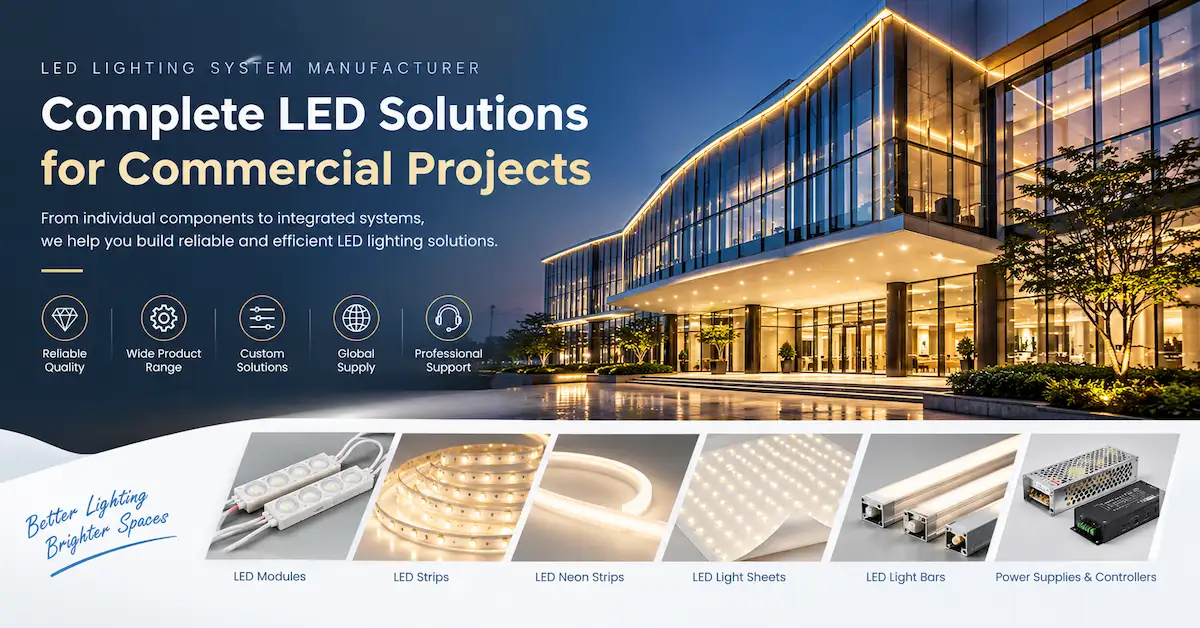
YESUN LED supplies LED signage and commercial lighting products, including LED modules, LED strips, LED light sheets, LED light bars, LED neon strips, and related accessories. Buyers can review the company's LED product portfolio to identify product categories relevant to their projects.
This guide explains how to evaluate an LED lighting system manufacturer, compare supplier capabilities, reduce procurement risks, and prepare a quotation request that supports a more accurate purchasing decision.
What Does an LED Lighting System Manufacturer Actually Provide?
An LED lighting system manufacturer supplies lighting components or configured product combinations intended to meet defined application requirements. Depending on its capabilities and the agreed project scope, this may include product selection, specification confirmation, customization, sample development, manufacturing, quality inspection, and supply of compatible accessories.
However, the term lighting system manufacturer does not automatically mean the supplier designs every part of a complete building lighting installation. Buyers should clarify whether the supplier provides components, an engineered product configuration, lighting calculations, installation design, or a turnkey solution.
For most signage and commercial display projects, the first priority is to establish a clear component scope.
|
System element |
Procurement questions |
|---|---|
|
LED light source |
Does the module, strip, light bar, or light sheet suit the intended application? |
|
Power supply |
Does its output voltage and capacity match the selected LED load? |
|
Controller |
Is it compatible with the required color, dimming, or dynamic effects? |
|
Wiring and connectors |
Are current capacity, cable length, polarity, and connection methods suitable? |
|
Mounting accessories |
Can the product fit the sign, cabinet, profile, or panel structure? |
|
Environmental protection |
Are the product and connection arrangements suitable for the installation conditions? |
|
Documentation |
Are the specifications and compliance documents available for the exact model? |
|
Replacement supply |
Can the buyer identify and reorder the same approved configuration? |
The objective is to reduce uncertainty before products reach the installation site. A technically suitable LED strip can still create problems when paired with an incompatible controller, an incorrectly sized power supply, or unsuitable connectors.
Which Buyers Benefit from Working with an LED Lighting System Manufacturer?
Different B2B customers purchase LED lighting for different reasons. Understanding these differences helps buyers evaluate suppliers against the right commercial and technical criteria.
1. Signage Manufacturers
Sign manufacturers may need LED modules for channel letters, LED strips for illuminated displays, and LED light bars or sheets for specific sign structures.
Their priorities often include consistent illumination, straightforward installation, compatible power accessories, stable product specifications, and efficient assembly.
For this buyer group, the most useful supplier is one that understands the construction of illuminated signage and can help identify the appropriate product category for each sign design.
2. Lighting Distributors and Importers
Distributors need products that can be presented, stocked, quoted, and reordered reliably.
They should evaluate the breadth of the manufacturer's relevant portfolio, SKU identification, packaging options, product documentation, and the availability of technically compatible accessories.
A wide catalog is valuable only when its products are clearly specified and commercially relevant to the distributor's target market.
3. Retail Display and Commercial Fixture Manufacturers
These companies may combine LED strips, light sheets, modules, and linear lighting within a single display or fixture.
Their purchasing decisions depend on physical fit, illumination uniformity, electrical integration, and repeatability across production batches.
For multi-store rollouts, they should also confirm that replacement products can be matched to the original approved specifications.
4. Lighting Brands and OEM Buyers
Lighting brands may require customized product configurations, private-label packaging, or specific electrical and mechanical characteristics.
Before selecting a manufacturing partner, they should clarify which modifications are technically feasible, what approval process is required, and whether custom tooling or minimum order quantities apply.
5. Project Contractors and Procurement Teams
Contractors often work against drawings, installation schedules, and defined technical specifications. Their priorities include product compatibility, documentation, delivery coordination, installation access, and the ability to resolve technical questions before ordering.
Projects requiring certified luminaires, building-wide controls, formal photometric design, or jurisdiction-specific approvals may need additional specialist suppliers and qualified engineering partners.
How to Match LED Product Categories to Commercial Applications
A manufacturer should be evaluated according to the products needed for the actual project, not merely the number of categories shown in its catalog.
|
Product category |
Potential applications |
Main selection considerations |
|---|---|---|
|
LED modules |
Channel letters, sign cabinets, localized illumination |
Letter depth, spacing, beam angle, voltage, mounting |
|
LED strips |
Linear accents, shelves, display fixtures, concealed lighting |
Width, power per meter, CCT, density, heat dissipation |
|
LED light sheets |
Backlit panels, light boxes, translucent surfaces |
Panel dimensions, light uniformity, wiring and connection limits |
|
LED light bars |
Cabinets, display structures, linear sign applications |
Length, mounting, optical distribution, electrical requirements |
|
LED neon strips |
Illuminated contours, logos, decorative outlines |
Profile dimensions, bending direction, environmental protection |
|
Power supplies and controllers |
Supporting the selected LED products |
Voltage, load capacity, control compatibility, installation conditions |
For example, a light-box producer may evaluate LED light sheets or modules depending on the internal construction and illumination requirements. A channel-letter manufacturer may focus on module spacing and the relationship between the light source and the letter face. A retail fixture producer may prioritize strip dimensions, mounting profiles, and color consistency.
These product categories are not automatically interchangeable. Selection must be based on the actual geometry, optical target, operating environment, and manufacturer's specifications.
How to Evaluate a Manufacturer's Technical Capabilities
The most important difference between a suitable manufacturing partner and a basic product vendor is the ability to support informed product selection and controlled purchasing.
1. Verify the electrical specifications
For every proposed LED product, confirm its operating voltage, power consumption, current requirements where applicable, connection limits, and compatibility with the proposed power supply.
A preliminary power calculation for a constant-power LED strip is:
For example, a 20-meter strip rated at 12 W/m represents a nominal connected load of 240 W. The final power supply selection must account for the manufacturer's requirements, operating conditions, appropriate capacity margin, and the actual wiring arrangement.
This calculation alone does not establish the maximum permitted continuous strip length. Voltage drop, conductor capacity, connection limits, and power-feed locations must also be checked.
2. Confirm optical performance
Different commercial applications require different lighting characteristics.
|
Requirement |
What buyers should verify |
|---|---|
|
Brightness |
Luminous flux or another relevant, documented output measurement |
|
White-light appearance |
CCT and available color-consistency data |
|
Color rendering |
CRI or other relevant color-quality information |
|
Light distribution |
Beam angle, lens structure, and installation geometry |
|
Surface uniformity |
Sample results using the actual sign face or display material |
|
Dimming or color control |
Compatible driver, controller, and control method |
Do not compare products using wattage alone. Two LED products with the same power consumption may produce different light output, beam distribution, or visual uniformity.
Where appearance is critical, request a representative sample and assess it under realistic installation conditions.
3. Review manufacturing and quality control
A professional supplier evaluation should establish how the manufacturer identifies products, checks specifications, handles defects, and controls approved configurations.
Ask whether the supplier can provide relevant inspection records, product datasheets, model identification, and supporting test reports.
Where applicable, discuss inspection at incoming-material, production, and final-product stages. The actual inspection plan should reflect the product, order requirements, and risks involved.
Certifications must be checked against the specific model, configuration, applicable standard, and destination market. A general statement that a company has certified products does not establish that every product in its catalog carries the same certification.
What Makes an LED Lighting Manufacturer Suitable for OEM Projects?
OEM and customized lighting orders require closer coordination than purchasing standard catalog products.
Customization may involve product dimensions, PCB width, LED density, color temperature, cable length, connectors, packaging, or other design requirements. Feasibility depends on the specific product and the manufacturer's capabilities.
A controlled OEM process should establish the following stages.
1. Requirement review
Confirm the application, drawings, quantities, target specifications, and destination market.
2. Technical feasibility
Check dimensions, electrical compatibility, materials, accessories, and customization constraints.
3. Sample and specification approval
Evaluate the physical sample, confirm agreed requirements, and document any approved changes.
4. Production and inspection
Manufacture against the approved configuration and perform the agreed quality checks.
5. Delivery and repeat-order control
Confirm packaging, shipping terms, product identification, and the process for reordering the approved model.
This workflow reduces the risk of ordering products that differ from the approved sample or discovering incompatibilities after installation.
For customized products, confirm the MOQ, sample charges, tooling requirements, production lead time, warranty terms, and available documentation directly with the manufacturer. These conditions may differ between standard and customized orders.
How to Compare LED Lighting System Manufacturers
A useful comparison evaluates technical fit, manufacturing evidence, commercial terms, and supply continuity together.
|
Evaluation factor |
Questions to ask |
|---|---|
|
Product relevance |
Does the supplier manufacture the categories required for this project? |
|
Technical support |
Can it clarify specifications and identify compatibility constraints? |
|
Customization |
Are the requested changes feasible, documented, and repeatable? |
|
Quality control |
What inspections and acceptance criteria can be agreed upon? |
|
Compliance |
Are applicable documents available for the exact products? |
|
Sample approval |
Can the buyer test representative products before bulk purchasing? |
|
Commercial terms |
Are MOQ, pricing, packaging, payment, and lead time clearly defined? |
|
Repeat orders |
Can the supplier maintain traceable model and specification consistency? |
|
Communication |
Are technical questions answered clearly and in a timely manner? |
Compare equivalent quotations
One supplier may quote the LED product only, while another includes controllers, wiring, connectors, or mounting accessories. Their prices are not directly comparable until the scope is aligned.
Ask each shortlisted supplier to quote the same technical configuration, quantity, customization scope, packaging requirements, and delivery terms.
The relevant cost comparison should include product price, accessories, installation implications, shipping, potential import charges, testing, and maintenance provisions where applicable.
The lowest initial price is not necessarily the lowest total procurement cost.
Common Procurement Mistakes to Avoid
Choosing by price per unit alone. A low-priced component can create additional installation work or require accessories that were excluded from the quotation.
Assuming all products are compatible. Voltage, current, controller protocol, connector type, and installation requirements must be checked for the selected combination.
Ordering in bulk without a representative sample. A product that looks suitable in a catalog may not produce the intended result when installed in the actual sign, panel, or display.
Treating certification as a company-wide claim. Verify the applicable documentation for the exact product and intended market.
Ignoring replacement requirements. Multi-site projects and distributors should keep approved model numbers and specification revisions so future purchases remain consistent.
Providing incomplete RFQs. Requests that omit dimensions, operating conditions, control requirements, or quantities often lead to unsuitable recommendations and repeated quotation revisions.
Why Consider YESUN LED as Your Manufacturing Partner?
YESUN LED is a Shenzhen-based manufacturer focused on LED signage and commercial lighting products. Its product portfolio includes LED modules, LED strips, LED light sheets, LED light bars, LED neon strips, and related accessories.
This range is relevant to B2B buyers who source components for illuminated signage, light boxes, retail displays, and other commercial lighting applications.
For buyers considering multiple product categories, the practical starting point is to identify the required components and verify whether the available products meet the project's technical requirements. A broad catalog can simplify sourcing, but the compatibility of the selected products must still be confirmed individually.
You can learn more about the company through the YESUN LED company profile and review the available LED product categories.
For OEM projects, ask about the feasibility of customization, sample approval, quality inspection, packaging, and repeat-order arrangements. Confirm all commercial terms and technical details before placing a production order.
Planning a signage, display, or commercial LED lighting project? Send YESUN your product requirements, drawings, estimated quantities, and destination market through the Contact Us page to discuss a project-specific quotation.
Frequently Asked Questions
1. What should an LED lighting system manufacturer provide?
Depending on the agreed scope, it may supply LED products, compatible accessories, technical specifications, customization, sample support, quality inspection, and production services. Buyers should confirm whether engineering design or installation support is included.
2. How do I choose an LED lighting system manufacturer in China?
Evaluate relevant product categories, technical documentation, manufacturing and inspection processes, customization feasibility, communication, commercial terms, and repeat-order controls. Request representative samples and verify the applicable compliance documents before bulk purchasing.
3. Can one manufacturer supply LED modules, strips, and power supplies?
Some manufacturers offer several LED product categories and related accessories. However, buyers should confirm availability and technical compatibility for the exact models instead of assuming every product combination will work together.
4. What information is needed for a commercial LED lighting quotation?
Provide the application, drawings or dimensions, product type, operating voltage, lighting requirements, installation environment, quantities, customization needs, destination market, and requested documentation.
5. Should buyers test samples before placing bulk orders?
Yes. Sample testing helps buyers assess appearance, dimensions, electrical behavior, installation fit, and other project-specific requirements. For system purchases, test the relevant components together wherever practical.
6. What is the difference between an LED product supplier and a lighting system manufacturer?
A product supplier may focus on individual components. A lighting system manufacturer may also support component selection, compatibility checks, configuration, customization, and production coordination. Actual responsibilities vary, so buyers should define the required scope in writing.
7. Can an LED lighting manufacturer support private-label products?
Some manufacturers support OEM customization, including approved product modifications and branded packaging. Buyers should confirm technical feasibility, intellectual-property arrangements, minimum quantities, documentation, and commercial terms.
8. How can buyers reduce quality risks in repeat orders?
Maintain an approved sample, record exact model numbers and specifications, define inspection criteria, and require written confirmation of changes. For critical applications, agree on how production variations and nonconforming products will be handled.
Conclusion
Choosing the right LED lighting system manufacturer means evaluating more than product prices or catalog size. For signage manufacturers, distributors, and commercial project buyers, the key factors are technical compatibility, verifiable quality controls, customization capability, clear commercial terms, and consistent repeat-order specifications.
Before committing to bulk purchasing, define the required system scope, verify the selected products, test representative samples, and document the approved configuration.
Explore YESUN LED's product range and contact YESUN for a project quotation to discuss your product requirements, customization needs, and sourcing plans.