

What Should an LED Sign Light Box Manufacturer Actually Deliver?
An LED sign light box manufacturer should deliver more than an illuminated frame. For a commercial buyer, the real deliverable is a repeatable display specification that combines the physical enclosure, visible graphic area, lighting system, front panel, electrical configuration, mounting method, artwork requirements, packaging, and quality criteria. That distinction becomes important when one approved sample must later be reproduced for dozens of stores, a distributor program, or recurring signage orders.
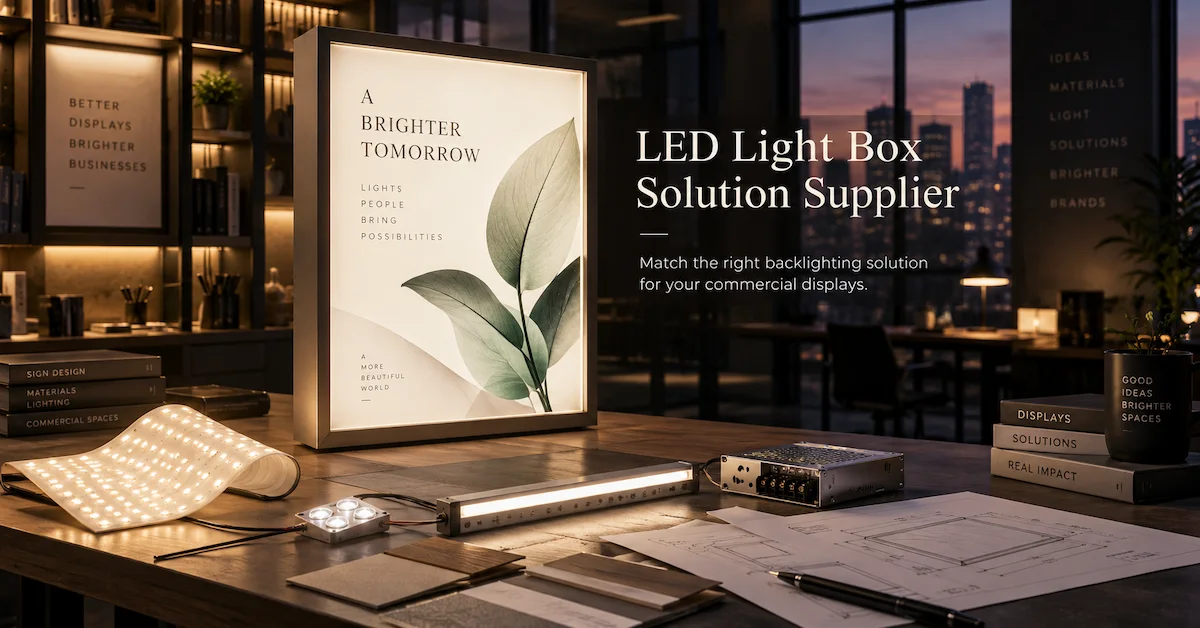
YESUN LED organizes finished Slim LED Light Boxes alongside LED modules, strips, light sheets, light bars, neon products, COB strips, and accessories. This wider product structure matters because a finished light box is only one way to create illuminated signage. A buyer should first determine whether the project requires a ready-made display product or a lighting component system that will be installed inside a custom sign cabinet.

Who Should Source From an LED Sign Light Box Manufacturer?
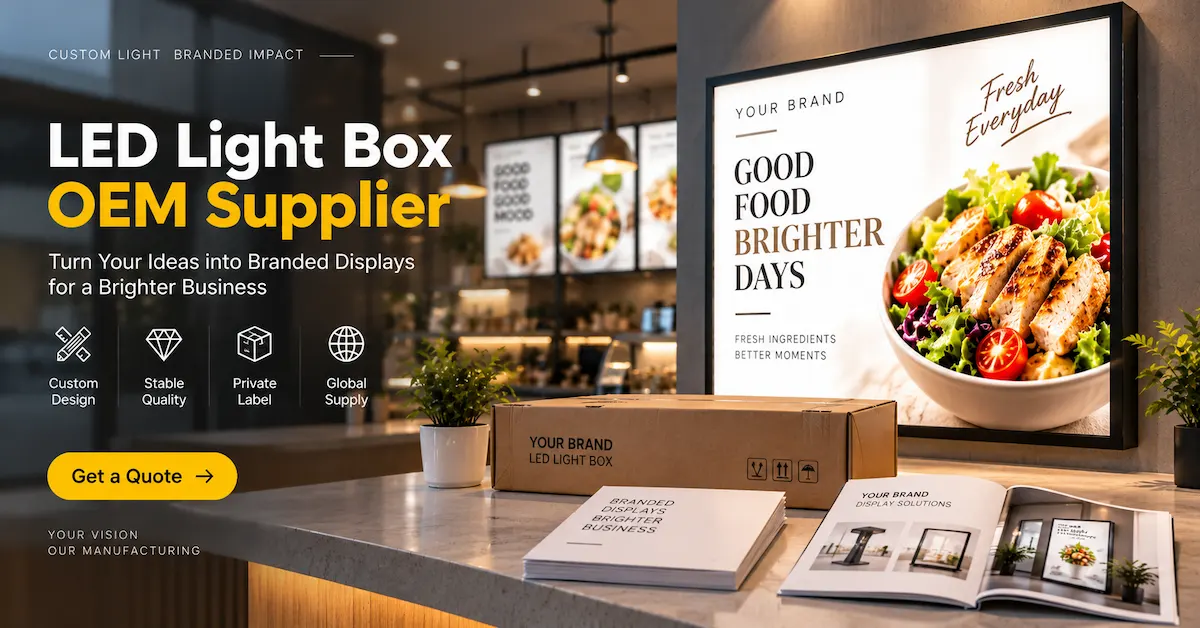
Finished LED sign light boxes are particularly relevant to restaurant chains, cafés, retail brands, shopping-mall stores, advertising companies, exhibition contractors, shopfitters, signage distributors, and franchise operators that need illuminated printed graphics in a controlled commercial environment. Their priorities usually include clean visual presentation, standardized sizes, easy installation, manageable graphic replacement, and repeatability between locations.
A finished light box is not automatically the best option for every illuminated sign. A sign factory producing deep channel letters may need LED Modules, while a large custom cabinet may be better evaluated with LED Light Sheets or LED Light Bars. Long decorative contours may require a different product family again. A capable supplier should therefore help the buyer select the correct lighting architecture rather than forcing every signage project into the same finished light box format.
Start With the Sign Application, Not the Catalog Size
One of the easiest purchasing mistakes is sending a request such as “quote A3 LED light boxes” before defining where and how the display will be used. Two displays with similar external dimensions may operate in very different environments. A restaurant menu above a counter, a retail promotion at eye level, a wall-mounted price board, and an exhibition display all impose different requirements for viewing, access, installation, graphic changes, and operating time.
Before asking an LED sign light box manufacturer for pricing, define the installation position, audience viewing distance, orientation, quantity, number of displays installed together, graphic-change frequency, mounting structure, electrical access, and indoor or outdoor conditions. If the project involves weather exposure, strong sunlight, wet cleaning, unusual temperatures, or another demanding environment, do not assume that a product intended for indoor displays is automatically suitable. Ask for a configuration specifically evaluated for that environment.
Build a Technical Specification Before You Compare Quotations
Comparing supplier prices without a common specification often creates a false price comparison. One quotation may include a complete power arrangement and mounting hardware while another may cover only the light box. One supplier may quote an existing size while another assumes a custom structure. Before comparing suppliers, give each candidate the same technical brief.
| Specification Item | Buyer Should Define | What Should Be Confirmed |
|---|---|---|
| Application | Menu, retail poster, promotional sign, showroom display or other use | Suitability of proposed configuration |
| Overall dimensions | Width, height and orientation | Dimensioned product drawing |
| Visible graphic area | Required viewing opening | Confirmed visible dimensions |
| Graphic dimensions | Printed insert size and allowance | Approved artwork template |
| Product depth | Maximum acceptable enclosure depth | Finished drawing |
| Front panel | Required material, finish and handling needs | Material specification |
| Lighting requirement | Required white appearance and visual consistency | Approved illuminated sample |
| Electrical setup | Local input, supplied power system and cable route | Electrical specification |
| Mounting | Wall, suspension, counter or project-specific method | Hardware and installation drawing |
| Operating environment | Indoor/outdoor, temperature and exposure conditions | Written application confirmation |
| Branding | Label, logo, packaging and carton requirements | Approved artwork |
| Quantity | Initial order, size mix and reorder forecast | Production plan |
| Acceptance | Appearance, dimensions, operation and packaging | Inspection criteria |
The most important dimensional distinction is between overall product size, visible image size, and printed graphic size. These are not necessarily identical. If artwork is printed before the manufacturer confirms the graphic template, a seemingly minor dimensional misunderstanding can result in reprinting across an entire project.
Finished Light Box or Custom Sign Backlighting: Which Solution Fits the Project?
A commercial buyer searching for an LED sign light box manufacturer may actually have several possible product routes. YESUN LED's range provides different lighting platforms for sign manufacturers, which makes it useful to compare the solution architecture before deciding which product should be quoted.
| Solution Type | Main Purchasing Advantage | Best-Fit Application Direction | Main Points to Confirm |
|---|---|---|---|
| Slim LED Light Box | Finished illuminated display format | Menus, retail posters, indoor promotions | Size, front panel, graphic access, mounting |
| LED Modules | Flexible point-source layout | Channel letters and custom sign cabinets | Sign depth, spacing, lens, voltage, environment |
| LED Light Sheets | Flexible area-backlighting approach | Thin or irregular illuminated surfaces | Cutting, layout, connection, power distribution |
| LED Light Bars | Structured linear backlighting | Larger light boxes and sign cabinets | Bar spacing, orientation, installation structure |
| LED Strips | Flexible linear lighting | Custom edges, profiles and special layouts | Density, voltage, bending, mounting |
| COB Light Strips | Continuous-looking linear illumination | Visible linear applications and compact profiles | Width, cutting, thermal installation |
| Neon LED Strips | Visible illuminated contour | Decorative signs and brand outlines | Bending direction, profile, cutting and sealing |
This comparison is more useful than deciding that one technology is universally “better.” The correct system depends on sign depth, illuminated area, graphic construction, installation space, viewing conditions, maintenance expectations, and whether the buyer wants a finished display or lighting components for its own sign production.
What Materials and Components Should Buyers Confirm?
The visible frame is only part of a light box. Buyers should confirm the front-panel construction, frame structure, graphic-retention method, internal optical components, LED source, power arrangement, cable routing, mounting hardware, and packaging. YESUN's navigation includes PC & Glass Front Light Boxes within its slim light box category, but the exact construction should still be confirmed for the selected product rather than assuming that every version uses identical materials.
Material discussions should also be connected to real purchasing requirements. For example, instead of simply asking whether a front panel is “high quality,” ask which material and thickness will be supplied, how it is retained in the frame, whether it can be removed during graphic replacement, and what dimensional tolerances apply. Instead of asking whether the LEDs are “bright,” approve the illuminated appearance of the complete light box with the intended graphic.
The electrical system should be treated the same way. YESUN provides LED Light Accessories, including power-related and control products, but the buyer should confirm the actual power configuration supplied with the finished display. Do not transfer electrical specifications from another product family to the ordered light box.
Approve the Sample With the Actual Sign Graphic
A sample should answer the questions that matter in the final installation. An empty illuminated white panel may look uniform but still behave differently when a real menu, product photograph, brand color, or text-heavy advertisement is installed. Use representative artwork during sample approval and inspect the display under conditions close to the final environment.
Check the center, edges, corners, frame joints, visible graphic alignment, panel seating, cable exit, mounting method, and overall illuminated appearance. If several displays will be installed side by side, evaluate multiple samples together where practical. A slight difference that is difficult to notice on two separate desks can become obvious when six menu panels form one continuous wall.
For chain-store or distributor orders, record the approved model, drawing revision, graphic version, electrical setup, and inspection conditions. The approved sample should become a controlled reference for bulk production rather than an informal showroom sample that cannot later be identified.
How Should Sign Buyers Evaluate Workmanship and Quality Control?
A buyer does not need a long list of generic QC slogans. The useful question is how the LED sign light box manufacturer verifies the features that affect the finished sign. Dimensional inspection should relate to the approved drawing. Appearance inspection should address scratches, gaps, panel alignment, corners, frame finish, and graphic seating. Electrical inspection should confirm operation under the approved configuration. Packaging inspection should verify that the product, hardware, labels, and accessories arrive together and remain protected during transport.
For repeat commercial orders, identification and change control are equally important. If the first batch uses one front material, power arrangement, frame detail, or cable specification, a future substitution should not be introduced without understanding whether it changes appearance, installation, performance, documentation, or the approved sample. This is particularly important for restaurant chains and retail brands because stores opened months apart still need to present the same visual standard.
Buyers can review YESUN's About Us page when evaluating overall company capability, but supplier qualification should eventually move from company-level statements to the controls applied to the specific product being purchased.
Treat Certifications as Product-Specific Documentation
Certification logos are useful starting points, but professional procurement requires document matching. A document may apply to a particular product, component, electrical configuration, or market requirement rather than automatically covering every customized light box a company can manufacture.
YESUN provides a Certification Resource section for buyers reviewing available documentation. For a project that requires a specific certificate or report, ask the manufacturer to identify the document relevant to the proposed configuration before the order is released. If dimensions, electrical components, construction, or another controlled feature is customized, verify whether that change affects the documentation being relied upon.
This prevents a common sourcing problem: certification is discussed generally during supplier selection but only checked against the actual ordered product after production has started.
Capacity and Lead Time Must Match the Actual Sign Project
General factory capacity does not answer a project-specific delivery question. A customer requiring 20 standard light boxes has a different production challenge from a retail rollout requiring 800 units in five sizes, custom labels, destination-specific cartons, and staggered shipment dates.
Ask the LED sign light box manufacturer to break the schedule into specification confirmation, drawing approval, sample preparation, sample approval, material preparation, bulk production, inspection, packaging, and shipment readiness. Also define which event starts the quoted lead time. If the buyer delays artwork approval for two weeks, that should not later be confused with production time.
For multi-location projects, divide quantities by size and shipment batch. If cartons need store numbers or destination labels, include these requirements before packaging begins. A delivery plan is more useful than a single sentence promising “fast lead time.”
OEM and Custom Light Box Orders Need Revision Control
OEM purchasing becomes risky when customization is described only through screenshots or informal messages. For a custom sign light box, convert requirements into a controlled specification covering dimensions, orientation, graphic opening, front-panel configuration, mounting, cable position, electrical arrangement, branding, labels, packaging, and any approved visual requirements.
A practical workflow is project brief → solution review → drawing confirmation → sample production → sample approval → specification release → bulk manufacturing → final inspection. Each drawing and artwork version should have an identifiable revision. If the buyer changes one dimension after sample approval, determine whether the change affects another part of the product rather than assuming it is automatically independent.
Private-label distributors should also approve carton artwork, product labels, accessory lists, packaging quantities, language requirements, and product identification. OEM value comes from creating a repeatable supply specification, not merely adding a logo to an existing box.
Repeat Orders Are a Better Test of Manufacturing Control Than One Good Sample
A first sample can receive extra attention. A stronger purchasing test is whether the same specification can be reproduced later. Retail brands and distributors should therefore plan repeat-order control from the beginning.
Retain the approved drawing, artwork template, product identification, sample reference, electrical requirements, packaging specification, and inspection criteria. When a reorder is placed, reference the approved version instead of asking for “the same one as last time.” If a component or construction change is proposed, require it to be identified before production.
This matters commercially because visual inconsistency creates consequences beyond the product itself. A changed visible opening may require new graphics. A different cable position may slow installation. A different mounting detail may conflict with existing store preparation. What appears to be a minor factory change can create substantial downstream work.
LED Sign Light Box Cost Should Be Evaluated as Installed Project Cost
Unit price is important, but it is only one line in a commercial-light-box project. Buyers should clarify whether the quotation includes the power arrangement, mounting hardware, graphics, customized labels, individual protection, master cartons, spare units, sample charges, and other requested items.
Installation and maintenance should also be considered. Suppose 400 light boxes are installed across a retail program. If one configuration takes six additional minutes per unit to unpack, identify, mount, connect, and check, that represents 40 additional labor hours across the rollout. This calculation is an example of procurement logic, not a claim about the installation speed of a specific YESUN product.
Graphic replacement can create the same issue over the life of the project. A restaurant may update prices and promotions repeatedly. Testing access during sample approval can therefore be more valuable than saving a small amount on the initial unit price.
What Should You Send an LED Sign Light Box Manufacturer for Quotation?
A useful inquiry should include the application, required overall dimensions, visible image dimensions if already defined, orientation, quantities by size, indoor or outdoor conditions, mounting method, destination market, electrical requirements, branding needs, packaging requirements, target schedule, and whether future repeat orders are expected. Attach artwork, installation drawings, store photographs, or an existing sample where these provide useful context.
If the exact light box architecture is not yet defined, explain the project rather than prematurely specifying a product. Buyers can review YESUN's LED Solutions, Product Catalog, and LED Video Resources to understand available product directions before preparing the final inquiry.
When the project requirements are ready, submit them through Contact Us. A detailed inquiry gives an LED sign light box manufacturer a much stronger basis for evaluating the correct product, customization level, sample process, and quotation than a message asking only for the lowest price.
Frequently Asked Questions About LED Sign Light Box Manufacturers
1. What does an LED sign light box manufacturer produce?
An LED sign light box manufacturer produces illuminated display structures used for printed menus, advertising graphics, retail promotions, branding, and other commercial visual communication. Depending on the supplier and project, services can also include size selection, customization, sample development, branding, packaging, and repeat-order production.
2. What is the difference between an LED sign light box and an LED sign cabinet?
A finished light box is generally supplied as a complete display product for inserting or presenting graphics. A custom sign cabinet may be fabricated by a signage company and use modules, light sheets, light bars, or another LED source internally. The right choice depends on dimensions, structure, application, and how much fabrication the buyer intends to perform.
3. When should I choose a slim LED light box?
A Slim LED Light Box is worth considering when a commercial project needs a clean, relatively compact illuminated graphic display such as a menu, retail poster, or indoor promotional panel. The exact configuration should still be matched to the installation environment.
4. Are LED modules better than a finished light box?
Neither is universally better. LED modules are components that give sign manufacturers flexibility when building custom channel letters or sign cabinets. A finished light box can reduce fabrication requirements when its dimensions and construction already match the display project. Compare the application rather than comparing the product names alone.
5. What dimensions should I confirm before ordering?
Confirm overall external size, visible graphic opening, required print size, product depth, mounting dimensions, and relevant cable clearances. Never assume that a familiar paper-size name automatically represents all of these measurements.
6. How should I test an LED light box sample?
Install representative artwork and inspect the illuminated product under realistic viewing conditions. Check uniformity, alignment, corners, frame workmanship, panel fit, graphic replacement, electrical operation, mounting, and cable routing. Record the approved sample configuration.
7. Can an LED sign light box be customized for my brand?
Custom requirements can include dimensions, labels, artwork, packaging, installation details, and other agreed features, depending on the manufacturing platform. Submit the required modifications at the beginning of the inquiry so feasibility, sample requirements, price effects, and production implications can be evaluated before bulk ordering.
8. What documents should I request from a manufacturer?
Request the current product specification, drawing, electrical information, relevant inspection requirements, packaging specification, and any certification or test documents required for the actual ordered configuration. Do not rely only on company-level certification logos.
9. How do I control consistency across multiple stores?
Approve one controlled product specification and keep the drawing, graphic template, sample reference, packaging details, and acceptance criteria. Divide deliveries by store or project batch where necessary, and require review before relevant manufacturing changes are introduced.
10. How can I get a more accurate LED sign light box quotation?
Provide application details, dimensions, quantities, mounting method, electrical requirements, installation environment, artwork, destination, customization, packaging, and delivery requirements. The more complete the project brief, the easier it is for the supplier to identify technical uncertainties before quoting.
Conclusion
Choosing an LED sign light box manufacturer should be treated as a specification, sample-control, and repeat-production decision rather than a simple unit-price comparison. Commercial buyers should first determine whether a finished slim light box or another sign-lighting architecture fits the project, then define dimensions, graphics, components, electrical requirements, installation, documentation, customization, packaging, and acceptance criteria before approving bulk production. For restaurant chains, retail brands, sign companies, distributors, and commercial projects, this process helps reduce artwork errors, installation conflicts, inconsistent repeat orders, and unexpected project costs. Explore YESUN's Slim LED Light Box and related LED signage products, then send your project dimensions, graphics, quantities, installation conditions, and customization requirements through YESUN Contact Us for a project-specific evaluation.