

What Should an LED Power Supply Manufacturer Help You Solve?
A professional LED power supply manufacturer should help a commercial buyer match the power supply to the complete LED system rather than simply sell the highest-wattage unit available. For signage and commercial lighting, the correct selection depends on the LED load, 12V or 24V architecture, AC input, installation environment, wiring distance, dimming requirement, enclosure protection, available installation space, and project-specific documentation.
YESUN's current product portfolio includes LED modules, strips, light sheets, light bars, neon products, slim light boxes, controllers, and power supplies used in signage and commercial lighting systems. Buyers can review the broader LED Light Accessories range when planning the electrical system rather than treating the power supply as an isolated component. (ysleds.com)
This system approach matters because a perfectly functional power supply can still produce a poor installation if its voltage does not match the LED product, its output capacity is inappropriate, the cable layout causes excessive voltage loss, the dimming interface is incompatible, or an indoor enclosure is used in an exposed location.
Who Should Evaluate an LED Power Supply Manufacturer Carefully?
The purchasing requirements are different for a channel-letter factory, a large light-box manufacturer, an LED strip distributor, and a contractor installing architectural lighting. A signage manufacturer typically wants reliable 12V or 24V constant-voltage power, compact dimensions, predictable wiring, and replacement availability. A light-box manufacturer may prioritize high-power units that reduce the number of separate supplies. Distributors also need stable model numbers, packaging, documentation, and repeat-order continuity, while project contractors need installation suitability and clear electrical information.
Not every YESUN lighting product necessarily requires the same type of external low-voltage supply. For example, YESUN also lists high-voltage LED products within its LED Module range. The electrical architecture therefore needs to be confirmed before a buyer automatically adds a 12V or 24V power supply to a quotation.
The first sourcing question should be: What LED system must this power supply operate, under what conditions, and how will the complete installation be wired?
Start With the LED Load Before Selecting Wattage
A common sourcing mistake is choosing a power supply from its headline wattage first and checking the LED system later. The correct sequence is the reverse. Establish the connected LED load, operating voltage, circuit layout, installation conditions, and any applicable derating requirements before selecting a power-supply model.
For a constant-voltage system, the basic electrical relationship is straightforward: the output voltage of the power supply must match the rated input voltage of the LED product. A 12V LED module requires an appropriate 12V supply configuration; a 24V strip or light sheet requires a 24V configuration. Do not assume that a product mentioning “12V/24V” automatically switches between both outputs. In many product families, those ratings represent separate model variants.
The power calculation should also reflect the real connected load rather than the nominal size of the sign. Determine the total wattage of the LEDs, then check the selected power supply's rated output under the actual input, ambient, mounting, and operating conditions specified for that model. Where manufacturer derating information applies, use it instead of applying an arbitrary universal safety percentage.
Build a Power-Supply Specification Before Requesting Quotations
An RFQ for an LED power supply manufacturer should contain enough information to distinguish one electrical solution from another. This prevents a low quotation from later becoming a different product once the correct voltage, enclosure, dimming function, cable arrangement, or market requirement is added.
| Specification Item | What the Buyer Should Define | What Should Be Confirmed |
|---|---|---|
| LED application | Channel letters, light box, LED strip, light sheet, neon or other load | Compatibility with selected supply |
| Output type | Constant-voltage or other required architecture | Exact product type |
| Output voltage | 12V, 24V or another required value | Model-specific rated output |
| Connected load | Actual calculated LED wattage | Available output under stated conditions |
| AC input | Required mains voltage and frequency | Exact input range of ordered model |
| Environment | Indoor, protected outdoor or exposed installation | Appropriate enclosure/IP rating |
| Dimming | None, TRIAC, 0–10V or another interface | Compatible model and controller |
| Installation space | Maximum length, width and height | Mechanical drawing |
| Wiring | Cable lengths, connectors and power zones | Current and voltage-drop plan |
| Protection | Required electrical protection functions | Model-specific specification |
| Compliance | Destination and required documentation | Exact certificate/report applicability |
| Order requirements | Quantity, packing, labels and repeat orders | Commercial quotation and revision |
The most valuable quotation is therefore not necessarily the one with the lowest cost per watt. It is the one based on the same defined application and electrical requirements.
How Do 12V and 24V LED Power Supplies Differ in a Real Project?
Both voltages are common in signage and commercial lighting, and YESUN's published power-supply range contains separate 12V and 24V model variants. The selection should follow the LED product being powered rather than personal preference.
A 12V system is widely used with signage modules and many compact LED products. A 24V system is frequently used with strips, larger lighting sections, and other applications where the product itself is designed around 24V. Because electrical current for the same wattage differs with voltage, wiring and circuit behavior also differ; this becomes increasingly relevant as loads and cable distances increase.
For example, YESUN lists YS-N-12100 and YS-N-24100 as 100W constant-voltage variants with DC12V and DC24V outputs respectively. Their published product information lists 100W maximum power and separate maximum output-current values of approximately 8.5A and 4.2A. This illustrates why a buyer should compare voltage, current, cable layout, and load together, not merely compare wattage. (ysleds.com)
Indoor IP20 or Waterproof IP67: Select by Installation Conditions
An LED power supply manufacturer may offer both open or non-waterproof products and sealed waterproof products because the applications are different.
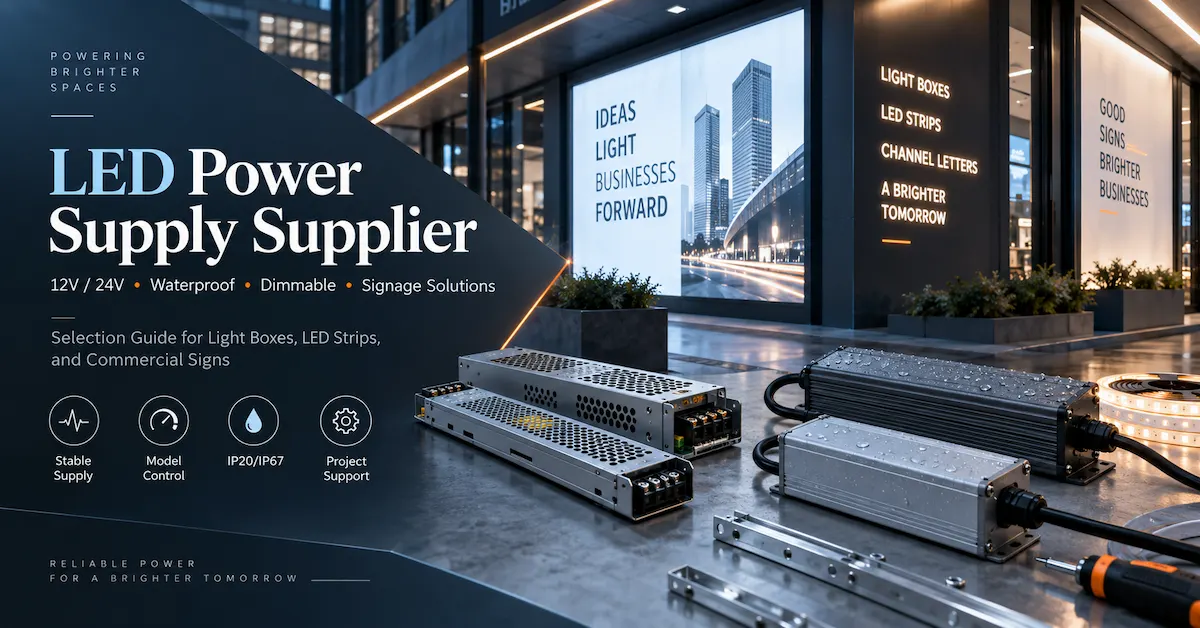
YESUN's published YS-N series includes IP20 power supplies intended for controlled indoor installations. For example, the YS-N-12400 / YS-N-24400 400W power supply is listed with an IP20 rating, 400W maximum power, DC12V/DC24V model variants, 92% efficiency, and separate AC input versions. It can be considered where the power supply is installed inside a suitable protected structure. (ysleds.com)
For environments requiring more protection, YESUN also publishes IP67 YS-WP products. The 30W waterproof LED power supply, for example, is listed with IP67 protection, 12V/24V variants and a 100–264V AC input range. YESUN positions this series for signage, light boxes, landscape lighting and other applications involving greater exposure to moisture and dust. (ysleds.com)
An IP67 power-supply enclosure does not automatically make the complete sign installation IP67. Cable joints, connectors, field wiring, LED products, controller enclosures, entry holes and installation workmanship all form part of the finished system.
Compare Published Power-Supply Platforms by Application
The following table uses currently published YESUN product information as a sourcing reference. It should be used for initial selection rather than as a substitute for the current datasheet or order confirmation.
| Published Platform | Key Published Information | Application Direction to Evaluate | Buyer Should Confirm |
|---|---|---|---|
| YS-WP 30W | IP67, 12V/24V variants, 100–264V input | Compact signage and exposed installations | Actual load, cable length and mounting |
| YS-N-12100 / YS-N-24100 | 100W, 12V/24V, IP20, 87% listed efficiency | Protected indoor signage and lighting systems | Required input-voltage version and ventilation |
| YS-WP 200W | 200W, IP67, 12V/24V variants | Higher-load outdoor signage and commercial projects | Installation temperature and circuit zoning |
| YS-N 400W | 400W, 12V/24V variants, IP20, 92% listed efficiency | High-load protected light-box/sign applications | Input version, current distribution and enclosure ventilation |
| YSD-TL 100W | 100W, IP67, TRIAC + 0–10V dimming | Controlled commercial or architectural lighting | Actual dimmer/controller compatibility |
The comparison also shows why there is no universally “best” model. A 400W indoor power supply is not automatically an upgrade from a 200W waterproof unit, and a dimmable supply is not necessarily useful when the LED installation operates at fixed brightness.
Input Voltage Is a Procurement Issue, Not Just an Electrical Detail
International buyers should verify the input range of the exact model being ordered. YESUN's published specifications show that different power supplies do not all use the same AC input architecture.
The 30W YS-WP page publishes a 100–264V AC range, while the 400W YS-N listing specifies separate 110–130V or 200–240V input versions. The published 100W YS-N listing similarly shows 100–130V or 175–264V alternatives. (ysleds.com) (ysleds.com)
This means an importer should not place a global order using only the output voltage and wattage as identifiers. The purchase specification should identify the destination market, AC input configuration, DC output, model code and revision. Product labels and cartons should make those distinctions clear where different variants are distributed through the same warehouse.
When Does a Dimmable LED Power Supply Make Sense?
Dimming capability is valuable only when it matches the control system. An LED power supply advertised as “dimmable” does not tell the buyer which interface is supported.
YESUN's YSD-TL 100W waterproof dimmable power supply is currently presented with both TRIAC and 0–10V control compatibility and an IP67 enclosure. YESUN positions it for commercial, architectural and other controlled lighting applications. (ysleds.com)
Before ordering a dimmable system, provide the LED load, dimmer or controller model, input voltage, required dimming range and installation arrangement. A useful sample test should evaluate the actual controller and LED load together. Check startup behavior, minimum usable brightness, visible flicker, shutdown behavior and repeatability rather than testing only whether the lamp becomes brighter and darker.
Efficiency, Power Factor, and Current Belong in the Comparison
Commercial buyers frequently focus on rated wattage because it is easy to compare, but other electrical specifications can affect system design.
YESUN's published YS-N 100W model lists 87% efficiency and PF>0.55, while the 400W YS-N listing publishes 92% efficiency and PF>0.55. Some published dimmable product variants also list their own efficiency and power-factor specifications. These values are model-specific and should be read together with the stated test conditions rather than generalized across the entire range. (ysleds.com) (ysleds.com)
Output current is equally important for wiring design. A higher-power 12V system can carry substantial current, which affects conductor sizing, terminal loading, branch circuits and voltage drop. Large signs should therefore be divided into an engineered power-distribution plan instead of connecting every LED product to one long cable merely because the power supply has enough nominal wattage.
Do Not Solve Voltage Drop by Buying a Larger Power Supply
Voltage drop is primarily a distribution problem. If LEDs at the far end of a sign appear dimmer, simply changing a 200W supply to a 400W supply does not necessarily correct the voltage arriving at the load.
The engineering review should consider cable length, conductor size, connected current, branch layout, LED operating voltage and where power is injected. Large LED Light Sheets, long strip installations and extensive module layouts may need multiple feed points or separately planned electrical zones.
This is where a good LED power supply manufacturer or complete lighting supplier should work from the wiring plan rather than from a total-wattage calculation alone.
Protection Functions Should Be Verified Model by Model
Commercial LED installations can experience short circuits, abnormal loads, temperature problems and other electrical faults. Buyers should therefore ask which protection functions are included and what happens when each one is triggered.
YESUN's published 30W YS-WP product information states protection against over-voltage, over-current, short circuit and over-temperature. Rather than assuming that every product uses the same protection scheme, request the current specification of the exact model you intend to purchase and confirm recovery behavior where it matters to the application. (ysleds.com)
For critical projects, the question should not be simply “Does it have protection?” but “What conditions trigger the protection, and how does the unit behave afterward?”
How Should Buyers Evaluate Power-Supply Manufacturing and QC?
When qualifying an LED power supply manufacturer, separate company-wide manufacturing capability from product-specific production evidence.
YESUN's About Us page currently describes a Shenzhen operation founded in 2013, a 5,000㎡ facility, six SMT lines, 100+ staff, more than 10 R&D engineers and monthly output exceeding 1.5 million LED products. It also references ERP-supported traceability and optical/environmental test equipment. These are useful company-level indicators, but they do not by themselves establish the dedicated capacity or test sequence for one power-supply series. (ysleds.com)
For a power-supply order, ask specifically how PCB assemblies, critical components, housings, potting or sealing where applicable, wiring, output performance and final operation are inspected. The approved order specification should identify the electrical test limits and any model-specific aging or production screening that is required.
A buyer preparing a large recurring program can also request a controlled reference sample and production revision so later deliveries can be checked against the same approved configuration.
Certification Logos Should Be Matched to the Exact Model
YESUN maintains a Certification Resource Center and references CE, UL, RoHS, UKCA and other documents across its company and product information. Buyers should still verify the exact document that applies to the power-supply model, output configuration and destination market rather than assuming company-level certification language covers every unit. (ysleds.com)
This becomes even more important if a product is changed for a private-label project. A different enclosure, cable, connector, electrical configuration or critical component can affect what documentation remains applicable.
The procurement record should therefore identify the ordered model and the supporting document together.
Capacity and Lead Time Should Be Quoted for the Actual Power-Supply Order
Company output figures are useful when screening a supplier but do not establish reserved capacity for a specific power-supply model. Ask for sample timing, material preparation, production timing, testing, packing and shipment readiness separately.
If the order contains 12V and 24V versions, waterproof and non-waterproof models, or different AC input versions, treat them as separate variants when confirming production quantities. An order for 5,000 power supplies split across ten configurations is not operationally identical to 5,000 units of one configuration.
Public YESUN information does not define one universal MOQ or lead time for every power-supply series, so those terms should come from the project quotation rather than be assumed from another LED product category.
What Should OEM and Private-Label Buyers Confirm?
A buyer requesting custom labels, packaging, lead wires, connectors or another modification should first determine what the selected product platform supports. YESUN publishes OEM/ODM capability for its wider signage-lighting business, but the public pages do not establish that every possible power-supply electrical modification is available across every series. (ysleds.com)
The correct approach is to submit the change list against an identified model. Confirm which items remain standard, which are customized, whether the change requires a new sample, and whether any documentation needs review.
For private-label distribution, the purchase specification should connect the buyer model number to the YESUN model, input-voltage version, output voltage, wattage, enclosure/IP version and packaging revision. This reduces the risk of visually similar power supplies being mixed in a warehouse.
Compare Total System Cost, Not Only Cost per Watt
The cheapest power supply can become expensive if it creates additional wiring, requires more installation space, does not match the available mains input, complicates dimming, or results in difficult field replacement.
A commercial comparison should include the power supply itself, enclosure requirements, wiring and terminals, controllers, installation labor, shipping, spare stock, testing and replacement strategy. High-power units can reduce the number of separate supplies in some projects, while multiple smaller supplies can make circuit zoning and service easier in others.
Neither architecture is universally cheaper. The correct comparison depends on the cabinet, LED layout, maintenance access and installation method.
A Practical LED Power Supply Sourcing Workflow
A useful procurement process begins by freezing the LED load and operating voltage, then documenting AC input, installation environment, wiring distance and control requirements. The next stage is selecting a suitable power-supply family and building the electrical distribution plan. A representative sample should then be tested with the intended LED load and controller, followed by confirmation of documentation, packaging and production requirements before bulk release.
For a complete signage system, buyers can compare the power requirement alongside YESUN's LED Modules, LED Strips, LED Light Sheets and other commercial lighting products. This is more reliable than sourcing the LEDs and power supply independently without checking system compatibility.
What Should You Send an LED Power Supply Manufacturer for Quotation?
A useful inquiry should describe the LED product being powered, total load, required DC voltage, destination-market AC input, installation environment, available mounting space, cable distances, dimming or controller information, quantity, documentation needs and target schedule. If the power supply must fit inside a light box or sign cabinet, include a drawing or installation photograph.
When contacting YESUN, identify the LED product and power-supply series you are considering and explain whether the quotation should include related controllers, connectors or other accessories. Submit the project requirements through YESUN Contact Us so the proposed configuration can be evaluated against the actual application rather than wattage alone.
Frequently Asked Questions About LED Power Supply Manufacturers
1. What does an LED power supply manufacturer provide?
An LED power supply manufacturer supplies electrical products that convert the available AC input into the output required by LED systems. Commercial buyers should evaluate not only wattage but output voltage, input range, current, enclosure protection, efficiency, control compatibility, installation conditions and supporting documentation.
2. Should I use a 12V or 24V LED power supply?
Match the power supply to the rated voltage of the LED product. A 12V LED load requires an appropriate 12V supply, while a 24V LED load requires a 24V supply. Do not change voltage simply because another power supply has a higher wattage.
3. How much power-supply capacity do I need?
Calculate the actual connected LED load first, then select the supply according to its rated operating conditions and any manufacturer-specified derating requirements. Also consider wiring, environment, load distribution and future configuration rather than relying on a universal percentage rule.
4. What is the difference between IP20 and IP67 power supplies?
They are intended for different exposure conditions. YESUN publishes both IP20 YS-N products and sealed IP67 YS-WP products. The complete installation still needs appropriate protection at cables, joints, connectors and other components.
5. Does a bigger power supply prevent voltage drop?
Not necessarily. Voltage drop is strongly affected by current, cable length, conductor size and circuit layout. A higher-wattage supply does not automatically correct an inadequate wiring design.
6. When should I use a dimmable LED power supply?
Use one when the project requires brightness control and when its control interface matches the intended dimmer or controller. YESUN's YSD-TL 100W series, for example, is published with TRIAC and 0–10V compatibility. Test the actual control system before bulk ordering. (ysleds.com)
7. Can the same power supply be used for LED modules, strips and light sheets?
Potentially, but only when the output voltage, load capacity, electrical architecture and installation requirements are compatible. Select the power supply from the actual specification of the connected LED product, not simply because both products are described as commercial LED lighting.
8. Is an IP67 power supply enough for an outdoor sign?
It addresses the enclosure protection of that power-supply product, not automatically the entire sign. The LEDs, connectors, cable joints, controllers, enclosures and installation workmanship must also suit the outdoor environment.
9. What documents should I request before a bulk order?
Request the current model specification, electrical data, dimensional drawing, relevant test or certification documents needed for the destination market, packaging information and confirmed commercial terms. Ensure that the documents match the exact input/output and enclosure version being ordered.
10. How do I get a more accurate power-supply quotation?
Provide the LED load, 12V or 24V requirement, AC input, quantity, operating environment, installation space, cable arrangement, dimming requirements and destination market. A complete electrical brief allows the supplier to propose a specific model rather than quote an unsuitable product based only on wattage.
Conclusion
Choosing an LED power supply manufacturer is a system-engineering and procurement decision, not simply a comparison of watts and price. Signage manufacturers, light-box factories, LED distributors and commercial contractors should match the supply to the actual LED voltage, connected load, AC input, wiring architecture, installation environment and control system, then verify model-specific efficiency, protection, documentation and production requirements. YESUN's current portfolio includes non-waterproof and waterproof power-supply options, higher-power models for commercial installations, and dimmable power supplies that can be evaluated alongside its LED modules, strips, light sheets and other signage products. Send your LED model, total load, voltage, environment, quantity and project requirements through YESUN Contact Us to evaluate a suitable power-supply configuration before sample approval and bulk ordering.