

Why Selecting an LED Power Supply Supplier Is Different From Selecting One Power Supply
A buyer can find a power supply that operates one LED sample and still choose the wrong long-term supplier. For signage manufacturers, light box factories, distributors, and project contractors, the purchasing challenge includes more than electrical compatibility. The supplier must be able to maintain model identification, 12V and 24V variants, input-voltage versions, waterproof and indoor product families, documentation, packaging, and repeat-order consistency across future purchases.
A reliable LED power supply supplier should therefore help the buyer answer two questions at the same time: Does this power supply fit the LED system, and can this configuration be supplied consistently when the project scales? YESUN lists power supplies within its LED Light Accessories portfolio alongside products used for signage and commercial LED systems, including modules, strips, light sheets, and light bars. Its broader product range shows why power selection should be connected to the actual lighting system rather than treated as an independent commodity purchase.
Which Buyers Need a Long-Term LED Power Supply Supplier?
A channel-letter factory may purchase large quantities of 12V constant-voltage power supplies to support recurring module orders. A light box manufacturer may need higher-power 24V models for larger backlighting systems. An LED distributor may stock several wattages for different customers, while a commercial-lighting contractor may require dimming, waterproofing, project documentation, and exact delivery schedules.
These purchasing models create different supplier requirements. A distributor cares about SKU stability and mixed-model orders. A sign factory cares about compatibility with its normal LED modules and cabinet layouts. A project contractor needs installation-specific electrical data. A private-label buyer may also require custom identification, packaging, and traceable model cross-references.
Not every YESUN lighting product necessarily needs an external low-voltage supply. Its LED Module range, for example, also includes AC110V/AC220V high-voltage module families. The buyer should therefore define the lighting architecture first and purchase a separate power supply only where the selected LED system requires one.
Start With a Load Schedule, Not a Supplier Price List
Before requesting wholesale pricing, create a load schedule that identifies the LED product, operating voltage, wattage, quantity, circuit arrangement, and installation environment. This makes different supplier quotations comparable.
For a constant-voltage system, the output voltage must correspond to the LED load. A 12V LED product requires the appropriate 12V configuration, while a 24V product requires a 24V configuration. Buyers should not interpret a listing that contains “12V/24V” as proof that one physical unit automatically changes between both outputs. YESUN's published YS-N series, for example, uses separate model identifiers such as YS-N-12100 and YS-N-24100 for 12V and 24V variants.
The load schedule should also show how the sign is divided electrically. One 400W total load does not automatically mean that one 400W supply is the best installation. Wiring distance, current, service access, cabinet layout, redundancy, and local electrical requirements can make multiple zones more practical.
Build an RFQ That Lets You Compare LED Power Supply Suppliers Fairly
Sending every supplier the same specification prevents low headline prices from hiding differences in input voltage, enclosure type, cables, connectors, control functions, or documentation.
| RFQ Item | Information to Provide | Supplier Confirmation Needed |
|---|---|---|
| Application | Channel letter, light box, strip lighting, light sheet or other system | Recommended product family |
| LED load | Product model, quantity and calculated wattage | Supported load range |
| DC voltage | 12V, 24V or another required output | Exact ordered model |
| AC input | Destination-market voltage and frequency | Input range/version |
| Environment | Indoor, protected or exposed installation | Enclosure/IP suitability |
| Dimming | Fixed output, TRIAC, 0–10V or other control | Compatible model |
| Installation space | Maximum dimensions and mounting position | Mechanical drawing |
| Wiring | Cable distance, branches and power-feed positions | Current/distribution requirements |
| Quantity | Sample, first order and forecast volume | MOQ and production assumptions |
| Documentation | Required reports and product information | Model-specific document availability |
| Packaging | Standard, project or private-label requirement | Packing specification |
| Repeat orders | Expected reorder cycle | Model/revision control process |
An LED power supply supplier that answers these points clearly gives the buyer a stronger basis for comparison than one that quotes only “100W 12V” and a price.
Build a Product Matrix Around Wattage, Voltage, and Environment
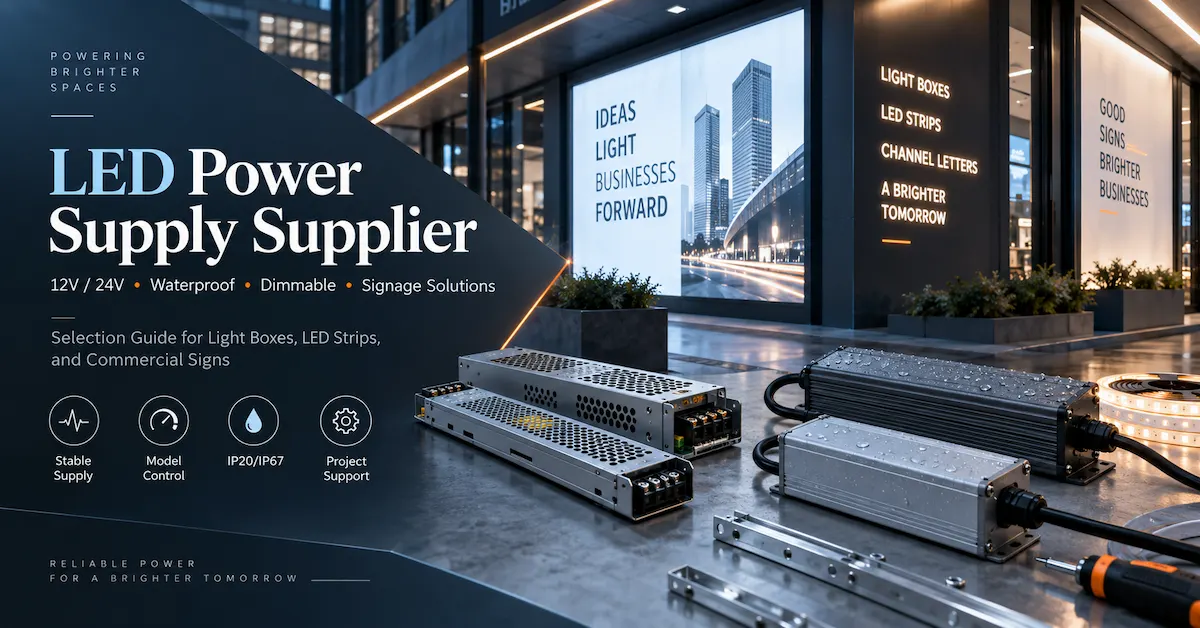
YESUN's published power-supply pages show why buyers should create a model matrix rather than sourcing by wattage alone. Its indoor YS-N family and waterproof YS-WP family address different installation conditions, while dimmable products add another control requirement.
| Published Product Direction | Key Published Data | Purchasing Use to Evaluate | Main Question Before Ordering |
|---|---|---|---|
| YS-N-12100 / YS-N-24100 | 100W, 12V/24V variants, IP20, 87% listed efficiency | Protected signage and commercial LED systems | Which input-voltage version is required? |
| YS-WP 200W Waterproof Power Supply | 200W, IP67, constant voltage, 12V/24V versions | Outdoor signs, light boxes and exposed installations | Are wiring and connections protected to the same project requirement? |
| YS-N-12250 / YS-N-24250 | 250W family | Medium/high-load protected systems | Exact input and output version |
| YS-N-12400 / YS-N-24400 | 400W, IP20, 12V/24V, 92% listed efficiency | Higher-load indoor/protected signage | Current distribution and ventilation |
| YS-N-12500 / YS-N-24500 | 500W, 12V/24V, IP20, 94% listed efficiency | High-load commercial LED systems | Wiring, thermal conditions and zoning |
| Dimmable power-supply platform | Control-specific configuration | Commercial lighting needing brightness control | Actual dimmer/controller compatibility |
These values should be used as shortlist information rather than universal specifications for the whole product family. Confirm the current datasheet and exact ordered version before releasing a purchase order.
12V and 24V Should Follow the LED System, Not Buyer Preference
Buyers sometimes ask whether 12V or 24V is “better.” A more useful question is which voltage the selected LED product requires and how that voltage affects the circuit layout.
At the same power, the lower-voltage system carries more current. YESUN's published 100W YS-N examples illustrate this: the 12V version lists a maximum output current of approximately 8.5A, while the 24V version lists approximately 4.2A. That difference matters when the buyer plans cable sizes, connectors, branches, and power-distribution distances.
An experienced LED power supply supplier should therefore ask for the actual LED load instead of recommending 12V or 24V in isolation.
Indoor and Waterproof Products Should Be Stocked as Different Supply Categories
A distributor serving both indoor sign factories and outdoor projects may need separate waterproof and non-waterproof inventories.
YESUN's YS-N products include IP20 configurations for protected environments. Its YS-WP series includes IP67 waterproof constant-voltage supplies; the published 200W model is described for outdoor signage, landscape lighting, and installations involving moisture or dust, with a compact sealed structure.
However, selecting an IP67 power supply does not make the entire finished sign IP67. The LED products, cable joints, controller, connectors, cabinet openings, and installation workmanship must also be considered. Procurement teams should therefore avoid using the power-supply IP rating as a blanket waterproof claim for the complete project.
For distributors, this distinction should also appear in product codes and warehouse labels so visually similar indoor and waterproof products are not mixed.
Input Voltage Variants Can Create Hidden Inventory Risk
Output voltage is only one side of the specification. The AC input needs equal attention, particularly for distributors serving multiple countries.
YESUN's published YS-N data shows that some high-power models use distinct input ranges rather than one universal input version. The YS-N 400W listing, for example, identifies 200–240V and 110–130V alternatives. The published 100W family likewise shows separate input-range options.
A warehouse containing 12V and 24V outputs plus multiple AC-input variants can quickly accumulate several similar-looking SKUs. The purchase order, product label, master carton, ERP description, and sales catalog should use an unambiguous model structure.
Before a bulk order, verify:
- AC input version
- DC output voltage
- Rated wattage
- Waterproof/IP version
- Dimming or fixed-output type
- Buyer item code
- Supplier model number
- Packaging revision
This model discipline becomes one of the most important advantages of a stable LED power supply supplier relationship.
Dimming Requires System Compatibility, Not a “Dimmable” Label
A dimmable power supply should be evaluated with the controller or wall dimmer that will actually be used. Different projects can require TRIAC, 0–10V, or another control approach.
YESUN publishes a waterproof 2-in-1 dimmable 100W LED power supply designed around TRIAC and 0–10V control. Buyers considering this type of product should provide the LED load, control device, AC input, required dimming range, and installation conditions before approving the system.
Sample testing should check more than whether brightness changes. Evaluate startup, low-level operation, visible flicker, shutdown, controller behavior, and repeatability with the real LED load. A successful test with one dimmer does not prove compatibility with every control product.
Supplier Selection Should Include Stock and Reorder Planning
A wholesale buyer may care as much about future availability as today's price. The procurement team should therefore ask which products are standard, which require production, and which configurations create separate material or assembly requirements.
For example, a distributor ordering 1,000 units may actually be requesting:
- 250 × 100W 12V IP20
- 200 × 100W 24V IP20
- 200 × 200W 12V IP67
- 150 × 200W 24V IP67
- 100 × 400W 12V
- 100 × 400W 24V
That is six variants, not one 1,000-unit product. This example is for procurement planning and does not represent YESUN's MOQ or available stock.
Ask whether mixed-model quantities can share a production run or shipment, how cartons are identified, and which models normally require longer material preparation. This is particularly useful for importers that need to keep replacement units available for customers without carrying excessive stock.
Approve Samples by Variant, Not by Product Family Name
A 100W sample does not automatically approve a 400W model, and a 12V sample does not automatically approve a 24V version. Establish which variants the sample actually represents.
A power-supply sample review can include:
- Model identification
- AC input version
- DC output voltage
- Output under representative LED load
- Physical dimensions
- Cable or terminal arrangement
- Startup behavior
- Temperature under intended mounting conditions
- Dimming performance where applicable
- Enclosure workmanship
- Product label
- Packaging
- Documentation
For waterproof products, also review the proposed cable entry and the way the complete installation will handle connections. Keep the approved sample tied to its specification and revision instead of retaining an unidentified unit in the purchasing office.
How Should Buyers Evaluate the Supplier's Manufacturing and QC Capability?
YESUN's current About Us page states that the Shenzhen operation was founded in 2013 and has a 5,000㎡ production facility, six SMT lines, 100+ employees, 10+ R&D engineers, and monthly output above 1.5 million LED products. It also describes ERP-supported traceability and several optical and environmental testing resources. These are company-level capabilities and do not establish a dedicated output allocation for one power-supply model.
For a power-supply order, buyers should ask how these factory systems connect to the actual product being purchased. Useful questions include:
- How is the model and revision identified?
- Which electrical values are checked during production?
- What incoming components are controlled?
- How are waterproof products sealed or inspected?
- Is aging or other production screening applied to the selected model?
- How are nonconforming units handled?
- Can batch information be traced where required?
- How are approved component or design changes communicated?
The answer should be tied to the exact model rather than a generic statement that the factory has “strict quality control.”
Documentation Should Follow the Exact SKU
YESUN maintains a Certification Resource Center and its company information references CE, UL, RoHS, UKCA and other compliance materials. A buyer should still verify the document that applies to the exact product or component being ordered.
This matters particularly when an order contains several electrical variants. Do not create a sales catalog stating that every power supply carries the same certification, IP rating, warranty, or efficiency solely because those claims appear somewhere within the supplier's wider portfolio.
A practical distributor document set can link:
Buyer SKU → Supplier model → input version → output voltage → wattage → IP class → relevant document → revision/date.
That structure is far safer than storing certificates separately without knowing which stock item they support.
Do Not Transfer One Model's Warranty or Efficiency to the Whole Range
YESUN's published 100W and 400W YS-N examples list different efficiency values—87% and 92% respectively—and published product information also identifies model-specific warranty details. This illustrates a basic sourcing rule: product-family language should not replace SKU-specific specifications.
The same rule applies to protection functions, power factor, dimensions, input range, output current, and IP rating.
When creating your own wholesale catalog, retain the supplier's model-specific technical data. If marketing needs a simplified statement, ensure it is supported across all products covered by that statement.
OEM and Private-Label Orders Need a Model Cross-Reference
YESUN's company page describes OEM/ODM support for signage LED projects, but a private-label power-supply program should be controlled at the exact product level rather than simply applying a new logo.
If your company uses its own item numbers, maintain a permanent cross-reference:
| Buyer Item | Supplier Model | Electrical Version | Packaging Version | Approval Revision |
|---|---|---|---|---|
| Example A | Exact YESUN model | AC input / DC output | Retail/industrial carton | Rev. A |
| Example B | Exact YESUN model | AC input / DC output | Private-label carton | Rev. B |
Confirm whether requested changes involve only labels and packaging or alter cables, connectors, enclosure construction, electrical components, or other product details. Changes beyond branding may require a new sample and documentation review.
Compare Supplier Cost by the Complete Sourcing Program
Two suppliers can quote the same wattage at different unit prices but create very different total purchasing costs. Compare:
- Unit cost
- MOQ by variant
- Mixed-model order flexibility
- Sample charges
- Packaging
- Label customization
- Freight volume
- Required spare inventory
- Documentation support
- Installation compatibility
- Replacement handling
- Reorder continuity
A lower-cost supply can become expensive if a model changes without notice or if 12V, 24V, 110V-input, 230V-input, and waterproof variants are difficult to distinguish in the warehouse.
For B2B buyers, total sourcing risk is therefore part of product cost.
A Practical Supplier Qualification Workflow
A repeatable process helps procurement teams avoid selecting suppliers from price comparisons alone.
Step 1: Define the LED systems. Identify which modules, strips, light sheets, or light bars require power.
Step 2: Build the model matrix. Separate wattage, 12V/24V, input-voltage, IP, and dimming requirements.
Step 3: Send a controlled RFQ. Give competing suppliers the same technical and commercial requirements.
Step 4: Review product documents. Check that specifications and relevant reports correspond to each shortlisted SKU.
Step 5: Approve representative samples. Test with the intended LED loads and installation conditions.
Step 6: Confirm packaging and identification. Ensure different electrical variants cannot easily be mixed.
Step 7: Place a controlled first order. Verify product, carton, label, and documentation consistency.
Step 8: Establish reorder rules. Reference the approved model and revision and require review before relevant changes.
This workflow turns an LED power supply supplier from a one-off source into a controlled part of the buyer's LED supply chain.
What Should You Send YESUN for an Accurate Power Supply Quotation?
Prepare the actual application rather than sending only a wattage request. Include the LED product or load, total calculated power, required 12V or 24V output, destination-market AC input, installation environment, quantity by version, available mounting space, dimming requirement, cable arrangement, packaging requirement, and expected order schedule.
If the power supply will be used with YESUN lighting products, include the intended LED Modules, LED Strips, LED Light Sheets, or other connected product so compatibility can be evaluated together.
Submit the project information through YESUN Contact Us, and request that the quotation clearly identifies the exact model, electrical version, included accessories, documentation, sample scope, quantity assumptions, and delivery terms.
Frequently Asked Questions About LED Power Supply Suppliers
1. What should I look for in an LED power supply supplier?
Check whether the supplier can match the actual LED load, maintain clear 12V/24V and input-voltage variants, provide indoor and waterproof options, support the required documentation, control product revisions, and supply repeat orders consistently. Price should be compared only after these requirements are aligned.
2. Is an LED power supply supplier the same as an LED power supply manufacturer?
The terms can overlap, but the purchasing emphasis is different. A manufacturer describes production capability, while a supplier relationship also involves product selection, quotation, inventory, documentation, packaging, order management, delivery, and repeat supply. Buyers should verify which activities the company actually performs.
3. Should I stock both 12V and 24V power supplies?
That depends on the LED products your customers use. If you distribute both 12V modules and 24V strips or light-sheet systems, separate power-supply variants may be necessary. Build stock around real customer applications rather than carrying duplicate voltages without demand data.
4. Can one power supply work with LED modules, strips, and light sheets?
It can only do so when output voltage, load capacity, control requirements, and installation conditions match each connected product. Verify the specification of the actual LED load rather than assuming that all low-voltage LED products use the same supply.
5. Should outdoor projects always use an IP67 power supply?
Outdoor and moisture-exposed applications need appropriate protection, but the exact requirement depends on the installation. An IP67 power-supply enclosure also does not make the complete LED sign waterproof; connectors, wiring, LEDs, controls, and the cabinet must be considered.
6. How should I compare 100W, 200W, and 400W models?
Compare more than wattage. Review DC output, AC input, output current, IP rating, efficiency, dimensions, installation space, wiring layout, documentation, and the way the LED load is divided into circuits.
7. What information should appear on a wholesale power-supply SKU?
At minimum, identify the supplier model, output voltage, wattage, applicable AC-input version, enclosure/IP type, and any dimming distinction. Your internal item code should remain linked to these details in future orders.
8. How should I evaluate a dimmable power supply supplier?
Provide the controller or dimmer model and intended LED load, then test the system together. Confirm the control interface, usable dimming range, startup and shutdown behavior, visible flicker, and electrical configuration before bulk purchasing.
9. What documents should I request before placing a bulk order?
Request the current specification, dimensions, electrical data, model identification, relevant compliance or test documents needed for your market, packaging details, warranty terms, and the commercial quotation. Make sure the documents correspond to the exact variant being purchased.
10. How can I reduce repeat-order risk?
Keep a cross-reference between your item code and the supplier's exact model and revision. Retain an approved sample and specification, confirm packaging identification, and require notification before relevant electrical, component, enclosure, cable, or documentation changes.
Conclusion
Choosing an LED power supply supplier for signage and commercial lighting requires more than comparing watts and price. B2B buyers should build a clear model matrix covering 12V and 24V outputs, AC-input versions, indoor and waterproof construction, dimming requirements, exact SKU identification, documentation, packaging, and repeat-order controls. Supplier qualification should then connect those commercial requirements to the real LED load and installation environment. YESUN offers LED Light Accessories alongside modules, strips, light sheets, light bars, and other signage lighting products, allowing buyers to evaluate the power supply as part of the complete LED system. Review the required electrical configuration and send your load, voltage, environment, quantity, destination, and packaging requirements through YESUN Contact Us to request a model-specific quotation and sample plan.