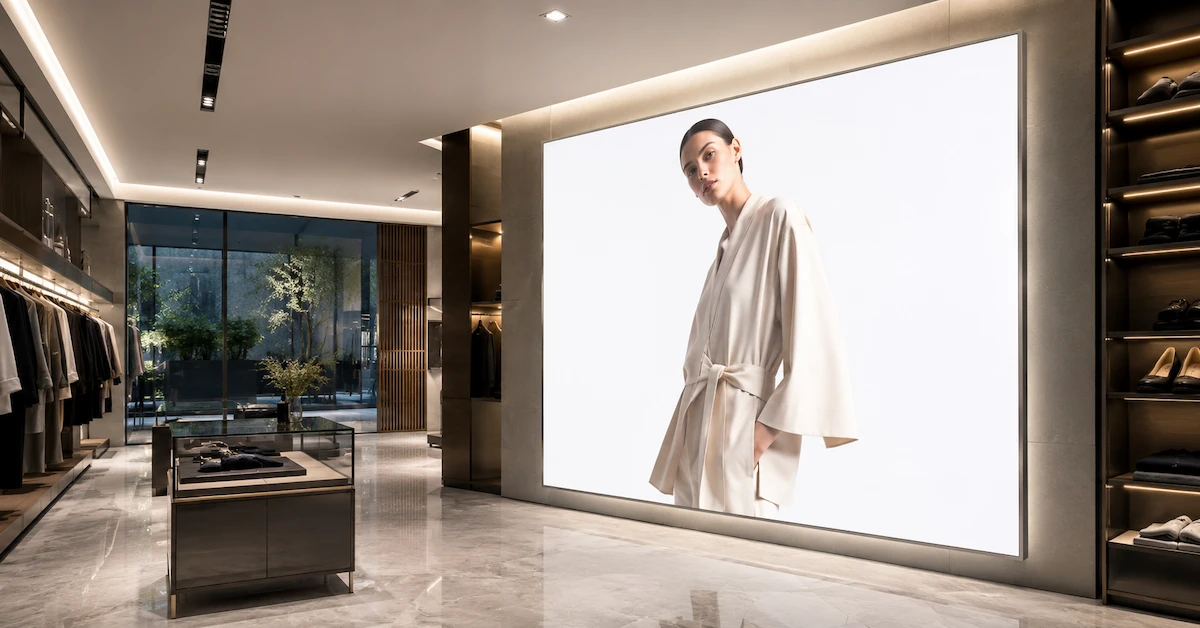


A reliable sign does not begin with the question, “Which LED is brightest?” It begins with the sign itself.
Cabinet depth, letter stroke width, diffuser material, viewing distance, indoor or outdoor exposure, required color, maintenance access, electrical layout, and installation method all influence which light source should be used. That is why professional LED signage lighting solutions are better treated as complete systems rather than individual LED products.
For a shallow channel letter, a wide-angle LED module may solve a hotspot problem that additional lumen output cannot. For an ultra-thin retail panel, a flexible light sheet may make more sense than conventional modules. A large advertising light box may benefit from LED light bars, while an architectural logo may require flexible neon or a specially designed strip.
For sign manufacturers and project buyers, the objective is therefore not to find the “best LED.” The objective is to select the correct combination of light source, optical distribution, electrical system, environmental protection, installation method, and quality standard for a specific sign.
YESUN develops LED lighting products for signage, light boxes, channel letters, retail displays, and commercial projects, allowing buyers to evaluate several lighting architectures within one supply system.
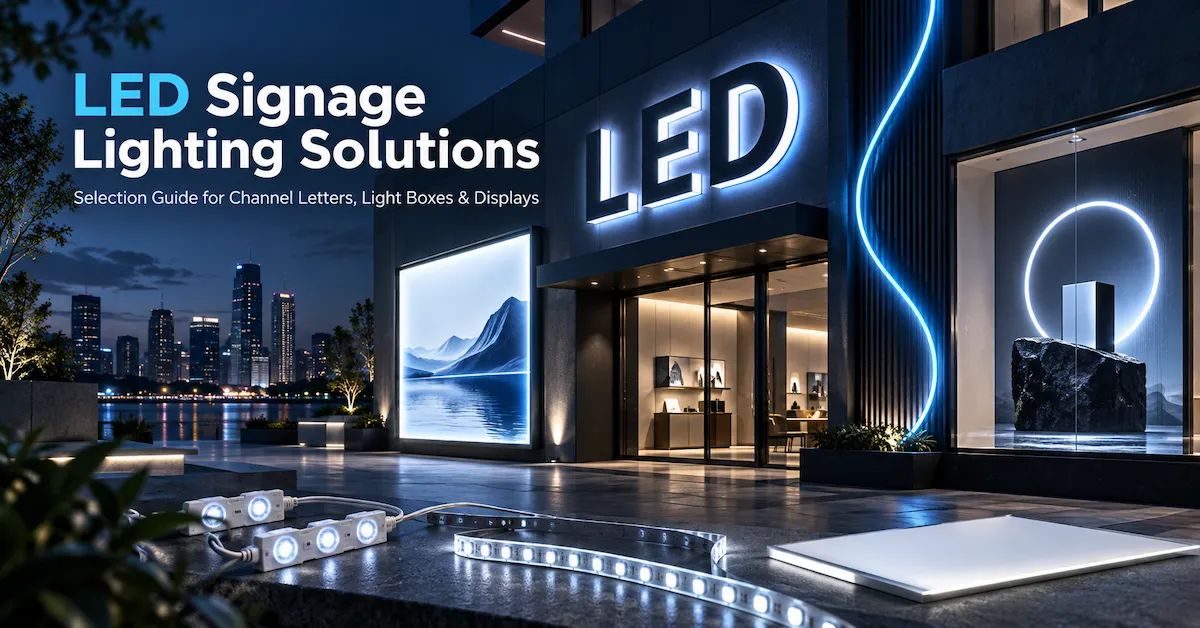
Quick Answer: What Is the Best LED Lighting Solution for Signage?
There is no single LED technology that is best for every sign.
In practical terms:
| Signage Application | Lighting Option Often Worth Evaluating | Main Selection Priority |
|---|---|---|
| Channel letters | LED modules | Beam angle, letter depth, module spacing |
| Mini letters | Compact LED modules | Module dimensions, heat, narrow stroke compatibility |
| Single-sided light boxes | LED modules, light bars, light sheets | Uniformity, cabinet depth, installation speed |
| Double-sided light boxes | Modules or purpose-designed light box systems | Two-sided uniformity and optical distribution |
| Ultra-thin displays | FPC LED light sheets | Low profile, uniform surface illumination |
| Large-format advertising boxes | LED light bars or modules | Installation efficiency and large-area uniformity |
| Curved logo lighting | Flexible strips or neon | Bend direction and visual continuity |
| Exposed decorative signs | LED neon strips | Continuous light line and weather protection |
| Retail displays | COB strips, light sheets, LED strips | Color quality, visual comfort, hidden installation |
| Dynamic signage | RGB/RGBW/addressable products | Controller compatibility and signal architecture |
The right solution depends on what the sign must do after installation—not only on what the LED data sheet says before installation.
Why LED Signage Lighting Should Be Designed as a System
One of the most common procurement mistakes is evaluating the light source separately from the rest of the sign.
A module may have good lumen output but still produce an uneven face if the cabinet is too shallow. A strip may be efficient but suffer from visible voltage drop when installed over a long run without proper power distribution. An IP67 module may be suitable for outdoor use, but the finished sign can still fail if cable joints, connectors, power supplies, drainage, or installation details are not protected correctly.
A complete LED signage system normally includes:
-
the LED light source;
-
PCB or flexible circuit;
-
optics or lens design;
-
wiring and connectors;
-
power supply;
-
controller where required;
-
mounting system;
-
enclosure or sign cabinet;
-
diffuser or sign face;
-
waterproofing strategy;
-
thermal path;
-
installation layout;
-
maintenance access.
This system-level view is especially important for B2B buyers because product cost is only one part of project cost. Labor, rework, replacement access, electrical complexity, installation time, visual complaints, and warranty risk can quickly cost more than the LED itself.
Start With the Sign Geometry Before Choosing the LED
Before selecting among YESUN LED signage products, define the physical structure of the sign.
Sign depth
Depth directly affects light mixing.
When LEDs are close to the illuminated face, individual light sources are more likely to become visible. This is why shallow signs usually benefit from wider optical distribution, closer light-source spacing, or a different lighting architecture altogether.
Increasing brightness alone does not fix this problem. In fact, a brighter but narrow-beam source can make hotspots more obvious.
For shallow structures, engineers should evaluate:
-
beam angle;
-
distance from LED to sign face;
-
module pitch;
-
diffuser transmission;
-
internal surface reflectivity;
-
LED density;
-
edge shadowing.
The relationship between these variables matters more than any one number.
Stroke width
Channel letters introduce another constraint: narrow strokes.
A large LED module that performs well in a deep light box may physically fit poorly inside narrow letters. Compact modules or specialized mini-letter lighting can make routing, spacing, and installation easier.
The YESUN LED module range includes options intended for different signage structures, including mini, wide-angle, side-lighting, RGB, CCT-adjustable, high-efficiency, and high-voltage applications.
Single-sided or double-sided construction
A single-sided cabinet primarily needs controlled forward illumination.
A double-sided light box must distribute light effectively toward two graphic surfaces. This can change module position, optical architecture, cabinet depth, and power density.
Do not assume a design developed for a single-sided box can simply be duplicated for a double-sided box.
Shape complexity
Straight rectangular signs are easier to illuminate than:
-
narrow letters;
-
logos with sharp corners;
-
curved structures;
-
circular displays;
-
irregular brand graphics;
-
thin wall panels.
For irregular shapes, flexibility can matter more than maximum output.
That is one reason FPC LED light sheets, flexible strips, and neon solutions are useful alternatives to conventional rigid arrangements.
Comparing the Main LED Signage Lighting Solutions
A useful procurement decision starts by understanding the job each product family is designed to perform.
LED Modules: The Workhorse for Channel Letters and Sign Boxes
LED modules remain one of the most practical choices for illuminated signage.
They are especially useful where installers need individual light points that can be distributed across letters, logos, or sign cabinets.
Typical advantages include:
-
flexible positioning;
-
easy adaptation to irregular shapes;
-
wide-angle lens options;
-
waterproof versions;
-
straightforward replacement;
-
multiple colors and CCT options;
-
RGB and multi-color possibilities;
-
compatibility with many channel-letter structures.
YESUN offers LED modules for signage applications across several configurations, including back-light, side-light, high-efficiency, mini, RGB, tunable CCT, matrix, lens-based, and high-voltage designs.
But modules are not automatically the right answer for every sign.
A very shallow illuminated panel may require so many modules to eliminate hotspots that installation becomes unnecessarily complicated. In that case, a light sheet or another distributed-light solution could be more practical.
Standard LED Strips: Flexible for Linear and Edge Applications
LED strips work particularly well where the installation follows a line, edge, shelf, contour, channel, or narrow profile.
Their strengths include:
-
compact dimensions;
-
flexible routing;
-
high LED density options;
-
multiple voltage choices;
-
RGB and multi-channel configurations;
-
various waterproof structures;
-
easy integration into aluminum profiles;
-
long continuous runs when the electrical design supports them.
For signage manufacturers, strips can be useful around:
-
logo outlines;
-
shallow linear structures;
-
retail shelves;
-
edge lighting;
-
decorative sign details;
-
architectural sign integration.
The main design risks are voltage drop, thermal management, bend limitations, unsuitable cutting points, and poor waterproof termination.
Buyers evaluating strips should therefore consider more than LEDs per meter.
PCB construction, conductor capacity, strip width, LED package, current loading, waterproof structure, cut length, cable design, and maximum recommended run length all affect real-world performance.
COB LED Strips: Better When the Light Source Is Visible
COB technology is particularly valuable when visual continuity matters.
Traditional SMD strips contain clearly separated LED packages. Depending on the diffuser distance, viewers may see individual dots.
COB designs use much higher emitter density to create a smoother light line.
This makes them useful for:
-
shallow profiles;
-
premium retail displays;
-
architectural details;
-
visible linear lighting;
-
narrow diffusers;
-
interior brand environments.
The question is not simply “COB or SMD?”
The correct question is:
Will the viewing geometry reveal individual LEDs, and does the application justify the smoother visual output of COB?
If the strip is hidden deep behind an opaque diffuser, conventional SMD may still be perfectly suitable. If the light line is directly visible, COB can produce a substantially cleaner result.
Buyers can review the broader YESUN LED product portfolio when comparing standard strips and COB architectures.
LED Light Sheets for Ultra-Thin and Irregular Backlighting
Some projects cannot provide enough depth for conventional point-source lighting.
This is where flexible light sheets become interesting.
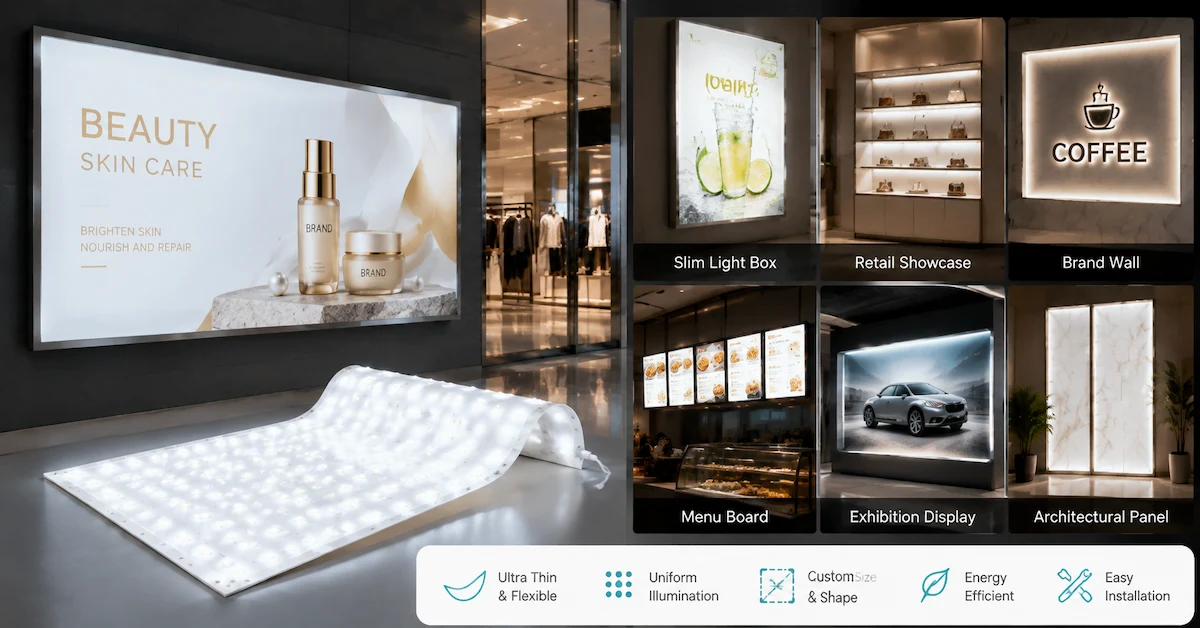
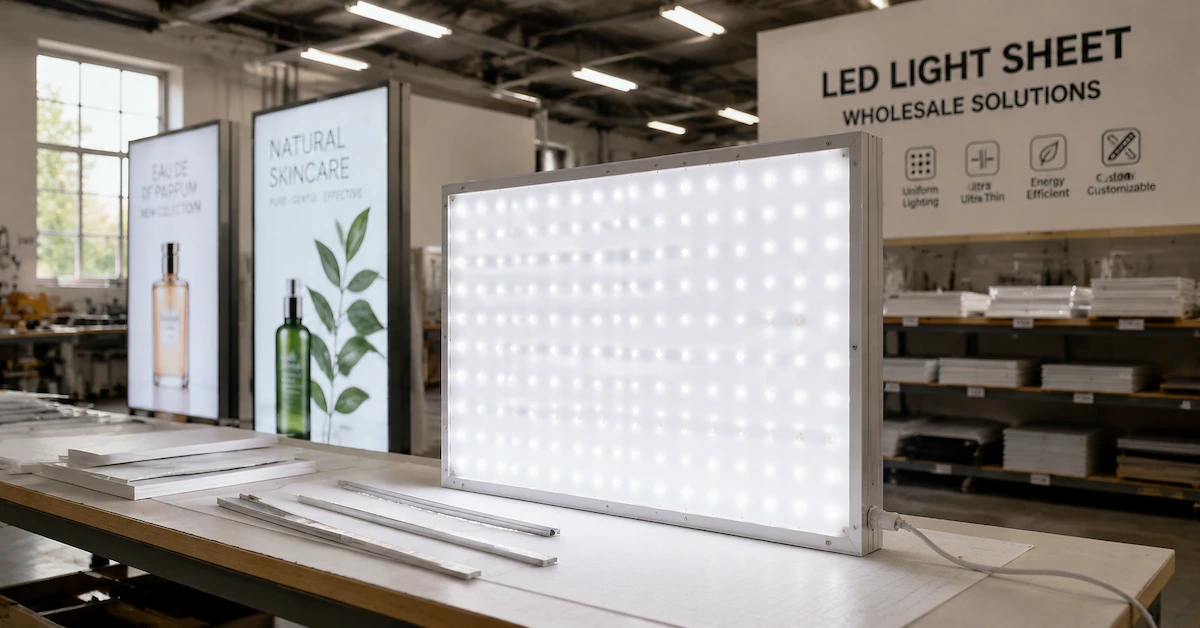
An FPC LED light sheet distributes LEDs across a flexible surface rather than along only a narrow strip or individual module chain.
This architecture can be useful for:
-
ultra-thin light boxes;
-
retail graphics;
-
brand walls;
-
exhibition displays;
-
translucent stone;
-
decorative panels;
-
irregular illuminated shapes;
-
shallow commercial fixtures.
A major advantage is design freedom.
Instead of forcing a grid of conventional modules into a limited cavity, a flexible light sheet can follow the illuminated area more directly.
However, buyers should still evaluate the complete structure.
Questions include:
How thin is the final cavity?
Can the sheet be cut or adapted to the required geometry?
What is the spacing between the LEDs and diffuser?
Is the application static white, tunable white, RGB, or dynamic?
How will heat leave the enclosure?
Where will power connections be located?
How will the sheet be serviced after installation?
For premium retail and architectural projects, serviceability can matter as much as initial appearance.
LED Light Bars for Large-Area Light Boxes
Large light boxes create a different engineering problem.
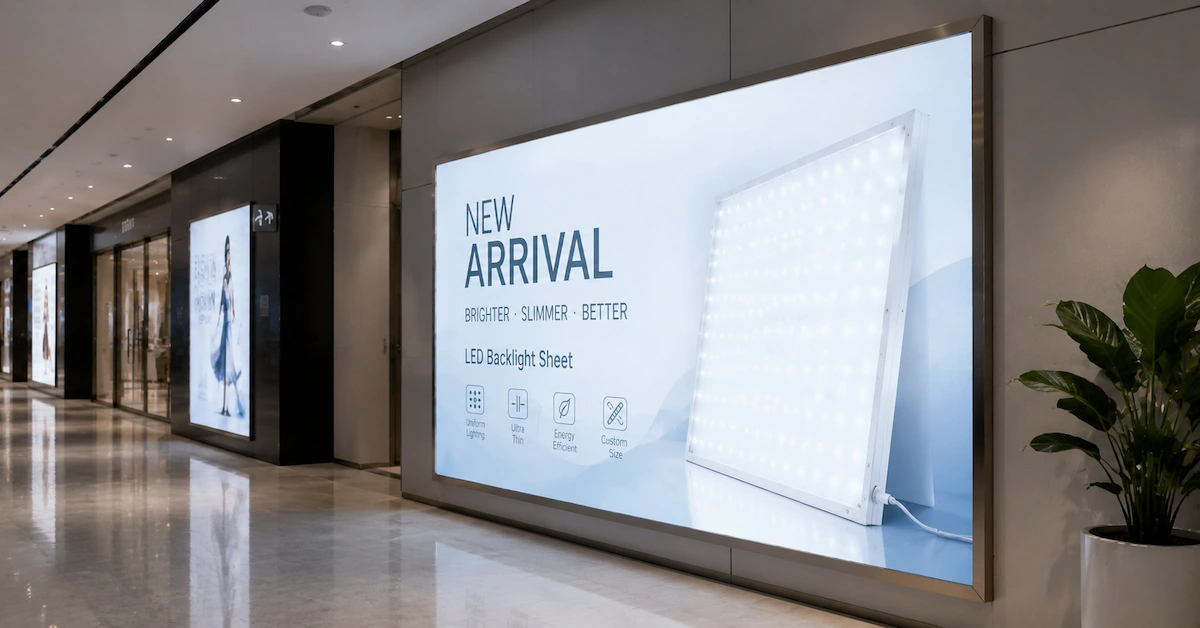
Installing hundreds of individual light points can increase labor and wiring complexity. In these cases, a purpose-designed bar can reduce installation steps.
LED light bars are particularly relevant for:
-
large advertising light boxes;
-
shopping mall displays;
-
airport signage;
-
subway advertising;
-
commercial graphic panels;
-
wide illuminated cabinets.
Wide optical distribution allows fewer linear elements to cover a larger surface when the cabinet geometry is suitable.
This can reduce installation time compared with layouts that require many small modules.
Yet buyers should not choose light bars only because the sign is large.
Cabinet depth, bar spacing, graphics, brightness requirement, maintenance path, power architecture, and transport dimensions must still be considered.
For a large but extremely shallow cabinet, another solution may perform better.
LED Neon for Visible, Flexible Signage
Backlighting hides the light source.
Neon-style signage does the opposite: the light source itself becomes part of the design.
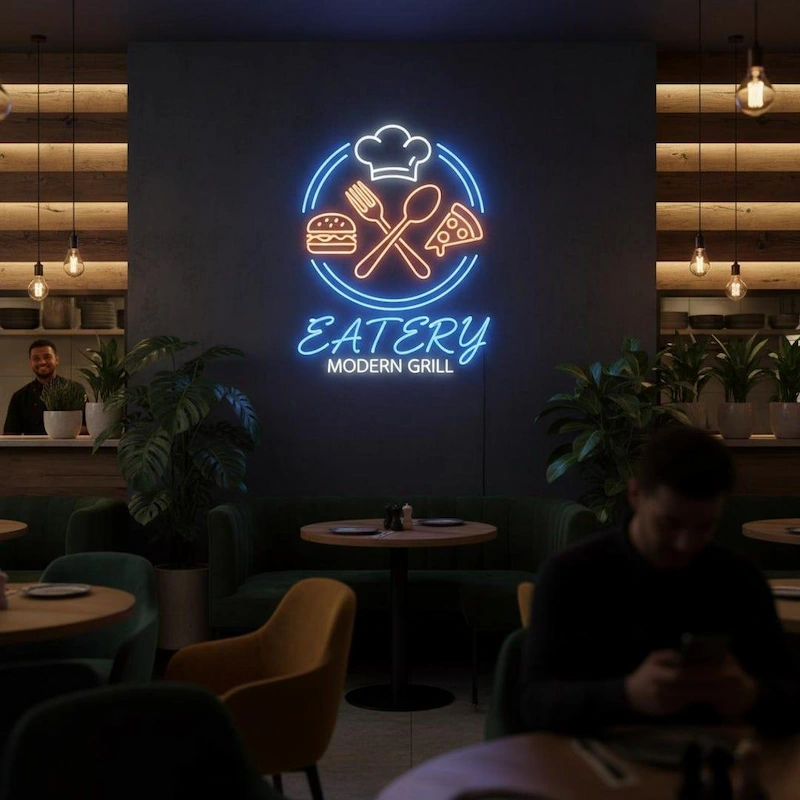
YESUN LED neon strips are suitable for applications such as:
-
storefront logos;
-
hospitality interiors;
-
restaurants;
-
bars;
-
entertainment venues;
-
hotel accents;
-
commercial interiors;
-
decorative building contours;
-
branded wall graphics.
Here, uniform appearance is critical.
Customers are not simply looking at an illuminated panel. They are looking directly at the luminous line.
Important selection factors include:
-
bending direction;
-
minimum bend radius;
-
silicone profile dimensions;
-
diffusion quality;
-
mounting method;
-
cable exit direction;
-
end sealing;
-
waterproof construction;
-
color consistency;
-
RGB or addressable requirements.
A common sourcing mistake is choosing a neon profile before checking the logo geometry. Some sections bend horizontally, others vertically, and some complex shapes may require a different profile or assembly method.
Logo artwork should therefore be reviewed early in the quotation process.
How Beam Angle Changes Signage Performance
Beam angle is one of the most important—and frequently misunderstood—parameters in LED signage lighting solutions.
A higher lumen number does not guarantee a better sign.
Imagine two modules with similar output.
One concentrates light into a narrower area. The other distributes light broadly.
Placed close to a diffuser, the narrow-beam module can create a bright center with dark spaces between modules. The wide-angle design allows neighboring beams to overlap earlier, improving surface uniformity.
This matters particularly in shallow:
-
channel letters;
-
mini letters;
-
slim light boxes;
-
wall panels.
Wide-angle optics can sometimes allow installers to increase spacing while maintaining uniformity. But this must be tested within the actual sign geometry.
Diffuser transmission, face material, internal color, module position, and viewing distance all affect the final result.
Professional buyers should ask for layout guidance rather than selecting a module solely from nominal lumen output.
Module Spacing: Why “More LEDs” Is Not Always Better
It is tempting to solve every illumination problem by adding more LEDs.
That approach can increase:
-
power consumption;
-
material cost;
-
wiring;
-
installation labor;
-
thermal load.
without producing a proportional improvement.
The goal should be adequate optical overlap, not maximum LED quantity.
Spacing depends on:
letter depth + beam angle + diffuser + required brightness + reflective environment.
A wider optical pattern may allow larger spacing. A shallow cavity may require tighter spacing.
Complex corners may need extra modules even when straight sections do not.
This is why prototypes and layout verification are valuable for repeat projects.
Once a design has been validated, the approved layout can become a repeatable production specification for future signs.
Choosing Between 12V, 24V, and High-Voltage Systems
Voltage affects much more than the power supply label.
12V systems
12V products are widely used in signage because they are familiar, flexible, and supported by a large ecosystem.
They can work well for:
-
channel letters;
-
small signs;
-
short module chains;
-
compact displays.
As cable length and load increase, voltage drop becomes more important.
24V systems
24V can be useful for longer linear lighting runs because the system carries less current for the same power compared with an equivalent lower-voltage architecture.
This can help reduce voltage-drop challenges in appropriate strip applications.
It does not eliminate the need for good electrical design.
High-voltage lighting
Some commercial installations benefit from high-voltage products, particularly where long runs would otherwise require many low-voltage power injection points.
YESUN's product portfolio includes high-voltage options within several signage-related categories.
However, high-voltage products change installation and safety requirements. They should be selected according to the destination market, electrical regulations, enclosure design, installer qualifications, and specific product certification.
The safest procurement rule is simple:
Choose system voltage after evaluating the installation architecture, not before it.
Voltage Drop Can Ruin an Otherwise Good Sign
A sign can look excellent near the power connection and visibly dim at the far end.
That is a classic symptom of voltage drop.
The risk increases with:
-
long cable runs;
-
high current;
-
undersized conductors;
-
long flexible LED strips;
-
too many modules on one feed;
-
poor connectors;
-
improper power distribution.
Designers can reduce the problem through appropriate conductor sizing, shorter runs, parallel feeding, power injection, correct supply placement, or a more suitable system voltage.
This issue is especially important in long storefront signage and large architectural outlines.
If a quotation lists only the LED product but does not consider the electrical layout, the project is not fully engineered.
Power Supplies Are Part of Signage Reliability
A reliable LED product connected to a poor power supply is still an unreliable lighting system.
A signage LED power supply should be selected according to:
-
input voltage;
-
LED output voltage;
-
total load;
-
operating environment;
-
waterproof requirement;
-
dimming requirement;
-
installation space;
-
ventilation;
-
target-market requirements.
Avoid treating rated wattage as the only selection criterion.
Running a supply continuously at inappropriate loading or installing a non-waterproof supply in a wet location creates unnecessary risk.
Power supplies also need physical service access. If a driver eventually requires replacement, technicians should not have to destroy the finished sign to reach it.
Maintenance planning belongs in the design stage.
Controllers for RGB, RGBW, and Tunable Lighting
Static white signs require relatively simple electrical systems.
Dynamic signs are different.
RGB, RGBW, tunable white, and addressable LED products introduce controller and signal requirements.
LED controllers should be evaluated together with the load they are expected to control.
Key considerations include:
-
total output current;
-
number of channels;
-
voltage compatibility;
-
signal distance;
-
synchronization;
-
remote-control requirements;
-
zoning;
-
addressable pixel architecture.
A visually impressive dynamic sign can still fail commercially if the control system is too complicated for the customer to operate.
For retail chains, hospitality environments, and repeat installations, simplicity and repeatability are often more valuable than adding unnecessary effects.
Indoor and Outdoor Signage Require Different Engineering Decisions
Outdoor LED signage lighting solutions face more than rain.
A long-life outdoor sign may be exposed to:
-
humidity;
-
water ingress;
-
UV;
-
temperature cycles;
-
condensation;
-
pollution;
-
vibration;
-
salt-laden air in coastal environments.
An IP-rated light source is useful, but IP rating alone does not make the entire sign weatherproof.
The finished system includes:
LEDs
cables
connectors
power supplies
cable exits
sign enclosure
drainage
seals
mounting points.
One unprotected connection can undermine the rest of the system.
This is why buyers should evaluate system-level waterproof design rather than asking only:
“Is the LED IP67?”
For documentation relating to the manufacturer's available approvals and waterproof reports, buyers can review YESUN certification resources. Certification should still be confirmed for the exact model and configuration being purchased.
CCT and Color Consistency Matter More Than Many Buyers Expect
A customer may specify “white,” but white is not one universal color.
Different projects may require:
-
warm white;
-
neutral white;
-
cool white;
-
tunable white.
When several signs are installed on one storefront—or hundreds of signs across a retail chain—color differences can become obvious.
Professional sourcing should therefore consider:
-
target CCT;
-
allowable color tolerance;
-
LED binning;
-
batch consistency;
-
sample approval;
-
repeat-order consistency.
This is particularly important when replacement products may be ordered months later.
A technically functioning replacement that visibly differs in color can still be unacceptable to a brand owner.
For multi-location programs, maintain approved product specifications and reference samples rather than relying on a generic description such as “white LED.”
CRI: Important for Retail, Less Critical for Some Sign Faces
CRI is valuable when the lighting influences how merchandise, materials, graphics, or architectural finishes appear.
Retail display lighting may benefit from stronger color rendering because customers are evaluating real products under the light.
A colored acrylic channel-letter face may be less dependent on extremely high CRI.
This distinction matters for cost optimization.
The best specification is not always the highest available specification. It is the specification that creates the required result for the project.
Over-specification adds cost without necessarily creating buyer value.
Under-specification creates performance complaints.
Good LED signage lighting solutions balance these two risks.
How to Choose Lighting for Channel Letters
Channel letters are one of the clearest examples of application-driven product selection.
Before choosing a module, collect:
-
letter height;
-
stroke width;
-
return depth;
-
face material;
-
face color;
-
trim-cap or trimless construction;
-
indoor/outdoor location;
-
required brightness;
-
power location.
For standard-depth letters, conventional signage LED modules may offer the most practical balance of cost, installation speed, and serviceability.
For shallow letters, wide-angle modules can become more important.
For mini letters, module dimensions and thermal conditions may dominate the decision.
For halo-lit letters, the direction of illumination and rear-wall distance change the optical requirement entirely.
There is no responsible “one module fits all letters” recommendation.
How to Choose Lighting for Single-Sided Light Boxes
For a single-sided box, evaluate:
-
cabinet depth;
-
face material;
-
graphic density;
-
box dimensions;
-
target brightness;
-
indoor/outdoor location;
-
maintenance access.
Deeper boxes often provide more freedom because light has more distance to mix.
As depth decreases, optical design becomes more demanding.
Depending on geometry, buyers may evaluate:
-
modules;
-
light bars;
-
LED strips;
-
flexible light sheets.
The most economical option should be determined from the total installed system, not only component price.
How to Choose Lighting for Double-Sided Light Boxes
Double-sided light boxes need careful optical planning because both sides must be illuminated.
Questions include:
Where is the light source positioned?
Does the optical design distribute light equally in both directions?
Is the cabinet deep enough for conventional backlighting?
How will power supplies be accessed?
Will internal supports create shadows?
Is brightness balanced across both faces?
In some double-sided boxes, a central lighting arrangement can be more efficient than installing separate backlighting systems for each surface.
Prototype testing is particularly valuable before a customer scales a design across many locations.
How to Light Ultra-Thin Retail Displays
A shallow retail display introduces three priorities:
uniformity, thickness, and visual quality.
Retail environments often place the illuminated surface close to the viewer. Hotspots and dark zones are therefore more noticeable than they may be on a highway sign viewed from far away.
This is where distributed lighting such as flexible LED light sheets can offer a strong solution.
Instead of treating the panel as a conventional deep light box, the lighting can be designed around the low-profile construction from the beginning.
For chain retail programs, buyers should also consider repeatability. A successful prototype is useful only if the same appearance can be reproduced across subsequent production batches.
Large Light Boxes: Think About Installation Labor
For a large box, purchasing teams often concentrate on LED price per unit.
Installation teams see the project differently.
They care about:
-
how many pieces must be mounted;
-
how much wiring is required;
-
how many connections need to be made;
-
whether alignment is easy;
-
whether replacement is straightforward.
This is where LED light bars may create value even when an individual bar costs more than a small module.
Reducing installation steps can reduce total project cost.
That is a recurring principle in B2B signage procurement:
Component price and installed cost are not the same thing.
Total Cost of Ownership Matters More Than Unit Price
Suppose Supplier A offers a cheaper LED module.
Supplier B's module costs slightly more but allows wider spacing, has better batch consistency, arrives with an installation-ready cable configuration, and reduces installation time.
Which is cheaper?
The answer cannot be found on the unit-price column alone.
A professional cost comparison should include:
-
LED quantity;
-
power supplies;
-
connectors;
-
wire;
-
installation labor;
-
testing time;
-
rework;
-
failure risk;
-
maintenance access;
-
replacement cost;
-
freight;
-
packaging;
-
warranty exposure.
For a distributor, unit price matters heavily because margin is visible immediately.
For a signage contractor, installation labor can be equally important.
For a chain retailer, visual consistency and maintenance may dominate the decision.
The same product can therefore have a different commercial value for different buyers.
Certification Should Be Checked at the Product Level
Certification can be critical for export projects, tenders, retail programs, and regulated markets.
YESUN publishes certification information and reports covering multiple product categories and approvals.
The key procurement lesson is not to assume a company-level certification automatically covers every product.
Ask:
Which exact model is certified?
Does the certification apply to the requested voltage?
Does changing the PCB, LED, cable, enclosure, or driver affect the approval?
Is the report valid for the destination market?
Can the supplier provide the relevant documentation before mass production?
For OEM orders, certification should be discussed before finalizing the product specification—not after production has started.
What Should Buyers Verify During Sampling?
Sampling is not just a formality before placing a bulk order.
It is where project assumptions should be tested.
A useful sample evaluation can include:
-
brightness;
-
uniformity;
-
hotspot visibility;
-
CCT;
-
color consistency;
-
electrical load;
-
cable length;
-
connector compatibility;
-
adhesion;
-
temperature;
-
waterproof structure;
-
installation spacing;
-
control behavior;
-
appearance through the actual sign face.
Whenever possible, test the product inside a representative sign rather than on an open workbench.
An LED viewed directly on a table tells you very little about how it will perform behind a diffuser.
Once the customer approves the solution, the confirmed specification can become a golden-sample reference for mass production.
A Better Procurement Workflow for Custom Signage Projects
For B2B projects, a practical workflow looks like this:
1. Define the application
Identify the type of sign, target appearance, destination market, quantity, and environment.
2. Provide dimensions
Include overall dimensions, cabinet depth, letter size, stroke width, or usable internal space.
3. Share materials
The lighting supplier should know whether the sign uses acrylic, fabric, polycarbonate, translucent stone, glass, or another diffuser.
4. Define color requirements
Specify CCT, single color, RGB, RGBW, tunable white, or addressable behavior.
5. Select the lighting architecture
Compare modules, strips, COB, light sheets, light bars, and neon.
6. Build and test a sample
Check actual optical performance.
7. Freeze the specification
Confirm product model, spacing, electrical system, cables, connectors, packaging, and approved appearance.
8. Begin mass production
Maintain the approved specification.
9. Perform production and final QC
Verify electrical and visual consistency.
10. Pack according to installation workflow
Good packaging should protect the product and help installers identify the correct components quickly.
For buyers who need engineering or project support, YESUN's LED resources center provides another useful starting point.
Evaluating an LED Signage Manufacturer
A supplier should be evaluated on more than its catalog.
Consider the following questions:
Can the supplier recommend different technologies rather than forcing one product into every project?
A manufacturer offering modules, strips, COB, light sheets, light bars, neon, drivers, and controllers can evaluate the application from several angles.
Can the supplier explain optical layout?
If every question is answered only with lumen data, technical support may be limited.
Can it support samples and customization?
OEM buyers frequently require non-standard cables, connectors, lengths, colors, packaging, or electrical characteristics.
Can it maintain batch consistency?
Repeat-order consistency matters for distributors and multi-site brand projects.
What testing capabilities are available?
Electrical, optical, aging, environmental, and waterproof testing help reduce avoidable quality risk.
Can the company support both lighting and system accessories?
Power supplies, controllers, and LED connection accessories can simplify system sourcing.
Can the supplier provide relevant documentation?
Certification claims should be traceable to the specific product.
Buyers can review the YESUN company profile to understand its manufacturing and development background before starting a project discussion.
Where OEM and ODM Create Real Value
Customization is useful when it solves a project problem.
It should not be used merely to make a standard product look different.
Meaningful OEM/ODM requests may involve:
-
module dimensions;
-
PCB shape;
-
FPC width;
-
LED density;
-
lens design;
-
CCT;
-
RGB configuration;
-
voltage;
-
cable length;
-
cable direction;
-
connector;
-
waterproof structure;
-
mounting method;
-
private-label packaging.
For distributors, customization can differentiate a product line.
For sign factories, it can reduce installation labor.
For chain brands, it can standardize lighting across multiple locations.
For project contractors, it can eliminate unnecessary on-site modifications.
The best custom product is therefore the one that reduces total project complexity.
Buyer-Specific Selection Priorities
Sign manufacturers
Focus on:
optical uniformity, installability, waterproofing, wiring, repeatability, and replacement.
Light box manufacturers
Prioritize:
cabinet depth, beam distribution, LED spacing, graphic material, power zoning, and installation speed.
Distributors and wholesalers
Evaluate:
SKU stability, certification, packaging, MOQ, batch consistency, warranty terms, and repeat-order availability.
OEM lighting brands
Prioritize:
specification control, documentation, customization, sample validation, packaging, branding, and production consistency.
Retail display companies
Pay close attention to:
CRI, CCT consistency, shallow installation, glare, visible hotspots, and visual quality.
Outdoor advertising contractors
Emphasize:
waterproof design, UV exposure, drivers, connections, service access, and long-term maintenance.
Architectural lighting designers
Evaluate:
light quality, dimensions, bend characteristics, dimming, controls, profile integration, and the appearance of the illuminated surface.
Different buyers search for the same LED signage lighting solutions for very different reasons. A useful supplier conversation begins by identifying which business problem is actually being solved.
Common Signage Lighting Mistakes—and How to Avoid Them
Choosing by lumen output alone
Brightness without optical distribution can create poor uniformity.
Better approach: evaluate beam angle and installation depth together.
Using the same LED spacing for every sign
Different depths, materials, and colors require different layouts.
Better approach: validate spacing by application.
Ignoring voltage drop
Long runs can become visibly uneven.
Better approach: design power distribution before installation.
Treating IP rating as complete waterproofing
The LED may be protected while joints or power supplies are exposed.
Better approach: evaluate the whole electrical system.
Selecting the cheapest component without calculating labor
A low-cost part can require more mounting and wiring.
Better approach: compare total installed cost.
Failing to approve a sample
A specification sheet cannot predict every interaction between LED, diffuser, depth, and sign material.
Better approach: prototype important projects.
Assuming one certification covers every SKU
Certification scope varies.
Better approach: verify exact product documentation.
Changing components after approval
A small change in LED bin, PCB, lens, cable, or driver can affect the final result.
Better approach: freeze the production specification.
RFQ Checklist for LED Signage Lighting Projects
Providing better information usually produces a better quotation.
Before contacting a manufacturer, prepare:
| RFQ Information | Why It Matters |
|---|---|
| Sign type | Determines likely lighting architecture |
| Width and height | Determines illuminated area |
| Internal depth | Critical for optical selection |
| Letter stroke width | Important for channel letters |
| Single or double sided | Changes optical layout |
| Face/diffuser material | Influences light transmission |
| Indoor or outdoor | Determines environmental protection |
| Required CCT/color | Controls visual appearance |
| RGB/RGBW requirements | Determines controller architecture |
| Input power | Affects driver selection |
| Quantity | Influences manufacturing and commercial planning |
| Destination market | Helps identify documentation requirements |
| Installation method | Influences cable and connector choices |
| Drawing/CAD/photo | Reduces interpretation errors |
| Target delivery schedule | Helps evaluate production feasibility |
If you already have project drawings, photos, dimensions, quantity, destination market, and target lighting effect, these should be included in the first RFQ.
That gives the engineering and sales team enough information to discuss the application rather than sending a generic product list.
FAQ: LED Signage Lighting Solutions
1. What type of LED is best for channel letters?
LED modules are usually one of the most practical options because individual modules can be distributed throughout letter shapes. The best module depends on letter depth, stroke width, face material, brightness target, and indoor/outdoor environment. Shallow letters often benefit from wider optical distribution.
2. Should I use LED modules or LED strips for signage?
Use modules when you need distributed point sources across irregular letters or sign cabinets. LED strips are often better for linear, edge, contour, shelf, or profile lighting. Neither is universally better; sign geometry determines the better architecture.
3. How can I prevent hotspots in a light box?
Hotspots are controlled through the relationship between cabinet depth, LED spacing, beam angle, diffuser characteristics, and internal reflectivity. Adding more brightness alone does not necessarily improve uniformity. Prototype testing is recommended for shallow or high-value projects.
4. Are COB strips better than SMD strips for signs?
COB strips are particularly useful when the luminous line is visible or the diffuser is very close to the LEDs because their higher emitter density can produce a smoother appearance. Conventional SMD strips may remain more cost-effective when the light source is well diffused or hidden.
5. When should I consider an LED light sheet?
A light sheet is worth evaluating for shallow panels, irregular shapes, retail displays, translucent materials, and other applications where traditional modules or strips are difficult to distribute evenly. See YESUN's FPC LED light sheet solutions for available product directions.
6. What IP rating is suitable for outdoor signage?
The required protection depends on the actual exposure and sign construction. Outdoor projects frequently require protected LED components, but module IP rating alone is not enough. Connections, cable exits, drivers, enclosure sealing, drainage, and installation workmanship must also be considered.
7. How do I size a power supply for LED signage?
Calculate the total electrical load of the connected LEDs, confirm voltage compatibility, and choose a power supply with appropriate operating margin for the application. Also consider environmental protection, ventilation, dimming, installation location, and destination-market requirements. YESUN offers LED power supply options for different LED systems.
8. What information should I send when requesting a quotation?
Send the sign type, dimensions, depth, face material, indoor/outdoor environment, target color or CCT, voltage if predetermined, quantity, destination market, required certifications, installation method, and project drawings or photos whenever available.
9. Can LED signage products be customized?
Depending on the project and product family, customization can include dimensions, PCB/FPC structure, LED density, optical design, CCT, color, voltage, cable length, connectors, waterproof construction, labels, and packaging. Custom requirements should be confirmed before sample approval and mass production.
10. How should I compare two LED signage suppliers?
Do not compare only the quoted unit price. Compare optical suitability, product consistency, test capability, documentation, engineering support, customization, installation impact, warranty terms, delivery reliability, and total installed cost. For larger projects, sample both solutions under the same sign conditions before making a final decision.
Building a More Reliable Signage Lighting Specification
The strongest signage specifications describe an application rather than merely naming a product.
Instead of writing:
“Need white LED modules.”
a stronger project brief would state:
“Outdoor single-sided channel letters, specified letter depth and stroke width, illuminated acrylic face, target cool-white appearance, destination market identified, with uniform illumination and minimal visible hotspots.”
That information allows the supplier to evaluate:
module size
beam angle
spacing
power
waterproofing
CCT
wiring
certification requirements.
This reduces quotation ambiguity and prevents expensive redesign later.
The same principle applies to light boxes, retail displays, neon logos, and architectural lighting.
Why a Multi-Product Supplier Can Simplify Signage Projects
Many commercial signs are not well served by a single lighting technology.
A retail rollout may require:
LED modules for exterior letters;
COB strips for shelves;
light sheets for shallow graphics;
neon for decorative branding;
controllers for dynamic elements;
power supplies for the complete electrical system.
Working across separate suppliers can create mismatched voltage, color, cable, connector, control, and documentation requirements.
A broad portfolio does not automatically make a manufacturer better, but it can make system integration easier when the supplier understands the application.
YESUN's complete LED signage and commercial lighting range covers multiple technologies for this reason.
Project buyers can also review technical and company resources before discussing a new application.
Turning a Lighting Purchase Into a Repeatable Signage Standard
For one sign, a good sample may be enough.
For 100 stores, the objective should be different.
You need a repeatable standard.
A scalable signage program should document:
approved LED model;
approved CCT or color;
module or strip spacing;
power supply configuration;
cable and connector specification;
installation layout;
sign depth;
diffuser material;
approved sample appearance;
packaging identification.
Once this is controlled, future production becomes easier to reproduce.
This matters for franchise groups, restaurant chains, retail brands, fuel stations, hotels, and international signage programs.
The supplier is no longer simply shipping LEDs. It is helping maintain a lighting standard across locations.
From Product Selection to Project Conversion
For buyers, a productive supplier conversation should end with a concrete next step.
If you are evaluating LED signage lighting solutions for a channel letter, light box, retail display, outdoor sign, neon logo, or custom commercial project, prepare the following before requesting a recommendation:
your sign drawing or photo;
overall dimensions;
internal depth;
face material;
indoor/outdoor environment;
required CCT or color;
quantity;
destination market;
control requirements;
target delivery date.
You can then contact YESUN with a project-specific RFQ rather than simply asking for a catalog or general price list.
For standard product research, begin with the LED product categories. For compliance-related questions, review the certification resources. For common pre-purchase questions, the YESUN FAQ provides additional information.
Conclusion
The best LED signage lighting solutions are not selected by brightness, wattage, or unit price alone. They are selected by understanding how optical design, sign geometry, electrical architecture, environmental exposure, installation labor, control requirements, quality consistency, certification, and long-term maintenance interact inside the finished sign.
LED modules remain a strong choice for channel letters and many conventional sign structures. LED strips and COB strips work well in linear and shallow applications. FPC light sheets can solve difficult ultra-thin and irregular backlighting challenges. LED light bars can simplify large-format light boxes, while flexible neon gives designers a visible continuous light source for logos, hospitality environments, and architectural branding.
The commercial decision is equally important. A product that saves a few cents at purchase but increases installation time, produces inconsistent color, requires additional wiring, or creates early service calls is not necessarily the lower-cost solution.
For sign manufacturers, light box producers, distributors, commercial lighting contractors, retail display companies, and OEM brands, the most reliable procurement process is to define the application first, compare suitable lighting architectures, validate a real sample, freeze the approved specification, and only then move into volume production.
YESUN provides LED modules, FPC light sheets, LED light bars, LED neon strips, power supplies, controllers, accessories, light boxes, strips, COB lighting, and related commercial LED products for different signage structures.
If you are preparing a new signage project, the most useful first step is not asking, “What is your cheapest LED?” It is sending the actual sign requirements. With dimensions, depth, materials, environment, quantity, destination market, and target lighting effect defined, the lighting system can be selected around the finished sign—and that is where a reliable signage solution begins.