

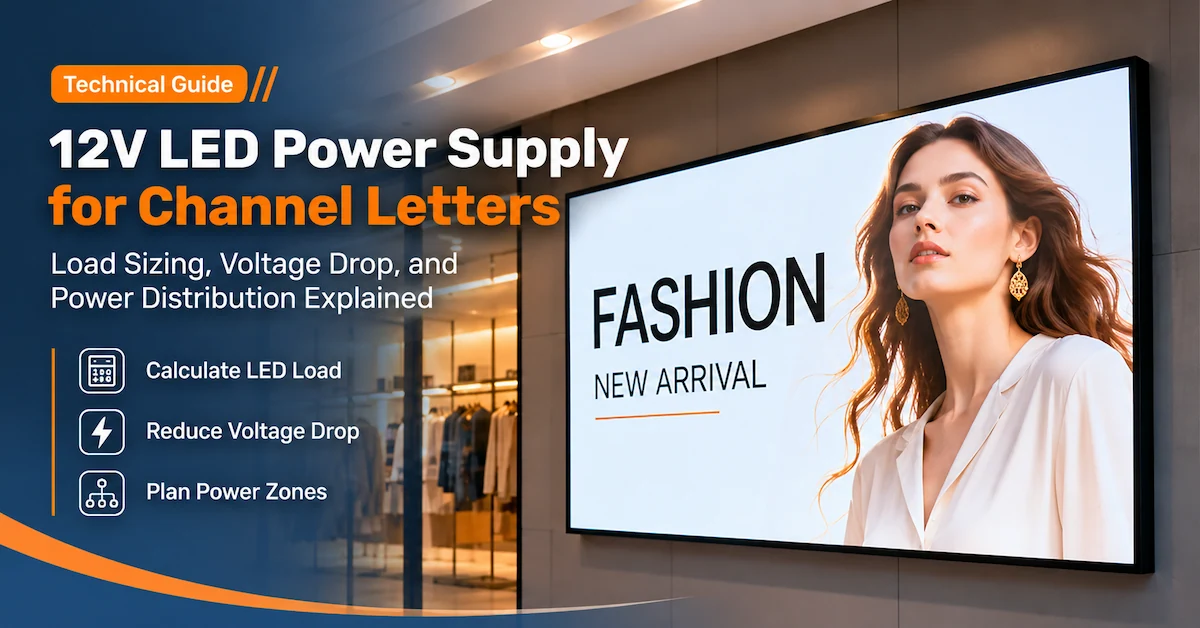
TL;DR: A 12V LED power supply converts AC electricity into regulated 12V DC power for compatible LED modules and strips. Correct sizing requires calculating total LED wattage, checking the supply's continuous output capacity, evaluating cable voltage drop, and following module connection limits. Large illuminated signs may require multiple feed branches or power zones rather than one long LED chain.
A common mistake in commercial signage projects is assuming that a sufficiently powerful LED driver guarantees uniform illumination.
In practice, a 100W power supply may operate an 80W LED load while distant modules still receive insufficient voltage because of cable resistance or unsuitable wiring.
For sign manufacturers, advertising contractors, and LED distributors, understanding the relationship between power capacity, electrical current, cable length, and module layout is essential.
This guide uses published YESUN LED product specifications and clearly identified engineering calculations to explain how to select and approve a suitable 12V lighting system.
Key Takeaways
-
Power supply capacity: Calculate the total connected LED load and verify that it remains within the driver's usable continuous output rating.
-
Voltage drop: Cable resistance and electrical current determine how much voltage is lost between the power supply and LED modules.
-
Power distribution: Multiple branches or zones can improve installation flexibility and reduce excessive cable runs.
-
IP rating: IP20 and IP67 supplies serve different installation conditions; connections require separate protection.
-
Model selection: The correct 12V version, AC input configuration, and dimensional requirements should be confirmed before ordering.
-
Quality verification: Representative system testing is more useful than checking whether a sample simply switches on.
1. What Is a 12V LED Power Supply and How Does It Work?
A 12V LED power supply is an electrical device that converts an appropriate AC input into a regulated 12V DC output.
It is commonly used with constant-voltage LED strips, channel-letter modules, and selected commercial backlighting products.
The power supply must maintain suitable output performance while delivering the current required by the connected LEDs.
How Constant-Voltage Regulation Works
A constant-voltage supply regulates its output voltage while the load determines the current drawn.
For a compatible 12V LED system, the nominal relationship is:
Power (W) = Voltage (V) × Current (A)
If a connected lighting load consumes 60W at 12V, its nominal current is:
60W ÷ 12V = 5A
The power supply must accommodate the required current under the intended operating conditions.
Constant Voltage vs Constant Current
| Parameter | Constant-Voltage Supply | Constant-Current Driver |
|---|---|---|
| Regulated output | Voltage | Current |
| Typical specification | DC12V or DC24V | Defined current in mA or A |
| Common application | Compatible LED modules and strips | LED assemblies designed for current regulation |
| Main selection requirement | Correct voltage and sufficient load capacity | Correct current and operating-voltage range |
| Typical mismatch risk | Excessive voltage or overload | Excessive current or unsuitable driver range |
Some LED modules incorporate internal current-regulating circuits but still require an external constant-voltage supply.
For example, YESUN's YS-MA2321 high-efficiency LED module is a 12V signage product with a published power consumption of 0.72W per module.
Its internal electrical design and external supply requirements should be treated as separate parts of the system.
Section Takeaway: Selecting the correct power supply begins with the LED product's specified electrical architecture, not the driver's maximum wattage.
2. How Does a 12V Power Supply Affect LED Brightness and Stability?
A power supply delivers electrical energy, but the voltage reaching each LED module also depends on the distribution system.
Three electrical factors have the greatest influence.
Output Voltage Regulation
The supply must provide an appropriate output voltage under load.
If the supply output is outside the LED product's permitted range, performance may become unstable or components may be damaged.
Available Output Current
The driver must supply the connected load without exceeding its continuous operating rating.
An undersized supply may experience excessive heating, voltage reduction, or protective shutdown depending on its design.
Distribution Resistance
Wiring, connectors, and electrical joints introduce resistance.
When current flows through resistance, part of the supply voltage is lost.
The simplified relationship is:
Voltage Drop (V) = Current (A) × Resistance (Ω)
This explains why two modules connected to the same driver can receive different voltages when installed at different distances.
A higher-wattage driver does not automatically correct voltage lost through unchanged cables.
Three Questions to Diagnose Low Brightness
-
Is the voltage at the power supply output within specification?
-
What voltage is measured at the affected LED modules while operating?
-
Does the connected load and wiring arrangement comply with the product requirements?
These measurements help distinguish a driver problem from a power-distribution problem.
3. How to Calculate the Correct 12V LED Power Supply Capacity
A structured calculation reduces the risk of undersizing a driver or purchasing unnecessarily large equipment.
Step 1: Identify the LED Module Power
Use the actual manufacturer's datasheet.
For this example, the YESUN YS-MA2321 module consumes a published 0.72W per unit.
Step 2: Calculate the Total Connected Power
Consider a hypothetical sign containing 120 modules.
Total Power = Number of Modules × Power per Module
120 × 0.72W = 86.4W
Step 3: Calculate the Nominal Current
Current = Power ÷ Voltage
86.4W ÷ 12V = 7.2A
Step 4: Evaluate Driver Capacity
A nominal 100W, 12V supply has more nameplate capacity than this calculated load.
However, the usable continuous rating may depend on input voltage, ambient temperature, mounting conditions, and manufacturer-specified derating.
Example Calculation Table
| Calculation item | Result |
|---|---|
| LED module | YESUN YS-MA2321 |
| Rated module power | 0.72W |
| Module quantity | 120 |
| Total LED load | 86.4W |
| Nominal operating voltage | 12V |
| Total nominal current | 7.2A |
| Preliminary driver consideration | 100W or higher, subject to verification |
Should Buyers Add a Power Margin?
A commonly used preliminary sizing method is to allow additional capacity.
For example:
86.4W × 1.25 = 108W
This suggests evaluating a supply with more than 108W of usable capacity if applying that planning margin.
However, a fixed 25% margin is not a universal requirement.
The final choice must follow the selected driver's continuous rating and installation conditions.
Section Takeaway: The correct driver is determined by verified usable output, not simply by selecting the next wattage above the calculated LED load.
4. Why Does Voltage Drop Cause Uneven LED Brightness?
Voltage drop is particularly important in 12V LED installations because relatively small voltage losses represent a noticeable percentage of the nominal supply voltage.
Electrical Mechanism
A cable has electrical resistance.
As current travels through the cable, voltage is lost according to the conductor resistance and the current flowing through it.
The main influencing factors include cable length, conductor cross-section, conductor material, temperature, current, and connection quality.
Example: A 10-Meter Power Cable
Consider an illustrative two-conductor DC circuit.
| Parameter | Example value |
|---|---|
| Nominal supply voltage | 12V |
| One-way cable length | 10m |
| Circuit current | 3A |
| Assumed conductor resistance | 0.013 Ω/m |
| Total conductor length | 20m |
For a simplified concentrated load:
Voltage Drop = 2 × Length × Current × Resistance per Meter
= 2 × 10 × 3 × 0.013
= 0.78V
Percentage voltage drop:
0.78 ÷ 12 × 100 = 6.5%
The approximate voltage at the load becomes:
12V − 0.78V = 11.22V
This is a theoretical calculation. It excludes additional connection resistance and does not represent a measured YESUN installation.
Why Changing the Driver May Not Help
Suppose the original 12V power supply is capable of supplying the required current, but the cable produces excessive voltage drop.
Replacing the driver with a larger-wattage 12V model may leave the same cable voltage loss.
The problem lies in the electrical distribution path.
Practical Ways to Reduce Voltage Drop
-
Reduce the distance between the power supply and LED load.
-
Select appropriately sized conductors.
-
Divide long circuits into shorter branches.
-
Add approved power-feed points where permitted.
-
Avoid excessive current in individual cables.
-
Check the voltage at the farthest LED modules under operating load.
Section Takeaway: Voltage-drop control requires appropriate wiring and distribution, not simply a higher power supply wattage.
5. How Should Channel Letters Be Divided Into Power Zones?
Large illuminated signs often contain multiple letters or physically separated lighting sections.
Dividing the installation into electrical zones can make wiring, testing, and future maintenance more manageable.
Step 1: Calculate the Entire Sign Load
Using the previous example:
-
120 LED modules
-
0.72W per module
-
86.4W total load
Step 2: Divide the Sign Into Two Zones
An illustrative arrangement uses two groups of 60 modules.
| Parameter | Zone A | Zone B |
|---|---|---|
| Module quantity | 60 | 60 |
| Connected power | 43.2W | 43.2W |
| Nominal current | 3.6A | 3.6A |
| Supply arrangement | Separate suitable 12V supply | Separate suitable 12V supply |
Step 3: Follow Module Cascade Limits
The YESUN YS-MA2321 product page identifies a standard one-side cascade limit of 20 modules and describes a separate two-side feeding configuration.
Therefore, connecting all 60 modules in a single uninterrupted one-side-fed chain would not follow its published standard cascade arrangement.
A preliminary design could instead use three appropriately connected groups of 20 modules within each zone.
Step 4: Confirm the Electrical Layout
Before installation, verify:
-
Maximum permitted module cascade
-
Power supply rating
-
Cable size and length
-
Branch current
-
Connection method
-
Mechanical installation
-
Service accessibility
Zone arrangements should be approved using actual project drawings.
Electrical installation and branch protection must follow applicable requirements and qualified engineering practice.
6. Which YESUN 12V LED Power Supply Models Should Buyers Compare?
YESUN offers constant-voltage power supply models for indoor and outdoor signage applications.
The following comparison uses its published product specifications.
| Model | Power | Output | Protection | Application to evaluate |
|---|---|---|---|---|
| YS-N-12100 | 100W | 12V, up to 8.5A | IP20 | Protected indoor signage |
| YS-WP-12100 | 100W | 12V, up to 8.5A | IP67 | Outdoor signage with appropriate connections |
| YS-WP-12200 | 200W | 12V, up to 16.7A | IP67 | Larger outdoor LED loads |
These models have separate 24V counterparts. The product family listing should not be interpreted as evidence that a single unit automatically switches between 12V and 24V.
YS-N-12100: 100W Indoor Power Supply
The YS-N-12100 constant-voltage LED driver is published with:
-
100W maximum power
-
12V output
-
Up to 8.5A output current
-
IP20 protection
-
145 × 48 × 24mm dimensions
Its published input-voltage options require buyers to confirm the correct version for the destination market.
YS-WP-12100: 100W Waterproof Power Supply
The YS-WP-12100 waterproof LED power supply is listed with:
-
100W maximum power
-
12V output
-
Up to 8.5A output current
-
IP67 protection
-
170 × 52 × 35mm dimensions
This model is worth evaluating for projects requiring an appropriately sealed supply enclosure.
YS-WP-12200: 200W Waterproof Power Supply
The YS-WP-12200 waterproof LED power supply is listed with:
-
200W maximum power
-
12V output
-
Up to 16.7A output current
-
IP67 protection
-
238 × 58 × 32mm dimensions
Greater output capacity may be useful for larger connected loads, provided that the wiring and LED connection limits are respected.
Comparison Decision
Select based on the required output capacity, ambient conditions, enclosure protection, input voltage, available space, and intended power-distribution design.
Confirm the current datasheet before ordering.
7. IP20 vs IP67: How Does Environmental Protection Affect Selection?
IP ratings classify defined levels of protection against ingress of solids and water.
IEC 60529 provides the underlying classification framework.
IP20 Power Supplies
An IP20 model may be suitable for appropriately protected indoor locations.
The installation must prevent exposure to unsuitable moisture, dust conditions, and contact hazards.
IP67 Power Supplies
An IP67-rated enclosure offers a defined level of dust and water-ingress protection.
However, the rating does not automatically cover the entire lighting installation.
The AC connection, cable exits, external connectors, junction boxes, and mounting conditions must also be considered.
Installation Comparison
| Environment | Main concern | Selection approach |
|---|---|---|
| Dry indoor sign cabinet | Ventilation and electrical safety | Evaluate suitable IP20 supply |
| Exposed outdoor sign | Rain and moisture | Evaluate sealed supply and protected connections |
| Sheltered exterior area | Condensation and occasional moisture | Assess actual exposure |
| Hot enclosed cabinet | Temperature and derating | Verify thermal conditions |
| Difficult maintenance location | Replacement accessibility | Plan accessible driver placement |
Section Takeaway: The correct enclosure rating must reflect the complete installation environment, not only the driver's IP label.
8. What Common Failures Occur in 12V LED Power Supply Systems?
Electrical problems often result from a combination of load, wiring, installation, and environmental factors.
| Failure symptom | Possible cause | Verification method |
|---|---|---|
| LEDs do not turn on | Wrong input/output voltage or wiring | Check ratings and connections |
| Far-end LEDs are dim | Excessive voltage drop | Measure voltage at distant modules |
| Driver becomes unusually hot | Overload or inadequate cooling | Measure current and temperature |
| Driver shuts down repeatedly | Protective operation or electrical fault | Check load and fault conditions |
| LEDs flicker | Supply instability or dimming mismatch | Test complete driver/controller system |
| Outdoor installation fails | Water ingress or damaged connection | Inspect seals and equipment |
| Replacement driver performs differently | Incorrect model or variant | Compare approved specifications |
Why a Larger Power Supply Does Not Always Solve Flicker
A higher-wattage supply may be appropriate if the previous unit was overloaded.
However, flickering caused by loose wiring or incompatible dimming equipment requires a different correction.
Fault diagnosis should identify the actual cause before replacing components.
Why Waterproofing Requires More Than IP67
Even an IP67-rated driver can be part of an unreliable installation if its electrical connections are not adequately protected.
Check the complete cable and connection arrangement rather than treating the driver enclosure as the only environmental barrier.
9. How Does Power Supply Selection Work in Practice?
The following is a hypothetical engineering example using YESUN's published module ratings. It is not a completed customer case or independently measured performance report.
Project Background
A signage manufacturer needs to illuminate a medium-sized commercial sign with 120 YESUN YS-MA2321 modules.
The installation uses 12V DC and requires serviceable power distribution.
Initial Load Calculation
| Parameter | Value |
|---|---|
| LED quantity | 120 modules |
| Module power | 0.72W |
| Total load | 86.4W |
| Nominal current | 7.2A |
| Number of proposed zones | 2 |
| Load per zone | 43.2W |
Initial Design Problem
The manufacturer could consider one centrally installed 100W driver.
However, this approach may create longer cables and requires verification of continuous output capacity and module cascade limits.
The available nameplate wattage alone cannot establish suitability.
Revised Distribution Approach
A possible alternative is to divide the modules into two separately powered zones of 60 modules.
Each zone can be further arranged into three branches of 20 modules, subject to the manufacturer's wiring instructions.
This reduces the number of modules in each proposed branch and creates separate areas for inspection and maintenance.
What Must Be Tested?
Before final approval, measure:
-
Supply output voltage under operating load
-
Voltage at the farthest module in each branch
-
Current drawn by the installed LEDs
-
Driver operating temperature
-
Lighting uniformity
-
Electrical connection quality
What Does This Example Demonstrate?
The calculation establishes the nominal load and a possible distribution structure.
It does not prove that the completed sign will meet a particular voltage-drop or temperature requirement.
Those results require actual installation measurements.
The practical lesson is to approve the complete distribution system rather than purchase a driver based on its wattage alone.
10. How Should B2B Buyers Inspect and Approve Power Supplies?
Sign manufacturers, distributors, and commercial project contractors should establish written acceptance criteria.
Technical Sample Checklist
| Inspection item | Acceptance focus |
|---|---|
| Product identity | Exact model and 12V variant |
| Input voltage | Correct AC input configuration |
| Output characteristics | Suitable operation under load |
| Electrical capacity | Within verified continuous rating |
| Thermal behavior | Acceptable under intended conditions |
| Enclosure | Appropriate protection and condition |
| Wiring | Correct terminals and connection method |
| Documentation | Datasheet and applicable test records |
Where relevant, IEC 61347-2-13:2024 provides safety requirements for electronic controlgear for LED light sources within its scope.
Buyers should identify the applicable market requirements and confirm model-specific documentation instead of assuming that a company-wide certification covers every power supply.
For bulk purchasing, retain the approved sample specification and establish a process for reviewing product revisions.
11. Why Consider YESUN LED for Commercial Signage Power Supplies?
YESUN LED is a Shenzhen-based supplier specializing in LED signage and commercial lighting products.
Its portfolio includes LED modules, strips, light sheets, light bars, neon lighting, controllers, and power supplies.
This product coverage is useful when customers need to evaluate a lighting system rather than a power supply in isolation.
YESUN publishes technical information for multiple 12V and 24V power supply models, including indoor and waterproof configurations.
Buyers can review the YESUN LED Power Supply range and LED Modules to identify products for further technical evaluation.
Requesting a Project-Specific Quotation
To receive a more accurate product recommendation, provide:
-
LED model and quantity
-
Total connected wattage
-
Required 12V output
-
AC input voltage and destination
-
Indoor or outdoor environment
-
Cable lengths and proposed power zones
-
Dimming requirements, if any
-
Estimated order quantity
-
Required documentation and delivery schedule
YESUN's published product range can support initial selection, while the exact electrical ratings, compatibility, MOQ, delivery terms, and certification requirements should be confirmed during quotation.
12. Frequently Asked Questions
1. How do I calculate the correct 12V LED power supply size?
Multiply the quantity of LEDs by their rated power to calculate total wattage. Divide by 12V to estimate current. Then verify the driver's continuous usable output, operating temperature limits, and electrical distribution requirements.
2. Can a 100W power supply operate 80W of LED modules?
Possibly. The driver must support that continuous load under the installation conditions. Check its rated output, thermal derating, input voltage, and wiring before approval.
3. What causes voltage drop in a 12V LED system?
Voltage drop occurs when current flows through the resistance of cables and connections. Longer conductors and higher currents generally increase the loss.
4. Does a 200W driver prevent voltage drop better than a 100W driver?
Not automatically. If both maintain the same 12V output, the wiring resistance and load current remain critical. A higher capacity does not eliminate cable losses.
5. How many channel letters can one 12V power supply operate?
There is no universal number. It depends on the wattage of each letter, module quantity, cable lengths, module cascade limits, and the driver's usable output capacity.
6. Can I use a 24V power supply for 12V LED modules?
Not directly unless the LED product explicitly supports that voltage or a properly designed conversion system is used. Applying an unsuitable voltage can damage LEDs.
7. What is the difference between IP20 and IP67 LED power supplies?
IP20 is generally intended for suitably protected environments, while IP67 defines higher levels of dust and water-ingress protection. Installation conditions and external connections must still be evaluated.
8. Should large signs use multiple 12V power supplies?
Multiple supplies may improve distribution and serviceability in some installations. The decision depends on total load, cable routes, connection limits, and installation requirements.
9. What tests should be completed before bulk purchasing?
Verify the exact model, input/output ratings, electrical load, voltage at distant modules, temperature behavior, enclosure suitability, connections, and applicable technical documentation.
10. How can I request a 12V LED power supply quotation from YESUN?
Use the YESUN LED contact page and provide your LED model, quantity, calculated load, voltage requirements, installation environment, expected order volume, and project schedule.
Conclusion
A reliable 12V LED power supply must be selected as part of a complete electrical system.
For channel letters, commercial light boxes, and illuminated signs, correct performance depends on more than the driver's maximum wattage. The connected LED load, output capacity, cable resistance, power-feed arrangement, environmental protection, and installation conditions must work together.
The most effective design approach is to calculate the nominal load, evaluate voltage drop, divide large installations into appropriate power zones, and verify the complete system under representative operating conditions.
YESUN LED provides 12V constant-voltage power supply options alongside signage LED modules and related lighting accessories. Its available models offer different capacities and enclosure configurations for professional buyers to evaluate.
For signage manufacturers, distributors, and project contractors, a clear technical specification and an approved sample can reduce avoidable purchasing and installation risks.
Need a suitable 12V LED power supply for your channel-letter or commercial lighting project? Contact YESUN LED to discuss power requirements, wiring layouts, product models, sample evaluation, and bulk purchasing.