

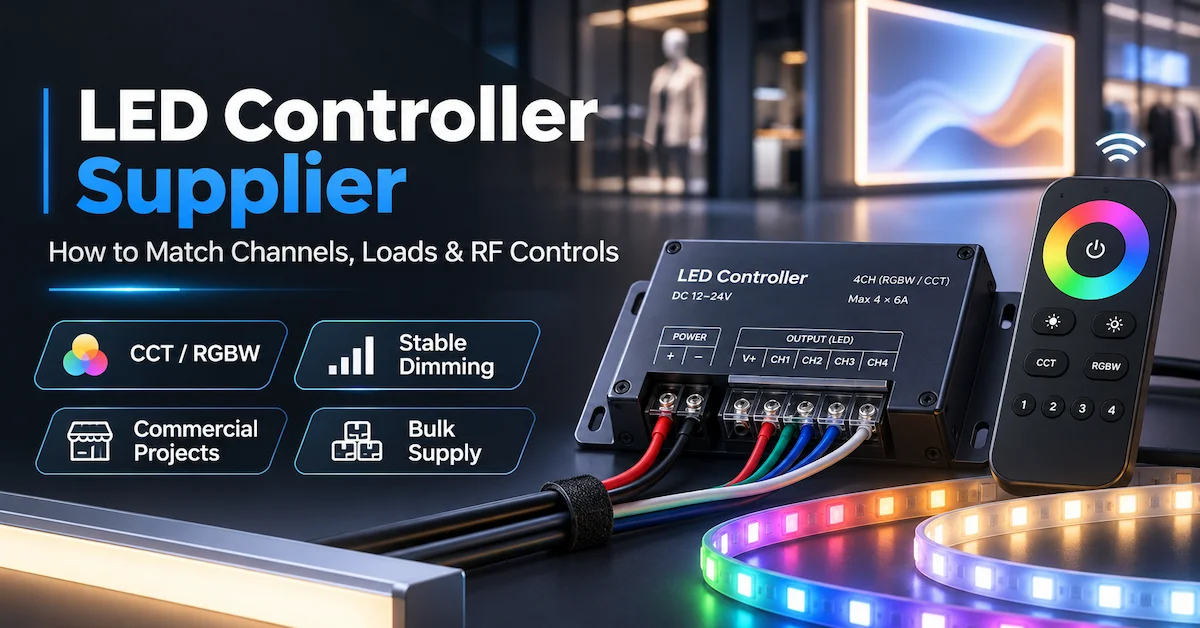
An LED controller supplier provides the electronic control equipment used to adjust brightness, color temperature, RGB colors, and lighting effects in commercial LED systems.
However, selecting an appropriate controller involves more than checking its voltage or choosing a compatible-looking remote.
Incorrect output channels, excessive electrical loads, unsuitable control protocols, and incompatible power supplies can cause flickering, unstable operation, incorrect colors, or premature equipment failure.
For signage manufacturers, commercial lighting contractors, and distributors, these problems can lead to installation delays and additional maintenance expenses.
TL;DR: A reliable LED controller supplier should help buyers match the controller's operating voltage, output channels, current ratings, signal protocol, and control functions with the actual LED load. Before bulk purchasing, verify the electrical configuration, calculate current requirements, test the complete system, and approve an identifiable controller and remote-control combination.
Key Takeaways
-
Electrical compatibility comes first. A controller must match the LED product's voltage, wiring configuration, number of channels, and current demand.
-
Control methods are not interchangeable. RF communication, PWM output, and addressable LED data protocols perform different functions.
-
Channel ratings determine usable capacity. Buyers must evaluate each channel's maximum load, not only the total advertised wattage.
-
Complete-system testing prevents mistakes. Controllers should be tested with the intended LED strips, power supplies, remote controls, and wiring.
-
Supplier qualification reduces purchasing risks. Technical documentation, approved samples, consistent product revisions, and clear commercial terms matter for repeat orders.
1. What Is an LED Controller and How Does It Work?
An LED controller is an electronic device that regulates the operation of compatible LED lighting.
It may control brightness, adjust warm-white and cool-white channels, generate RGB colors, or communicate with programmable LED devices.
A controller does not necessarily generate its own supply power. In many constant-voltage systems, it receives DC power from a separate LED power supply and regulates output to the connected LEDs.
LED Controller vs LED Driver vs RF Remote
These components perform different tasks.
| Component | Main function | Key technical requirement |
|---|---|---|
| LED Power Supply | Provides regulated electrical power | Output voltage and current capacity |
| LED Controller | Regulates LED output channels | Voltage, channel configuration, load rating |
| RF Remote | Sends wireless commands | Communication frequency and receiver compatibility |
| LED Strip or Module | Produces light | Electrical characteristics and control requirements |
A typical control system follows this arrangement:
AC Input → LED Power Supply → LED Controller → LED Strip or Module
A compatible RF remote communicates with the controller receiver separately.
For example, YESUN's R8-1 RF remote uses a 3V battery-powered circuit and a 2.4GHz communication signal.
That 3V figure refers to the remote itself—not the operating voltage required by the LED strip.
Buyers should distinguish between these specifications when evaluating control products.
Explore YESUN LED controllers and lighting accessories for available control configurations.
What an LED Controller Cannot Do
A controller cannot compensate for incorrect wiring, inadequate power-supply capacity, incompatible LED output technology, or excessive electrical load.
A 24V-rated controller does not automatically convert a 12V power supply into a 24V output.
Similarly, a conventional RGB controller cannot automatically operate digital addressable LEDs.
Section Takeaway: Controller selection begins with the complete lighting system rather than the controller model alone.
2. How Do LED Controllers Regulate Brightness and Color?
Most commercial LED control problems can be traced to a mismatch between the required LED function and the controller's output technology.
Understanding the operating principle helps buyers identify the correct equipment.
PWM Dimming: Controlling Light Through Switching
Pulse-width modulation, or PWM, controls the average power delivered to compatible LEDs by rapidly switching the output.
The proportion of time the output remains on is called the duty cycle.
A higher duty cycle generally produces greater brightness, while a lower duty cycle reduces the average output.
However, the actual dimming appearance depends on the complete driver-controller-LED combination.
Important factors include:
-
PWM switching frequency
-
Dimming resolution
-
Minimum stable output
-
LED and driver compatibility
-
Camera interaction
-
Electrical noise and wiring
A controller with a published PWM frequency should not automatically be described as flicker-free under every operating condition.
For applications involving video cameras, displays, or sensitive visual environments, complete-system testing is necessary.
CCT Control: Mixing Warm and Cool White Light
Correlated color temperature (CCT) control generally uses two independently controlled LED channels.
One channel operates warm-white LEDs, while the other operates cool-white LEDs.
Adjusting their relative outputs changes the resulting appearance of the light.
YESUN's 24V CCT LED strip YS-F002835C-S120 lists V2 and V2-L as relevant controller configurations.
The V2 is listed as a two-channel controller with a 12–24VDC input range and a rated output of 5A per channel.
For tunable-white projects, both channels must be evaluated individually.
RGB and RGBW Control
RGB LED systems regulate red, green, and blue outputs.
RGBW systems add a dedicated white channel.
A conventional RGB controller generally has three color channels, while an RGBW controller generally requires four.
The channel count is important because each output must be regulated independently to provide the intended lighting effects.
YESUN's RGBW 5050 LED strip YS-RN5050Q460 includes published control references such as the VP four-channel RGBW controller.
Addressable LED Control
Addressable LED products use digital data signals to control individual pixels or pixel groups.
Their controllers must support the relevant LED driver IC and communication protocol.
Traditional RGB output controllers cannot be substituted automatically for addressable systems.
Section Takeaway: PWM describes an output regulation method, RF describes a wireless communication method, and digital addressable control involves a separate data interface. They are not equivalent categories.
3. How Should Buyers Specify and Approve an LED Controller?
A structured approval process helps prevent errors before bulk production.
The following five-stage workflow can be used by lighting contractors, OEM buyers, and purchasing teams.
Stage 1: Identify the LED Load
Start with the actual lighting product.
Record its operating voltage, power consumption, wiring configuration, number of controlled channels, and intended installation environment.
Determine whether the LEDs require single-color, CCT, RGB, RGBW, RGB+CCT, or addressable control.
Stage 2: Match the Controller Configuration
Check the controller's published electrical specifications.
Confirm:
-
Input voltage range
-
Output channel count
-
Continuous current per channel
-
Output power rating
-
Compatible LED wiring arrangement
-
Control interface
-
Remote-control compatibility
A suitable controller should match the required functions without relying on assumptions about universal compatibility.
Stage 3: Calculate Electrical Load
Calculate the total connected load and determine the maximum demand of each channel.
For constant-voltage LED systems:
Current (A) = Power (W) ÷ Voltage (V)
This provides an initial calculation but does not replace channel-specific load verification.
Stage 4: Test a Representative System
Connect the intended LED product, controller, power supply, and remote.
Check startup, dimming, color control, pairing, thermal behavior, and recovery after power interruption.
The test should reflect realistic operating conditions.
Stage 5: Approve the Bulk Configuration
Record the approved model and product revision.
Confirm the included accessories, packaging, test criteria, quantity, and delivery requirements.
This creates a reference for future purchasing and troubleshooting.
Controller Approval Checklist
| Approval stage | Required verification |
|---|---|
| Product identification | Exact controller and remote models |
| Electrical compatibility | Voltage and channel load suitability |
| Function verification | Correct dimming, CCT, or RGB behavior |
| Communication | Successful pairing and control response |
| Installation | Suitable mounting, wiring, and environment |
| Documentation | Approved specifications and wiring instructions |
| Purchasing | Identified SKU, quantity, and acceptance terms |
Section Takeaway: A repeatable approval workflow is more dependable than selecting controllers solely from catalog descriptions.
4. LED Controller Comparison: Which Type Fits Your Application?
Different lighting systems require different control equipment.
The following comparison illustrates common configurations relevant to commercial LED projects.
| Controller type | Typical channels | Primary function | Suitable applications |
|---|---|---|---|
| Single-Color Controller | 1 | Brightness adjustment | Channel letters, cabinet lighting |
| CCT Controller | 2 | Warm/cool white mixing | Light boxes, retail displays |
| RGB Controller | 3 | Color mixing | Decorative signage |
| RGBW Controller | 4 | RGB with dedicated white | Commercial decorative lighting |
| RGB+CCT Controller | 5 | Color plus tunable white | Multifunction display lighting |
| Addressable Controller | Protocol-dependent | Pixel-based effects | Dynamic signage and architectural accents |
YESUN LED Controller Model Comparison
| YESUN model | Published specifications | Selection consideration |
|---|---|---|
| V1 | 5–36VDC input; single-color dimming | Basic brightness control |
| V1-L | 12–48VDC input; higher-capacity single-color output | Larger compatible single-color loads |
| V2 | 12–24VDC; 2 channels; 5A/channel | CCT lighting |
| V2-L | 12–48VDC; 2 channels; 8A/channel | Higher-capacity CCT applications |
| VP | 12–24VDC; 4 channels; 4A/channel listed | RGBW lighting |
| V5-M | 12–24VDC; 5 channels; 3A/channel | RGB+CCT lighting |
| R8-1 | 3V battery-powered; RF 2.4GHz | Wireless remote transmitter |
Specifications are based on YESUN's published controller and associated LED product information. Confirm the current datasheet, exact variant, and approved electrical ratings before purchasing.
V2 vs V2-L: What Is the Practical Difference?
Both controllers support two-channel CCT applications.
The main published differences concern their operating-voltage ranges and output-current ratings.
V2 is listed for 12–24VDC systems with 5A per channel.
V2-L is listed for 12–48VDC systems with 8A per channel.
A higher channel rating may provide additional capacity for appropriately designed lighting systems, but it does not remove the need for proper load calculation and wiring.
VP vs V5-M: Which Should You Choose?
The VP is a four-channel RGBW controller.
The V5-M is a five-channel RGB+CCT controller.
Choose according to the connected LED product's control configuration.
A project requiring separate warm-white and cool-white channels in addition to RGB needs an appropriately matched five-channel controller rather than a conventional RGBW controller.
For related products, visit YESUN LED Controllers.
5. Why Compare RF, PWM, and Digital LED Control Systems?
Control-system comparison is important because different technologies solve different problems.
RF Wireless Control
RF allows compatible transmitters to send control instructions without a direct command cable.
It is useful for small commercial installations, decorative lighting, and selected multi-zone applications.
However, wireless range depends on the installation environment.
Obstacles, receiver positioning, interference, and building construction can affect communication.
PWM Output Control
PWM is commonly used for brightness and channel adjustment in compatible constant-voltage LED systems.
It is suitable for many single-color, CCT, and analog RGB applications.
Performance depends on controller design, switching frequency, load, and associated power equipment.
Digital Addressable Control
Addressable systems communicate data to supported LED pixels or pixel groups.
They are useful when a project requires animated effects or individually controlled sections.
However, they require more careful evaluation of protocol compatibility, addressing, signal distribution, and controller capacity.
Technical Comparison
| Technology | What it controls | Main limitation |
|---|---|---|
| RF | Wireless command transmission | Receiver compatibility and installation range |
| PWM | Average LED output through switching | Electrical and dimming compatibility |
| Addressable data | Digital pixel or group instructions | Protocol and pixel compatibility |
These technologies may also work together in the same system.
For example, an RF remote may send instructions to a receiver that uses PWM to regulate LED outputs.
Section Takeaway: Buyers should distinguish the command interface from the electrical output technology when comparing controllers.
6. What Causes LED Controller Failures in Commercial Lighting?
Many control problems occur because the system components were not fully verified together.
The following failure modes are particularly relevant to commercial lighting procurement.
Incorrect Voltage Matching
A controller operating outside its specified voltage range may not function correctly or may be damaged.
The supply voltage must match the controller and connected LED product.
Output Channel Mismatch
Connecting an RGBW strip to a controller without the required independent outputs can prevent proper color control.
CCT products also require the correct warm-white and cool-white connections.
Excessive Electrical Load
A controller may become overloaded if connected LEDs exceed its per-channel current rating.
This can result in overheating, unstable operation, protective shutdown, or damage.
RF Communication Problems
A remote may fail to control a receiver when pairing is incomplete, the devices are incompatible, or communication is affected by installation conditions.
A shared RF frequency does not guarantee interoperability.
Dimming Instability
Flicker or inconsistent brightness may result from incompatible electrical equipment, insufficient supply capacity, unsuitable controller behavior, or poor connections.
Environmental and Installation Problems
Moisture, excessive temperature, inadequate ventilation, or inaccessible wiring can reduce system reliability.
Controllers installed outdoors may require suitable protective enclosures.
Failure Diagnosis Table
| Symptom | Possible cause | Recommended verification |
|---|---|---|
| LED does not turn on | Voltage or wiring problem | Check supply, polarity, connections |
| Incorrect colors | Channel wiring mismatch | Verify output terminals |
| Controller overheats | Excessive load or poor ventilation | Measure current and temperature |
| RF remote does not respond | Pairing or compatibility issue | Verify model and pairing procedure |
| LED flickers while dimming | Control or power incompatibility | Test driver-controller combination |
| Uneven lighting across zones | Wiring or synchronization problem | Inspect distribution and zone settings |
| Replacement controller behaves differently | Model or revision change | Compare approved specifications |
Failure Modes Worth Remembering
A controller with sufficient total advertised power may still be unsuitable if an individual output channel is overloaded.
Likewise, an RF remote with the correct frequency may not operate a receiver using an incompatible pairing system.
The correct response is to test the complete electrical and communication configuration, not replace components at random.
7. How LED Controller Selection Works in Practice: A Retail Display Example
The following example illustrates how a purchasing team can evaluate a CCT controller for a commercial retail display.
It is a hypothetical engineering scenario, not a published YESUN customer project or laboratory test.
Application Scenario
A retail display manufacturer plans to install tunable-white LED strips in a shelving system.
The preliminary specification is:
| Project parameter | Example requirement |
|---|---|
| Application | Commercial retail shelves |
| LED technology | CCT tunable-white strip |
| Operating voltage | DC24V |
| Total strip length | 8 meters |
| Nominal power | 12W/m |
| Controller function | Two-channel CCT control |
| User interface | Compatible RF remote |
Principle in Practice
The total nominal LED power is:
8m × 12W/m = 96W
At 24V, the nominal combined current is:
96W ÷ 24V = 4A
A buyer might initially consider the YESUN V2 controller because its published specification includes two channels rated at 5A per channel.
However, the combined nominal current of 4A does not establish the maximum current that each CCT channel may draw under all operating modes.
The actual LED strip datasheet and control behavior must be reviewed.
The design must also account for voltage drop, conductor sizing, power-supply capacity, and any current limitations imposed by the installation.
Sample Testing and Approval
The buyer should test the intended configuration and verify:
-
Warm-white and cool-white channel operation
-
Brightness control at low and high settings
-
Smooth color-temperature adjustment
-
Stable controller and power-supply operation
-
Acceptable electrical and thermal performance
-
RF remote pairing and response
-
Consistent illumination across the display
Results and Purchasing Insights
No measured performance result can be claimed until the assembled system has been tested.
The useful conclusion from the calculation is that total nominal wattage alone is insufficient to approve a CCT controller.
Per-channel loading, electrical connections, driver compatibility, and practical operating conditions must also be verified.
Once accepted, the buyer should record the exact controller model, LED strip model, connection diagram, and approved configuration.
8. How to Evaluate an LED Controller Supplier Before Bulk Ordering
Selecting a supplier involves both technical assessment and commercial review.
Technical Documentation
Request current product datasheets, wiring diagrams, output ratings, control instructions, and compatibility information.
Check that the documents correspond to the specific controller variant being quoted.
Sample and Quality Verification
Evaluate representative samples under realistic electrical loads.
Test the required brightness or color functions, remote pairing, startup behavior, and temperature performance.
Product Consistency
Controller hardware, firmware, and paired remote-control products should remain identifiable across repeat orders.
Buyers should clarify whether substitutions or material changes require approval.
Commercial Requirements
Confirm MOQ, sample costs, production lead time, packaging, shipping, warranty terms, and replacement arrangements.
For customized products, request written confirmation of engineering feasibility and any additional development or testing requirements.
LED Controller Supplier RFQ Checklist
| RFQ item | Buyer information | Supplier confirmation |
|---|---|---|
| Application | Signage, retail, light box, architectural | Suitable controller type |
| LED product | Model, voltage, power, channels | Electrical compatibility |
| Controller | Preferred configuration | Exact model and datasheet |
| Control method | RF, PWM, digital | Supported interface |
| Electrical load | Maximum current per channel | Rated continuous capacity |
| Installation | Indoor, outdoor, enclosed | Environmental suitability |
| Remote | Function and zone requirements | Compatible transmitter |
| Quantity | Samples and bulk volume | MOQ and price |
| Documentation | Required technical/compliance records | Model-specific availability |
| Delivery | Destination and schedule | Lead time and shipping terms |
A complete RFQ makes quotations easier to compare and reduces misunderstandings during order preparation.
9. Why Consider YESUN LED for Controller and Lighting Accessories?
YESUN LED is a Shenzhen-based company specializing in LED signage and commercial lighting products.
Its published portfolio includes LED modules, SMD and COB strips, LED light sheets, light bars, flexible neon products, power supplies, controllers, and connection accessories.
For B2B buyers, this product coverage is useful when evaluating lighting components and their associated control requirements.
Application-Based Product Selection
YESUN provides lighting products for illuminated signs, light boxes, retail displays, and decorative commercial installations.
Published Controller References
Its product documentation includes controller references associated with CCT LED strips, RGB modules, and RGBW products.
These references help buyers identify equipment for technical evaluation.
Manufacturing and Engineering Resources
YESUN describes its production resources, R&D capabilities, and quality-control approach on its company information page.
Specific controller manufacturing arrangements, custom development options, certification scope, and production conditions should be confirmed before purchasing.
Related Components
YESUN's LED Light Accessories category includes controllers, power supplies, and connection products.
This makes it possible to discuss several parts of a commercial lighting system through the same supplier inquiry.
10. Frequently Asked Questions
1. What should I look for in an LED controller supplier?
Look for clear electrical specifications, appropriate control technologies, verified model compatibility, sample availability, technical documentation, quality-control arrangements, and dependable repeat-order communication.
2. Can one LED controller work with both 12V and 24V LED strips?
Some controllers support both voltages, but they must receive the appropriate supply voltage and be connected to compatible LED loads. Verify the exact model's voltage range and current limits before installation.
3. What is the difference between RGB and RGBW controllers?
Conventional RGB controllers regulate three color channels. RGBW controllers add a fourth channel for a dedicated white output. The controller must match the connected LED product's wiring and channel requirements.
4. Why does an LED strip flicker when connected to a dimmer?
Possible causes include incompatible control equipment, unstable power, unsuitable PWM behavior, excessive load, or poor electrical connections. Testing the complete system is necessary to identify the cause.
5. How do I calculate LED controller power requirements?
Calculate the connected LED power and current, then verify the maximum current demanded by every controlled channel. Confirm the power-supply rating, conductor requirements, and permitted operating conditions.
6. Is a 2.4GHz RF remote compatible with every 2.4GHz controller?
No. Sharing the same radio frequency does not guarantee compatible communication or pairing. Verify the specific transmitter and receiver combination.
7. What controller is suitable for CCT LED lighting?
A compatible two-channel CCT controller is commonly used for warm-white and cool-white LED products. The controller must match the LED voltage, wiring arrangement, and channel currents.
8. Can a conventional RGB controller operate addressable LED strips?
Not automatically. Addressable LED products use digital control protocols that require compatible controllers and data connections.
9. What should distributors verify before ordering controllers in bulk?
Confirm model identification, electrical specifications, compatible remotes, sample results, packaging, MOQ, delivery schedule, documentation, and the process for managing product revisions.
10. How can I request an LED controller quotation from YESUN?
Visit the YESUN LED contact page and provide the connected LED product model, required controller functions, voltage, electrical load, preferred remote-control method, quantity, and destination market.
Conclusion
Selecting a reliable LED controller supplier requires a clear understanding of how electrical power, output channels, communication methods, and LED products interact.
For commercial signage, retail displays, light boxes, and decorative lighting systems, the most common compatibility problems involve incorrect voltage selection, mismatched control channels, excessive electrical loads, and unsuitable remote-control arrangements.
These risks can be reduced through a structured engineering workflow that begins with the LED product specification, continues through electrical calculations and complete-system testing, and ends with documented sample approval.
YESUN LED provides LED controllers and related lighting accessories for commercial applications, including configurations relevant to single-color dimming, CCT, RGB, and RGBW lighting.
Before committing to bulk orders, buyers should verify the exact controller model, approved technical documentation, and compatibility with their intended installation.
Looking for an LED controller supplier for your commercial lighting project? Contact YESUN LED to discuss technical requirements, compatible controller options, sample evaluation, and wholesale purchasing.