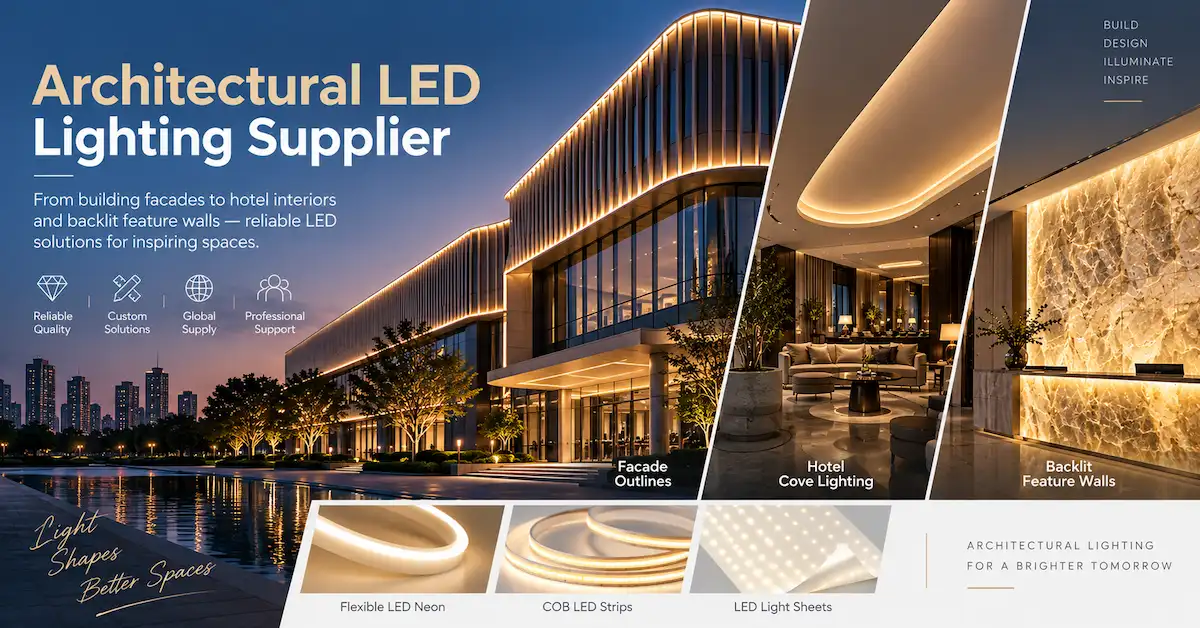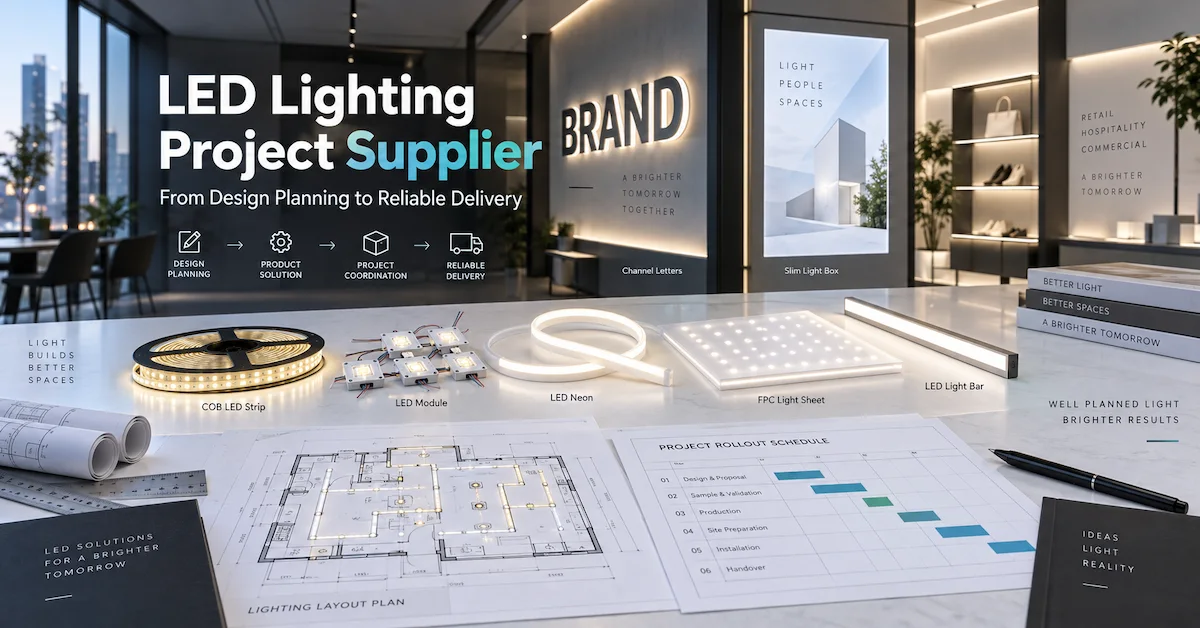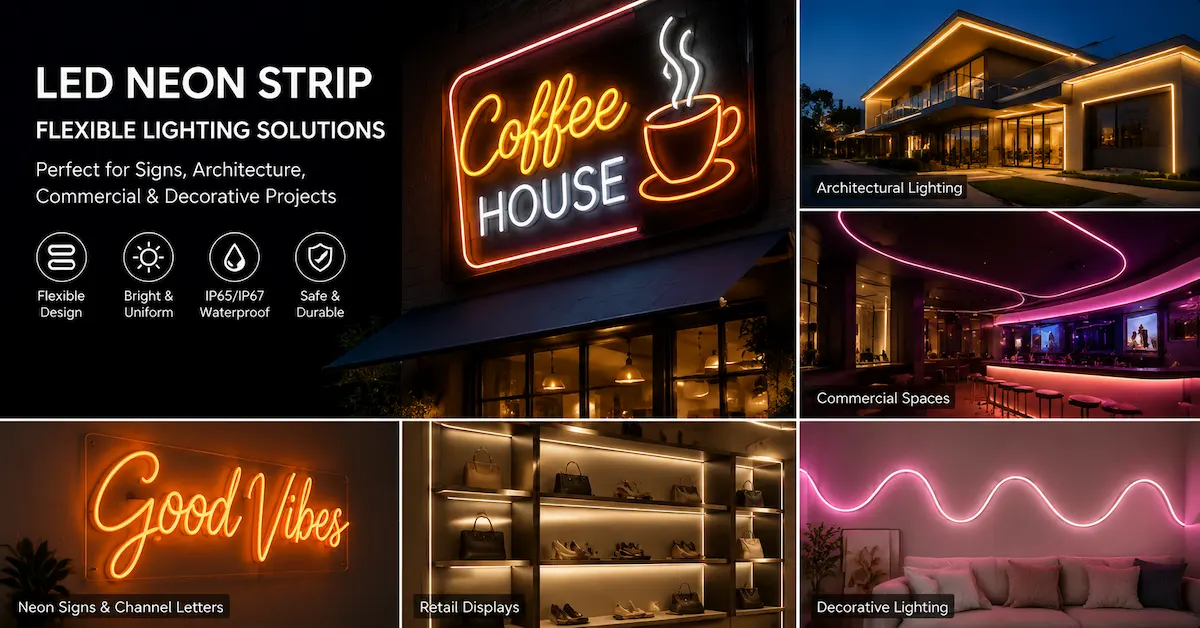


For architectural lighting contractors, facade installers, signage manufacturers, and commercial project procurement teams, the challenge is selecting LED products that work together as a complete system.
Quick answer: Reliable LED lighting for building facade outlines starts with five decisions: define the illuminated geometry, select the appropriate LED profile, verify environmental protection, divide long runs into suitable electrical zones, and approve a representative installation mock-up before bulk purchasing.
This guide focuses on LED contour and decorative facade lighting rather than full-surface floodlighting. It explains how to turn architectural drawings into a practical specification, compare suitable products, and request a quotation supported by measurable acceptance criteria.
1. What Type of LED Lighting Does Your Building Facade Need?
Not every facade lighting project needs the same technology.
A commercial building may require a continuous illuminated roofline, while a hotel entrance needs a soft architectural accent. A shopping center may use programmable color effects around selected structural features.
Before selecting products, identify the visual result.
| Facade application | Lighting objective | Suitable technology to evaluate |
|---|---|---|
| Building rooflines | Continuous visible light outlining the structure | IP-rated silicone LED neon |
| Entrance canopies | Defined architectural edges | Flexible LED neon profiles |
| Columns and decorative frames | Highlight vertical or curved details | Narrow-profile LED neon |
| Shopping mall exteriors | Brand colors and decorative effects | RGB or addressable LED neon |
| Covered walkways | Soft, continuous linear accents | Suitable IP65 or IP67 LED neon |
| Large stone or glass facades | Illuminate broad wall surfaces | Dedicated architectural wall-washing or floodlighting luminaires |
For visible outlines, flexible LED neon offers several practical advantages over exposed LED tape, including an integrated diffusing profile and a more continuous-looking illuminated line.
However, LED neon designed for contours should not automatically be treated as a substitute for a professional wall-washing luminaire.
Projects requiring broad surface illumination, precise beam control, or building-wide photometric calculations should use equipment specifically designed and verified for those tasks.
YESUN LED provides silicone LED neon strips and flexible linear lighting products that can be evaluated for architectural outlines, storefront contours, and decorative building features.
2. Which Buyers Benefit From Facade LED Lighting Solutions?
Architectural Lighting Contractors
Contractors need dependable products, clear installation instructions, electrical compatibility, and predictable delivery.
Their primary concern is avoiding unexpected problems after installation at height.
Signage and Facade Manufacturers
These companies often integrate lighting directly into architectural elements, decorative metalwork, entrance structures, or branded building exteriors.
They prioritize dimensions, profile flexibility, mounting methods, and customization.
Commercial Developers and Property Owners
Hotels, shopping malls, retail complexes, and entertainment venues require consistent visual performance and manageable operating costs.
Maintenance accessibility and long-term replacement compatibility can be more important than obtaining the lowest initial product price.
Distributors and Project Importers
Bulk buyers need identifiable models, repeatable specifications, suitable technical documentation, and consistent procurement terms.
A specialized facade outline product may not be appropriate for customers requiring certified complete luminaires, structural design services, or installation contracting. Those requirements should be assigned to appropriately qualified providers.
3. How to Plan LED Facade Lighting From Architectural Drawings
One of the most expensive mistakes in architectural lighting procurement is ordering LED strips before confirming the installation layout.
A reliable project begins with the elevation drawings.
Step 1: Divide the Building Into Lighting Zones
Identify individual sections such as:
-
Roof edges and parapets
-
Entrance canopies
-
Vertical columns
-
Window surrounds
-
Decorative facade frames
-
Curved architectural features
Record the length, mounting height, orientation, and environmental exposure of each section.
Separating these areas helps contractors estimate materials and determine electrical and maintenance boundaries.
Step 2: Define the Viewing Direction
LED neon products have different emitting surfaces and bending directions.
A strip that produces a satisfactory appearance when viewed from the front may not perform as expected when installed along a projecting edge.
Confirm whether the light should face outward, downward, upward, or toward a specific viewing area.
The profile's physical direction must also match the required curve.
Step 3: Identify Corners and Connection Points
Architectural drawings should indicate:
-
Straight and curved sections
-
Corner radii
-
Cable entry and exit locations
-
Strip termination points
-
Mounting clip positions
-
Accessible maintenance locations
These details affect the visual continuity of the illuminated line.
A flexible product should never be twisted or bent against the manufacturer's specified direction merely to follow a difficult corner.
Step 4: Plan Electrical Sections
A 40-meter architectural outline does not necessarily mean one electrically continuous 40-meter strip.
The system may require multiple properly sized circuits, separate power feeds, and independently maintainable lighting sections.
Electrical planning should happen before the final mounting channels and cable routes are approved.
Step 5: Check the Nighttime Appearance
View a representative sample at the intended observation distance.
A line that appears bright and uniform from one meter may look different from across a street or public square.
Check unwanted glare, visible dark gaps, color differences, and whether the lighting emphasizes the intended architectural features.
4. Compare YESUN LED Products for Building Facade Lighting
YESUN LED offers several silicone neon configurations suitable for evaluation in architectural contour applications.
The following comparison illustrates how product dimensions, protection levels, voltage, and control features affect selection.
| YESUN model | Published technical characteristics | Recommended application to evaluate |
|---|---|---|
| YS-NR0612A-W100 | DC12V; 6 × 12 mm; 100 LEDs/m; 10 W/m; IP67 | Compact outdoor building contours and detailed architectural edges |
| YS-NR0612A-W120 | DC12V; 6 × 12 mm; 120 LEDs/m; 9 W/m; IP67 | Continuous-looking decorative outlines requiring a higher LED density |
| BS-FNC2835A/C-X120 | DC12V/24V variants; 13 × 5 mm; 120 LEDs/m; IP65 | Protected architectural edges and suitable semi-outdoor details |
| BS-FNE2835A/C-X120 | DC12V/24V variants; 15 × 13 mm; 7.2 W/m; IP65; 180° distribution | Covered entrance features and rounded decorative light lines |
| YS-NR0612A-D096 | DC12V; 96 LEDs/m; up to 12 W/m; IP67; 20 controllable pixel units/m | Dynamic RGB facade outlines and programmable decorative features |
These are published product characteristics, not guaranteed results for every facade configuration. Confirm the exact model revision, bending limits, permitted electrical run length, accessories, and applicable test documentation before placing an order.
Single-Color vs Addressable RGB Facade Lighting
Single-color LED neon is a practical choice for projects requiring a consistent illuminated outline with relatively straightforward controls.
Addressable RGB systems provide additional flexibility for moving colors, programmable sequences, and selected dynamic lighting effects.
However, dynamic systems also introduce more control requirements.
Buyers must verify controller compatibility, pixel mapping, data-signal distribution, power injection, and maintenance access.
For commercial buildings requiring only one architectural color, addressable technology may add unnecessary cost and complexity.
Explore YESUN's addressable RGB neon LED strip when project requirements specifically include programmable lighting effects.
5. Which Technical Specifications Matter Most?
The right purchasing specification should describe the complete lighting requirement rather than listing only power consumption and color.
| Technical parameter | What buyers should verify | Why it matters |
|---|---|---|
| Input voltage | DC12V, DC24V, or another supported configuration | Power supply and wiring compatibility |
| Power consumption | Actual W/m for the selected model | Electrical load and operating cost |
| Profile dimensions | Width, height, and illuminated surface | Fit within architectural details |
| LED density | LEDs per meter | Light-line appearance and spacing |
| Color/CCT | Fixed color, white CCT, RGB, or addressable RGB | Architectural appearance |
| IP rating | Verified rating of the supplied configuration | Resistance to dust and water exposure |
| Bending direction | Top-bend, side-bend, or product-specific limitation | Compatibility with curves and corners |
| Cutting interval | Manufacturer-approved cutting positions | Finished-length accuracy |
| Maximum electrical run | Permitted feed length and power distribution | Voltage-drop control |
| Operating temperature | Rated operating range | Suitability for local climate |
| Mounting method | Clips, channels, fixing and cable routing | Mechanical stability and maintenance |
IP65 vs IP67: What Changes Outdoors?
Water resistance is particularly important for LED lighting for building facade installations exposed to rain, moisture, and changing temperatures.
IP65 and IP67 describe different tested levels of protection against water ingress.
IEC 60529, Degrees of Protection Provided by Enclosures (IP Code), establishes the underlying classification framework.
However, an IP67 product label does not automatically mean the complete installed system is waterproof.
Cut ends, connectors, power connections, and junction boxes must also be evaluated.
For an exposed roofline, request documentation showing that the selected product and its required sealing method suit the proposed environment.
For a sheltered entrance canopy, an appropriately installed IP65 product may be worth evaluating, depending on actual exposure conditions.
The correct decision depends on the complete installation—not the IP number alone.
6. Power Distribution: Prevent Voltage Drop and Uneven Brightness
Long architectural outlines can produce visible brightness differences if their electrical layout is inadequate.
Voltage drop increases with conductor resistance and current. The problem can become particularly noticeable when long LED runs are supplied through undersized cables.
Example: Estimating the Connected Lighting Load
Consider a hypothetical building outline requiring 40 meters of a 10 W/m DC12V LED neon product.
| Calculation | Result |
|---|---|
| Total lighting length | 40 m |
| Nominal LED power | 10 W/m |
| Calculated connected load | 400 W |
| Nominal system-wide current at 12V | Approximately 33.3 A |
This calculation is useful for preliminary load estimation, but it does not mean that one 40-meter strip can be powered from one end or that a single 400W driver is suitable.
The installer must divide the load into appropriately designed circuits, check permitted feed lengths, calculate conductor sizes and voltage drop, and select drivers with suitable operating margins.
How to Reduce Electrical Problems
Use the following approach:
-
Determine the total connected load for each lighting zone.
-
Confirm the product's allowable feed length and electrical limits.
-
Plan suitable power-feed or injection locations.
-
Match driver output voltage and capacity to each connected circuit.
-
Check cable routing and protection.
-
Verify that dimming or RGB controllers support the selected LED configuration.
-
Test brightness consistency before final installation.
YESUN offers LED power supplies, controllers, and connection accessories for compatible lighting applications.
For large projects, request a model-specific wiring proposal rather than assuming that all products within one voltage category can share the same electrical arrangement.
7. Materials, Installation, and Outdoor Durability
The performance of outdoor LED contour lighting depends on more than the internal LED chips.
A typical flexible neon assembly includes an LED circuit, a silicone diffuser or enclosure, conductive connections, cable entries, end seals, and mounting accessories.
Each component affects installation reliability.
Silicone Profile and Light Diffusion
A silicone neon enclosure helps produce a continuous-looking illuminated surface by diffusing the output of the internal LEDs.
For architectural applications, the profile should also be evaluated for:
-
Color and visual consistency
-
Resistance to expected environmental exposure
-
Compatible bending geometry
-
Dimensional accuracy
-
Appropriate mounting accessories
Secure Mechanical Mounting
Mounting clips or channels must suit the product dimensions and the building surface.
Do not assume that a flexible strip can be installed without appropriate mechanical support.
Facade installations also require consideration of wind exposure, building movement, corrosion, thermal expansion, and access for maintenance.
Structural fastening and work at height should be designed and performed by qualified professionals.
Waterproof Connections and Service Access
Electrical joints are common points of vulnerability in outdoor installations.
Confirm how cut ends, cable entries, connectors, and terminations will be protected.
Avoid permanently concealing drivers or connectors where later inspection or replacement would require unnecessary damage to finished facade materials.
8. Quality Control: Approve a Mock-Up Before Bulk Production
A product sample confirms only part of a project's requirements.
For larger facade lighting installations, buyers should approve a representative mock-up using the intended mounting method, electrical components, and installation conditions.
Recommended Facade Lighting Mock-Up Checklist
| Inspection point | Acceptance requirement |
|---|---|
| Visual continuity | No unacceptable dark gaps or visible brightness changes |
| Color consistency | Matches the approved color or CCT reference |
| Profile compatibility | Correct dimensions, emitting direction, and bend geometry |
| Electrical performance | Stable operation under the agreed operating conditions |
| Waterproof details | Seals, joints, and terminations match the approved installation method |
| Mechanical mounting | Product is securely installed without damaging the profile |
| Control response | Correct dimming, RGB behavior, or programmed effects |
| Maintenance access | Connections and replaceable components remain accessible |
Where appropriate, the project team should document the results with photographs, measurement records, and an approved sample reference.
Nighttime inspection is especially important because visible seams, glare, and color differences may not be apparent during daytime installation.
For exterior lighting, CIE 150:2017, Guide on the Limitation of the Effects of Obtrusive Light from Outdoor Lighting Installations, provides an established reference for considering unwanted spill light and other effects on surrounding environments.
Project-specific lighting assessments and local approval requirements should be handled by qualified designers and relevant authorities.
9. How to Compare Facade LED Lighting Quotations
Comparing prices per meter alone can lead to an incomplete purchasing decision.
Two quotations may use similar LED products but include very different accessories, protection methods, control equipment, and installation requirements.
Compare the Complete System Cost
Request each supplier to identify:
-
LED product model and variant
-
Quantity and finished lengths
-
Power supplies and controllers
-
Connectors and waterproof accessories
-
Mounting channels and fixing hardware
-
Custom cables and cable exits
-
Sampling or customization costs
-
Packaging and delivery charges
-
Technical documents and spare parts
-
Warranty coverage and exclusions
A lower-cost strip may not be the better choice if it requires more installation work or leads to expensive maintenance.
For lighting installed high on a building, future access costs may exceed the value of the replacement LED components.
The commercial objective should be the lowest practical total installed and maintained cost—not simply the lowest initial unit price.
10. OEM/ODM Options and Bulk Project Supply
Facade lighting projects often require non-standard lengths, specific colors, cable configurations, or packaging arrangements.
YESUN LED is a Shenzhen-based manufacturer offering LED lighting products and OEM/ODM support for signage and commercial lighting applications.
Potential project-specific requirements include:
-
Customized product lengths within permitted cutting intervals
-
Selected color or color-temperature configurations
-
Specified cable lengths and exit positions
-
Matching mounting and connection accessories
-
Project-specific labeling and packaging
-
Defined production batches for phased deliveries
Customization feasibility depends on the selected product, engineering requirements, and order specifications.
What About MOQ, Lead Time, and Certifications?
Do not assume that the minimum order quantity, production schedule, or certification scope is identical across product families.
Before approving a bulk project, request confirmation of:
-
Prototype or sample availability
-
MOQ for the exact configuration
-
Pre-production approval procedure
-
Production lead time
-
Batch inspection arrangements
-
Model-specific certificates or test reports required for the destination market
-
Spare-part and repeat-order availability
For installations spread across multiple buildings or locations, maintain an approved specification and product identification system to reduce inconsistencies between deliveries.
11. What Should You Send When Requesting a Facade Lighting Quote?
A precise request for quotation helps suppliers recommend suitable products and reduces unnecessary clarification.
Prepare the following project information:
| RFQ field | Information to provide |
|---|---|
| Project type | Hotel, shopping mall, office tower, retail building, or other |
| Facade drawings | Elevations, dimensions, sections, and installation details |
| Lighting zones | Rooflines, columns, entrance frames, or other features |
| Total quantities | Estimated lengths by zone and overall order volume |
| Visual requirements | White, fixed color, RGB, or dynamic pixel effects |
| Environment | Exposed outdoor, sheltered exterior, or other conditions |
| Electrical requirements | Preferred voltage, power locations, and control needs |
| Mounting requirements | Profile dimensions, clip/channel preferences, and access |
| Purchasing schedule | Sampling date, approval milestone, and required delivery |
The supplier can then identify missing information, recommend products for evaluation, and prepare a more meaningful commercial proposal.
Planning an Outdoor Facade Lighting Project?
YESUN LED can help buyers evaluate relevant LED neon products and available customization options for architectural contour lighting.
Explore YESUN LED Neon Products
Request a Project-Specific Quotation
12. Frequently Asked Questions
1. What is the best LED lighting for building facade outlines?
There is no universally best product. For visible architectural contours, flexible silicone LED neon is often worth evaluating because it creates a continuous-looking light line. Select the profile according to dimensions, bending direction, environmental exposure, color requirements, and electrical layout.
2. Can IP67 LED neon strips be installed outdoors?
IP67-rated products can be considered for suitable outdoor applications when installed according to their specified conditions. However, cut ends, cable connections, drivers, and mounting details must also be protected appropriately. The complete installation requires evaluation.
3. Is 12V or 24V better for facade LED lighting?
Both can work in appropriately designed systems. For equal power, a 24V system draws less current than a 12V system, which may help with some wiring arrangements. However, permitted run length, circuit design, product availability, and voltage-drop calculations determine the appropriate choice.
4. How do I avoid dark gaps in building outline lighting?
Check cutting intervals, segment lengths, corner construction, power-feed locations, and the connection between adjacent illuminated sections. A representative mock-up helps reveal dark gaps that may not be visible in architectural drawings.
5. What is the difference between LED neon and LED wall washers?
LED neon generally creates a visible line for architectural outlines and decorative details. Wall washers are designed to illuminate larger surfaces through controlled light distribution. They serve different visual objectives and should not be considered automatically interchangeable.
6. Can RGB LED neon create dynamic building facade effects?
Yes, when the selected product supports addressable control and the controller is compatible. YESUN's YS-NR0612A-D096 series is an example of an addressable RGB neon product designed for programmable decorative effects.
7. How many power supplies does a facade lighting project need?
The quantity depends on the total load, permissible electrical run lengths, driver ratings, ambient conditions, and planned power zones. Calculate the load for each approved circuit rather than simply dividing total wattage by a driver's advertised maximum capacity.
8. How should contractors test facade LED lighting before installation?
Use a representative mock-up with the actual LED product, mounting accessories, connectors, power supply, and control method. Evaluate visual continuity, color, electrical performance, sealing details, and ease of maintenance under relevant conditions.
9. Can YESUN customize LED lighting for building facades?
YESUN offers OEM/ODM support for commercial LED applications. Buyers can discuss product-specific requirements such as lengths, colors, cables, connection methods, and packaging. The availability of each customization should be confirmed through technical review and quotation.
10. What information is needed for a bulk facade LED lighting quote?
Provide facade drawings, lighting-zone dimensions, required colors, environmental conditions, preferred electrical configuration, control requirements, estimated quantities, installation details, and project schedule. These details allow the supplier to identify suitable options and clarify technical or commercial requirements.
Conclusion
Successful LED lighting for building facade projects depend on selecting the right lighting technology, creating an installation-ready specification, and validating the complete system before bulk purchasing.
For exterior architectural outlines, particular attention should be paid to LED profile geometry, waterproof connections, voltage drop, electrical zoning, mechanical mounting, and long-term maintenance access. A product that looks impressive in a showroom is not necessarily suitable for every building environment.
For lighting contractors, facade manufacturers, developers, and international procurement teams, the most reliable approach is to compare verified specifications, confirm responsibilities, and approve a representative mock-up before production.
YESUN LED offers silicone LED neon strips, addressable RGB options, and compatible lighting accessories for commercial and decorative applications. By providing detailed project drawings and technical requirements, buyers can obtain a more relevant product recommendation and quotation.
Ready to plan your next building facade lighting project? Contact YESUN LED to discuss your drawings, product requirements, sampling needs, and bulk purchasing plans.