

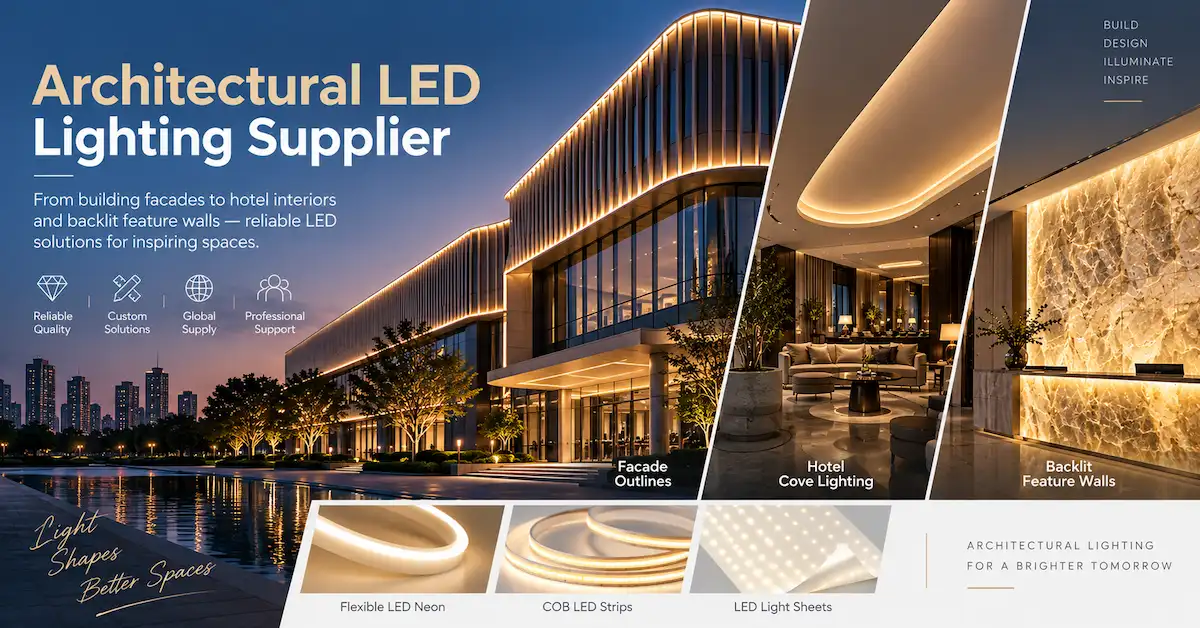
An architectural lighting design may look seamless on a rendering, but the final result depends on dozens of decisions that are difficult to see in the drawing. A facade outline needs a continuous visible light line, a hotel ceiling requires comfortable indirect illumination, and a translucent stone wall needs evenly distributed backlighting. All three may use LEDs, yet they require different products, mounting methods, electrical layouts, and acceptance criteria.
For lighting contractors, architectural firms, commercial interior manufacturers, and importers, selecting an architectural LED lighting supplier means finding a manufacturer whose products match these different requirements—and whose specifications can be verified before installation.
The key purchasing principle is to specify architectural LED lighting by application zone, optical performance, electrical configuration, environmental conditions, and maintenance requirements—not by wattage or price per meter alone.
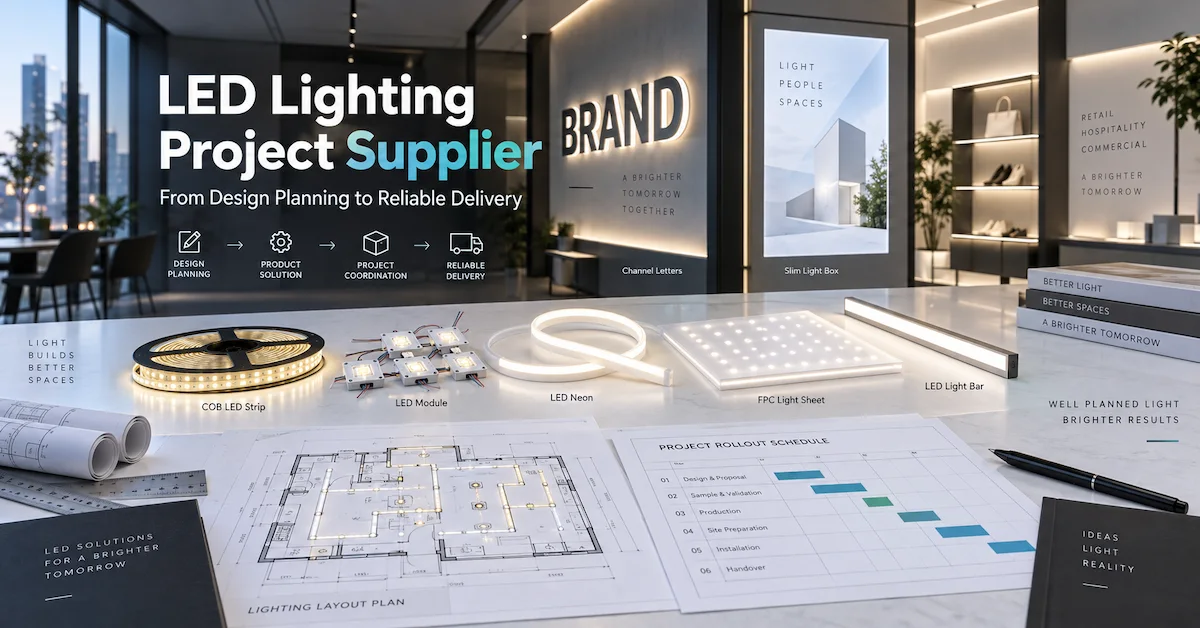
YESUN LED, a Shenzhen-based manufacturer specializing in signage and commercial LED lighting, offers relevant product families including flexible LED neon strips, COB LED strips, LED light sheets, and LED power and control accessories. These products can support architectural outlines, interior features, illuminated surfaces, and commercial decorative lighting when selected for the actual installation conditions.
This guide explains how to build a project-specific lighting specification, compare suitable technologies, evaluate supplier documentation, and request a technically useful quotation.
What Should an Architectural LED Lighting Supplier Provide?
An architectural LED lighting supplier should provide more than lighting components with attractive sample photographs. Professional buyers need sufficient technical information to determine whether a particular product can produce the intended visual effect, operate within the electrical system, withstand its installation environment, and remain serviceable.
For component-based decorative and architectural projects, the supplier evaluation should cover five areas: product suitability, optical and electrical characteristics, environmental protection, customization feasibility, and batch-to-batch consistency.
Different buyers will emphasize different outcomes. A facade contractor may prioritize IP protection, cable routing, mechanical fixing, and safe maintenance access. A hotel fit-out company may care more about warm-white consistency, dimming, reflected light quality, and concealed installation. A lighting distributor needs clearly identified SKUs, documented variants, and predictable replacement compatibility.
However, a specialist LED component manufacturer is not automatically a full-service architectural lighting designer or electrical installation contractor. Projects requiring complete illumination calculations, building-wide lighting controls, emergency systems, structural design, or statutory approvals should assign those responsibilities to appropriately qualified professionals.
That distinction helps avoid a common procurement mistake: assuming that purchasing the LED product includes the complete engineering scope.
Match the LED Technology to the Architectural Application
The first step is to divide a building project into lighting zones and define the required result for each one.
|
Architectural application |
Suitable LED technology to evaluate |
Primary selection criteria |
|---|---|---|
|
Exterior facade outlines and entrance canopies |
Silicone LED neon strips |
Profile shape, bending direction, weather protection, mounting |
|
Hotel ceilings and concealed coves |
COB LED strips, tunable-white strips |
Smooth reflected illumination, CCT, dimming, heat dissipation |
|
Visible curved interior features |
Semi-circular LED neon |
Beam distribution, profile size, bending limits |
|
Translucent stone and feature walls |
Flexible LED light sheets |
Light uniformity, panel transmission, cavity depth |
|
Retail architectural detailing |
COB strips, flexible neon |
Color quality, visible light line, fixture integration |
|
Decorative RGB architectural features |
RGB/RGBW strips or compatible neon systems |
Controller compatibility, color consistency, electrical zoning |
These are application-based product-selection recommendations, not claims that every model is suitable for every environment.
A successful lighting design might combine three technologies within one building. Silicone neon can outline the exterior entrance, COB strips can illuminate the interior ceiling coves, and LED light sheets can backlight a decorative wall behind the reception desk.
Attempting to use a single LED strip everywhere may initially simplify purchasing, but it can create optical, installation, and maintenance compromises.
Architectural LED Lighting Product Comparison: Real Options from YESUN LED
Before selecting an architectural lighting product, procurement teams should compare actual manufacturer specifications instead of assuming that all flexible LED products deliver similar performance.
The following products illustrate different technologies available from YESUN.
|
Product and model |
Published characteristics |
Architectural application to evaluate |
|---|---|---|
|
6 × 12 mm profile, 10 W/m, IP67 |
Facade contours, entrance outlines, architectural edging |
|
|
12V/24V variants, 15 × 13 mm, 7.2 W/m, IP65 |
Visible curved features, interior contours, protected exterior accents |
|
|
DC24V, 608 LEDs/m, 2700–6500K, 26.3 mm cutting unit |
Hotel coves, indirect architectural lighting |
|
|
DC12V, 200 SMD2835 LEDs/sheet, published 2000 lm/sheet |
Translucent stone, backlit feature walls, architectural panels |
These specifications come from the manufacturer's published listings and apply to the indicated models or variants. Final dimensions, environmental ratings, optical performance, permitted connection lengths, and availability should be reconfirmed against the latest product datasheets before purchase.
How should buyers interpret these differences?
The LED neon products are primarily suitable for creating visible illuminated lines. COB strips can provide a relatively continuous source for indirect illumination. LED light sheets distribute light over a wider area, making them worth evaluating behind translucent surfaces.
None of these products is automatically interchangeable with a complete architectural luminaire. A project calling for high-output facade floodlighting, roadway illumination, emergency lighting, or precision wall washing may require different fixture categories and photometric documentation.
This distinction is particularly important when choosing an architectural LED lighting supplier China buyers can rely on for repeat orders: the supplier's actual product specialization must match the project brief.
1. Exterior Facade Lighting: Design for Weather, Geometry, and Maintenance
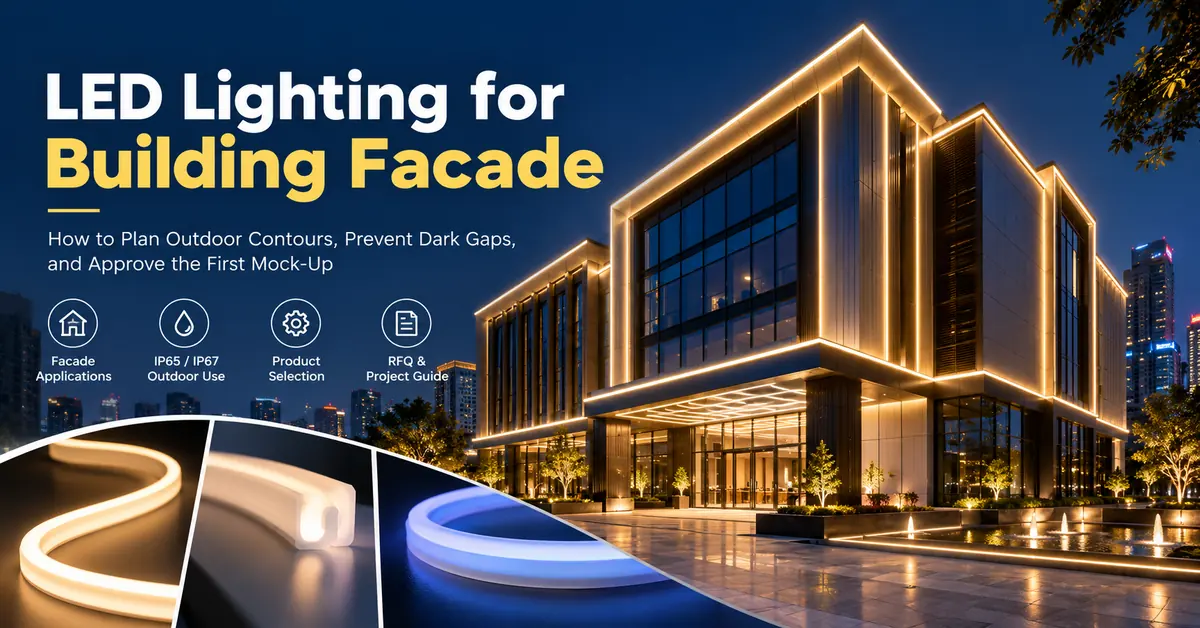
Architectural facade contour lighting highlights structural lines rather than simply illuminating a large surface. Typical applications include entrance canopies, roof edges, columns, decorative frames, and commercial building outlines.
For these applications, flexible LED neon can provide a visible illuminated profile that follows the geometry of the building.
Select the correct emitting profile
A light strip's width and height determine how it appears both during the day and when illuminated at night. Its emitting direction and permitted bending direction determine whether it can follow a curved detail without mechanical stress.
Before approving a profile, compare the architectural drawing with an actual cross-sectional product drawing. Check corner transitions, termination points, joint positions, mounting channels, and cable exits.
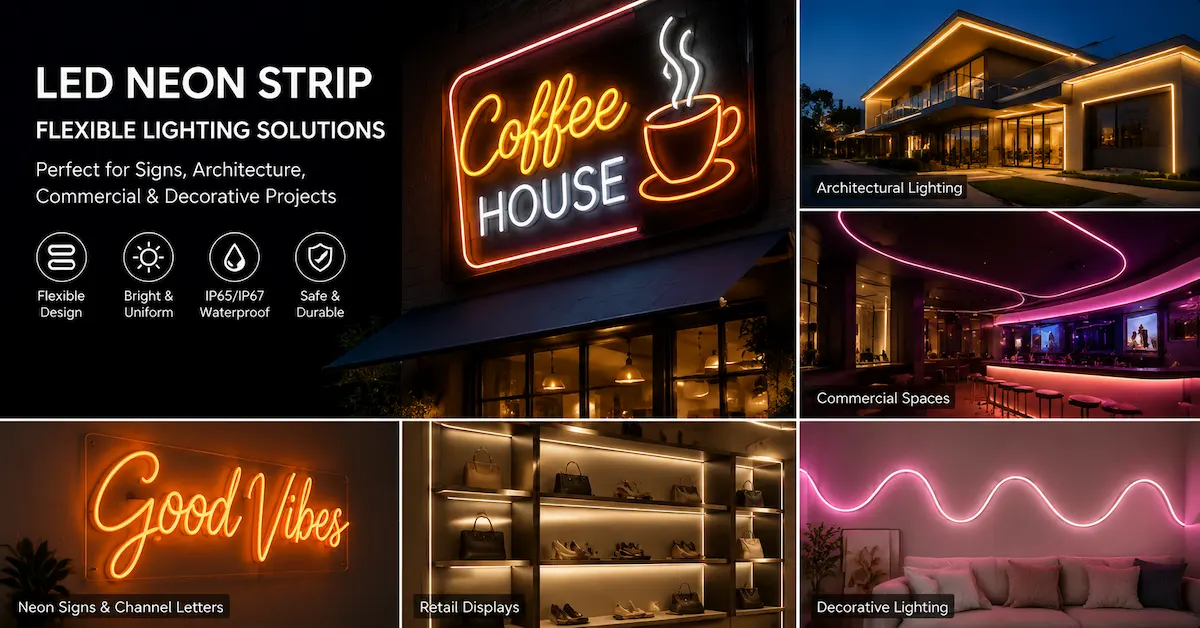
YESUN's Neon Art series includes compact profiles intended for applications such as facade accents and decorative building outlines. Buyers can review the LED neon strip product range when preparing a facade lighting specification.
IP protection is not a complete installation guarantee
An LED product may have an advertised IP65 or IP67 rating, but the finished installation also includes cut ends, connectors, wiring entries, junction boxes, and power supplies.
A practical approval process should verify the rating and test scope of the exact configuration being supplied.
For exposed projects, also consider ultraviolet exposure, accumulated moisture, temperature changes, potential corrosion, cleaning practices, and mechanical movement. These requirements cannot be established from an IP number alone.
Plan maintenance before the facade is completed
Lighting installed above entrances or at elevated positions may be expensive to access later.
The installer should identify removable sections, driver access points, cable replacement routes, and compatible spare parts before the building envelope is closed.
A slightly higher component price can be justified if it reduces difficult future maintenance—but that benefit must be assessed against the actual project design.
2. Hotel and Commercial Interior Lighting: Evaluate Light Quality, Not Just Brightness
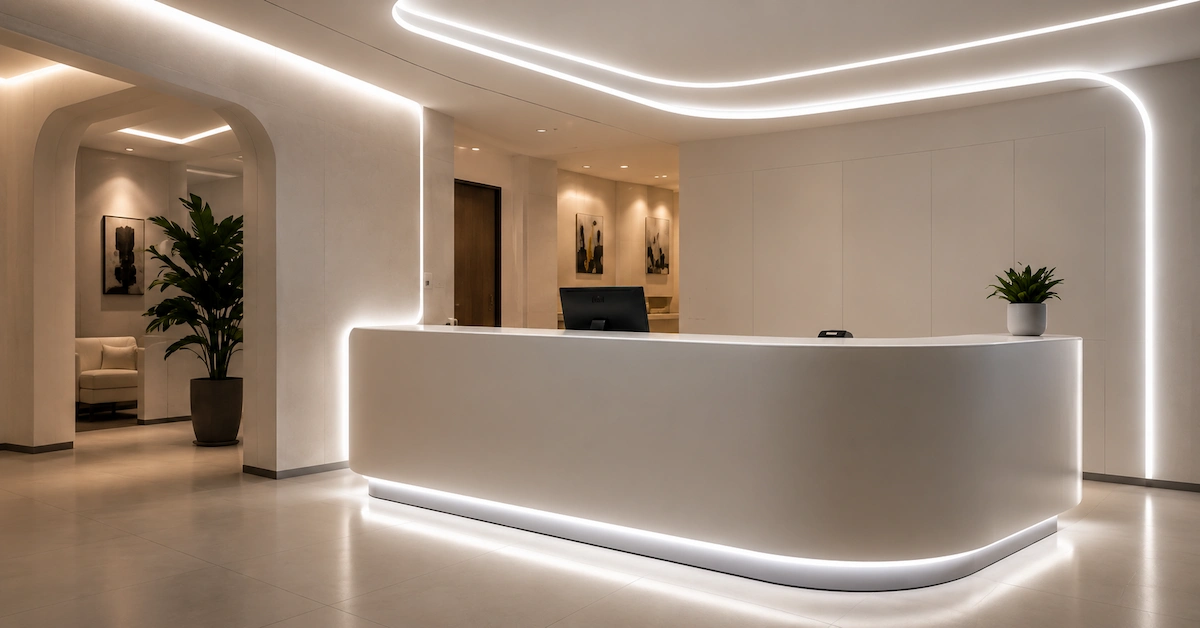
In hospitality and premium retail spaces, architectural lighting often serves an atmospheric purpose. The objective is not always maximum light output; it may be a comfortable ceiling glow, consistent warm-white appearance, or an illuminated contour integrated into the interior design.
COB LED strips for concealed cove lighting
COB LED strips can be useful where closely spaced light sources create a smooth-looking line, especially when compared with some conventional exposed SMD strip arrangements.
For indirect lighting, however, the final appearance also depends on the distance between the light source and the reflecting surface, cove geometry, surface finish, and visibility of the strip.
YESUN's 24V CCT-adjustable COB LED strip offers a published adjustable color-temperature range of 2700K to 6500K, making it a candidate for interiors requiring different white-light settings.
The appropriate color temperature should be chosen from project mockups rather than assuming that one setting suits every hospitality space.
Color consistency and dimming
Architects and hotel operators should define the target correlated color temperature (CCT), acceptable color variation, color rendering requirements, and dimming behavior.
An acceptable sample is not enough if later production batches have visibly different white tones.
Buyers should therefore request the manufacturer's available color-consistency data and confirm whether the selected power supply and controller can provide the intended dimming behavior.
For example, a hotel reception may need a brighter daytime appearance and a softer evening setting. That requires a coordinated LED-and-control system, not merely a strip described as dimmable.
Visible architectural contours
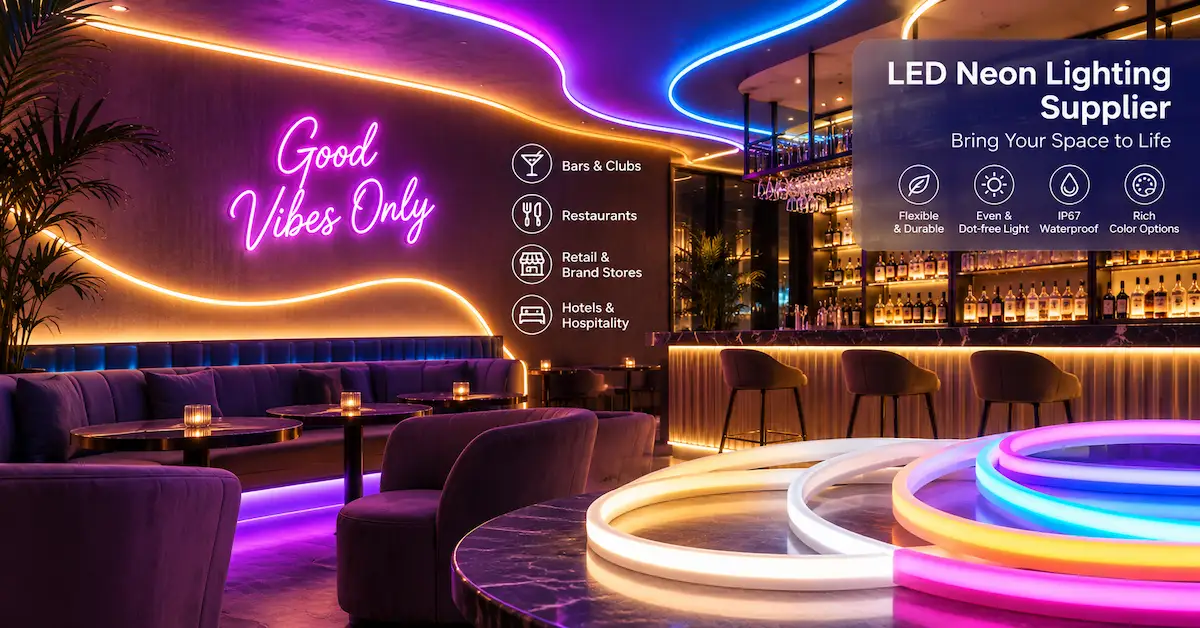
Where the lighting itself is intended to be visible, a flexible neon profile may create a more deliberate architectural line than an exposed bare COB tape.
YESUN's semi-circular LED neon strip provides a published 180-degree light distribution and a 15 × 13 mm body. Its suitability should still be checked against the actual viewing angles, permitted bending directions, and mounting structure.
3. Backlit Architectural Feature Walls: Control Uniformity Before Bulk Ordering
Backlit stone, translucent decorative panels, and illuminated reception walls introduce a different technical challenge.
Instead of lighting a narrow line, the system must distribute light across a surface whose optical behavior depends on material thickness, color, translucency, and internal structure.
A bright LED product does not necessarily produce a visually uniform wall.
Why flexible LED light sheets are worth evaluating
A flexible LED light sheet places multiple LEDs across a relatively broad circuit area. This architecture can simplify distributed backlighting compared with assembling many individual strips, depending on panel geometry and cavity depth.
YESUN's YS-F801-3200-10-W 12V LED light sheet is a relevant product example for architectural panels and premium backlit surfaces.
However, published LED-sheet lumens describe the product's light output—not the final transmitted light through a particular stone slab.
Two pieces of stone with different thicknesses or internal patterns can produce noticeably different results using the same lighting arrangement.
Prototype the complete illuminated panel
A technical sample should use the actual panel material, proposed cavity depth, LED layout, supporting structure, and intended viewing position.
Inspect the illuminated surface for hotspots, dark borders, color variation, visible joints, and uneven transmission. Also evaluate thermal conditions and access for repair.
For large walls, confirm permitted sheet cutting, wiring layout, electrical zones, and replacement method. A small sample should represent the real construction closely enough to support a purchasing decision.
This is especially important for projects using costly decorative stone or panels that cannot be easily removed after installation.
4. Electrical Engineering: Treat Each Architectural Lighting Zone as a System
An architectural LED lighting supplier should provide enough electrical data for the contractor or qualified designer to build a compatible system.
At minimum, buyers need the actual operating voltage, power consumption, connection limits, wiring configuration, control requirements, and relevant installation guidance.
Calculate connected load before selecting drivers
For a constant-power-per-meter product, a preliminary connected-load estimate is:
For example, a hypothetical 30-meter installation using a product rated at 10 W/m has a nominal connected load of 300 W.
This does not mean that the entire 30-meter installation can be powered through one continuous strip connection or one feed point.
Actual design still depends on the manufacturer's maximum permitted run length, conductor capacity, voltage drop, ambient temperature, driver rating, and power-feed positions.
Why electrical zoning matters
A building outline may appear visually continuous while consisting of several independently powered electrical sections.
This allows the design team to evaluate cable lengths, current loading, driver access, and maintenance boundaries without sacrificing the intended visual effect.
For DC systems, cable resistance can cause voltage drop, which may affect brightness or color behavior toward the end of a run. A larger power supply alone does not resolve inappropriate wiring.
Coordinate controls with the LED configuration
Single-color, tunable-white, RGB, RGBW, and addressable products have different control requirements.
A controller suitable for conventional RGB strips is not necessarily compatible with digitally addressable lighting. Likewise, support for a particular building-control protocol should never be assumed from the term "dimmable."
YESUN lists LED controllers and LED power supplies among its accessories. Buyers should confirm exact compatibility, load limits, electrical interfaces, and required control protocols for the selected models.
5. Evaluate Supplier Quality Control and Technical Documentation
A professional buyer needs verifiable documentation, especially when lighting products will be installed in multiple buildings or purchased repeatedly.
|
Evaluation area |
What procurement teams should request |
|---|---|
|
Electrical characteristics |
Voltage, current, power, tolerances, connection limits |
|
Optical performance |
Luminous flux, CCT, CRI, available color-consistency data |
|
Mechanical characteristics |
Dimensions, minimum bend requirements, mounting details |
|
Environmental performance |
IP test scope, operating temperature, installation restrictions |
|
Thermal performance |
Relevant operating-temperature information and installation guidance |
|
Production consistency |
Model identification, approved samples, specification revisions |
|
Compliance |
Applicable certificates and test reports for the exact product and market |
|
After-sales support |
Warranty terms, replacement procedure, compatible spare models |
Verify certifications by product and destination
Compliance requirements depend on the destination country, electrical configuration, product category, and installation.
For example, buyers may need to review applicable IEC/EN or North American electrical-safety requirements, environmental documentation, and relevant photometric test information.
The correct question is not whether a factory has ever obtained a particular certificate. It is whether valid documents cover the exact model and configuration being ordered.
Similarly, IP ratings describe specific protection characteristics under defined conditions; they do not establish every aspect of electrical safety or project suitability.
Approve a physical sample
The most useful sample evaluation reproduces actual installation conditions.
Record its model, voltage, power, CCT or color, dimensions, optical appearance, operating behavior, and any observed limitations. Where required, ask the supplier for supporting test reports.
An approved sample should become a controlled reference for subsequent production—not merely a promotional demonstration.
6. Compare Total Installed Cost, Not Only Factory Price
Wholesale architectural LED lighting quotations can differ because products use different materials, protection methods, PCB structures, accessories, packaging, and customization requirements.
Price per meter is therefore an incomplete comparison.
A more useful purchasing analysis is:
Total installed cost = LED products + power and controls + mounting and wiring + installation + testing + expected maintenance provisions.
A lower-priced strip may require more field connections or complicated installation. Another product may cost more initially but fit the required mounting profile more easily.
Neither option is automatically more economical without comparing the complete installation.
Other commercial variables include sample costs, custom tooling where applicable, order quantities, destination freight, import charges, spare-parts allowances, and future replacement compatibility.
For distributors and multi-site project buyers, repeated orders also create inventory risks. Different PCB widths, connector arrangements, CCT variants, or model revisions may complicate replacement unless product specifications are controlled.
Ask each supplier to quote an equivalent technical scope before comparing prices.
7. How to Request an Accurate Architectural LED Lighting Quotation
A detailed RFQ helps the manufacturer recommend products suited to the project and reduces the chance of quoting an unsuitable standard item.
|
RFQ information |
Details to provide |
|---|---|
|
Project description |
Hotel, facade, retail interior, backlit wall, commercial renovation |
|
Architectural drawings |
Dimensions, sections, installation photos, lighting-zone layout |
|
Optical requirements |
Color, CCT, brightness targets, appearance, dimming |
|
Electrical requirements |
Voltage, estimated lengths, wiring, control system |
|
Environmental conditions |
Indoor/outdoor, moisture, exposure, operating environment |
|
Physical integration |
Profile dimensions, bends, mounting, cable exits, panel depth |
|
Purchasing requirements |
Quantities, trial order, planned repeat orders, destination |
|
Required documents |
Product datasheets, applicable test reports, packaging details |
For custom architectural LED lighting, the approval process should proceed from technical clarification to product selection, then representative sampling, final specification approval, and production release.
Do not confirm a large order until both parties agree on the product model, approved variant, acceptance criteria, documentation, and delivery terms.
Reducing procurement risk through a controlled sample
Before bulk production, record what was accepted and what remains conditional.
A sample may be accepted for visual color but still require confirmation of mounting accessories, environmental sealing, electrical compatibility, or packaging.
This prevents a common problem in project purchasing: different teams assuming that one sample approval covers every technical requirement.
8. Why Consider YESUN LED for Architectural Accent Lighting Components?
YESUN LED is a China-based manufacturer established in 2013, with a portfolio focused on LED signage and commercial lighting products.
Its architectural project relevance lies particularly in flexible neon contours, COB linear lighting, illuminated display surfaces, and associated electrical accessories.
These product families may serve lighting contractors, commercial interior specialists, advertising and display manufacturers, importers, and lighting distributors looking for component-based solutions.
YESUN also describes OEM/ODM and technical customization support. Project buyers can discuss such requirements as selected product dimensions, light colors, cable configurations, and other specification changes, subject to engineering feasibility and commercial confirmation.
For specialized applications, procurement teams should use actual product documentation and sample testing to determine suitability rather than treating a broad manufacturer capability statement as a product-level guarantee.
Planning a facade, hotel, retail, or architectural backlighting project? Review the YESUN commercial LED lighting product range and contact YESUN for a technical quotation with your drawings, application conditions, and target quantities.
Frequently Asked Questions
1. What products should an architectural LED lighting supplier offer?
For component-based decorative projects, useful categories include LED neon strips for visible contours, COB strips for linear and cove lighting, LED light sheets for broad-area backlighting, and compatible power supplies and controllers. Other architectural applications may require complete luminaires or specialist fixtures beyond these categories.
2. Which LED lighting is suitable for exterior building outlines?
Flexible silicone LED neon is one option for exterior contour lighting, provided the exact product has appropriate environmental characteristics and can be installed according to its technical requirements. Buyers must consider mounting, bending direction, cable entries, sealing, temperature, and maintenance access—not simply the advertised IP rating.
3. Is COB LED strip better than flexible neon for hotel interiors?
It depends on the intended effect. COB strips are often worth evaluating for concealed coves and reflected lighting, while flexible neon may be more suitable when the light line itself is visible. The final choice depends on profile geometry, viewing angles, light quality, dimming requirements, and the installation environment.
4. Can LED light sheets be used behind translucent stone walls?
Yes, suitable LED light sheets can be evaluated for translucent stone and architectural panels. However, uniformity depends on the actual stone, cavity depth, sheet layout, optical behavior, and heat management. A full-construction sample is recommended before bulk purchasing.
5. Can architectural LED lighting products be customized?
Manufacturers may support project-specific lengths, colors, cables, connectors, mounting arrangements, or other product modifications. Customization must be reviewed for technical feasibility, testing implications, minimum quantities, tooling requirements, and production schedules.
6. What should buyers send to an architectural LED lighting supplier before requesting prices?
Provide architectural drawings, lighting zones, intended visual effects, required quantities, voltage and control requirements, environmental conditions, destination market, and requested technical documentation. More complete information allows suppliers to propose a meaningful product configuration and quotation.
Conclusion
Selecting an architectural LED lighting supplier requires matching each building zone to the right lighting technology, installation method, and electrical specification. Facade outlines, hotel coves, and backlit feature walls have different optical, environmental, and maintenance requirements, so one generic LED product rarely suits every application.
For dependable project procurement, prioritize verified product specifications, representative samples, compatible electrical components, documented quality requirements, and total installed cost.
Explore YESUN LED's lighting solutions and submit your architectural lighting requirements to discuss suitable products, customization options, and a project-specific quotation.