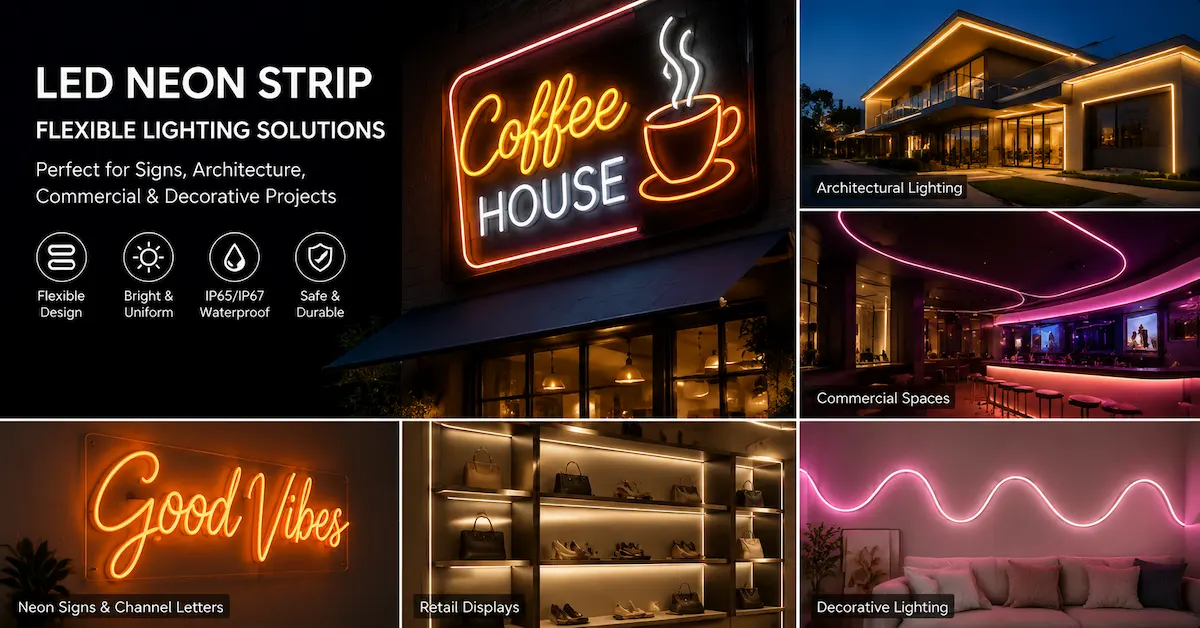


What Does an LED Lighting Project Supplier Actually Deliver?
An LED lighting project supplier helps a professional buyer convert an installation requirement into a reproducible lighting system. The deliverable is not merely a carton of modules or reels of strip. It is an agreed combination of suitable components, electrical compatibility, optical performance, drawings or layout guidance where available, sample evidence, controlled production specifications, and a delivery plan that fits the project.
That distinction matters when a lighting decision affects more than one sign or display. A hotel renovation, a retail-chain rebrand, or a commercial light-box rollout may involve several sizes, multiple installation teams, phased construction, and replacement stock. One wrong cable direction can delay installation; one unapproved LED substitution can make adjacent signs look different; one misunderstood power input can require on-site rework.
The best supplier relationship begins with a clear division of responsibility. A component manufacturer can recommend products, support customization, and provide technical documentation. The project designer or qualified electrical contractor remains responsible for design approval, applicable installation rules, and site-specific electrical work unless an agreement expressly assigns additional tasks to the supplier. Do not assume that a factory offering “project solutions” is also providing a turnkey engineering, procurement, and construction contract.
For signage and commercial-display projects, YESUN's product portfolio combines LED modules, standard and COB strips, FPC light sheets, light bars, neon products, controllers, power supplies, and other accessories. Its resources center also describes technical consultation, product-selection support, and project design optimization. These are relevant capabilities to evaluate when the project involves customized illuminated signs, light boxes, retail displays, or decorative commercial lighting.
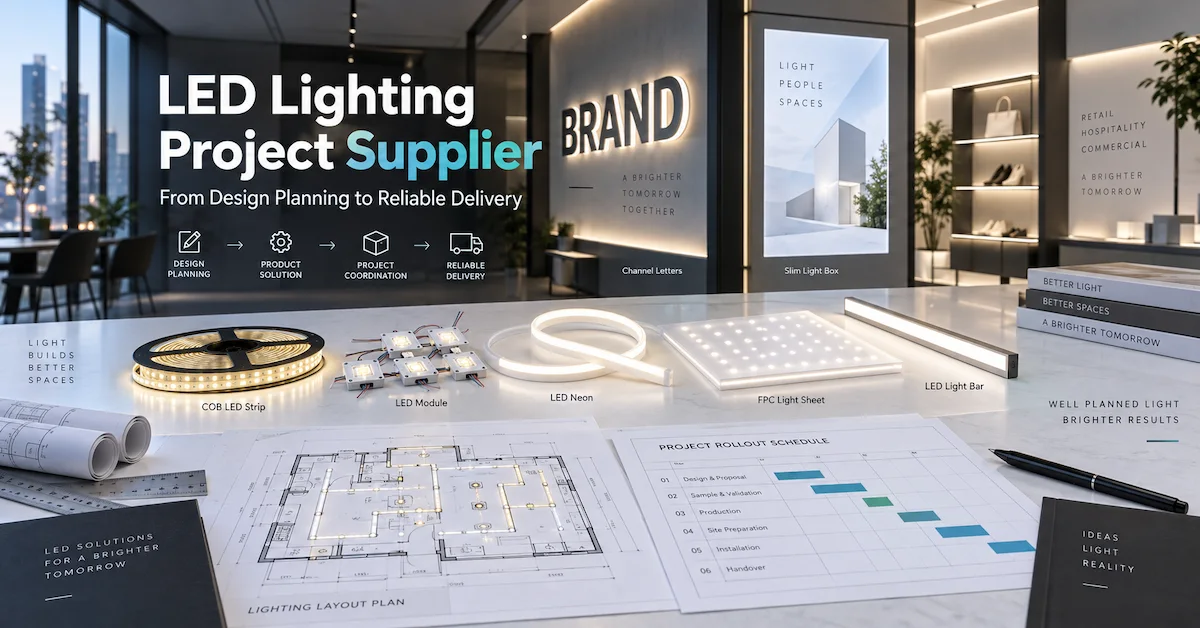
The Ten Questions a Project Buyer Should Answer Before Asking for a Price
A request for “the best LED and your lowest price” cannot produce an engineering-ready quotation. Ten questions are more useful:
-
What is being illuminated? A channel letter, graphic light box, stone panel, retail shelf, neon outline, or a mix of these?
-
What does the structure permit? What are the true internal dimensions, depth, mounting surfaces, and service openings?
-
What should the observer see? Uniform backlighting, a continuous visible line, a particular CCT, accurate merchandise colors, or programmable effects?
-
Where will it operate? Indoor, humid, sheltered outdoor, fully exposed outdoor, or another demanding environment?
-
What electrical infrastructure exists? Available input power, driver locations, maximum cable routes, switching, dimming, and control requirements?
-
What are the required approvals? Which destination market, customer specification, or project documents apply to the actual configured product?
-
Who fabricates and installs the assembly? Is the buyer purchasing loose components, a prewired kit, or a finished slim light box?
-
How many sites and phases are involved? Are shipments needed at once, by store, by region, or against construction milestones?
-
How will approval be measured? What must a physical prototype and production batch pass before release?
-
What happens after handover? Who keeps spare parts, controls drawing revisions, handles failure reports, and supports repeat orders?
Answers to these questions establish the project scope. They also help identify projects that do not fit a particular supplier. A client seeking full building-wide lighting design, site wiring, commissioning, and installation should appoint qualified design and installation partners; a specialized LED component manufacturer can support the product portion without taking over responsibilities outside its agreed scope.
Match the Lighting Architecture to Each Project Zone
Commercial projects seldom consist of a single lighting condition. A new store may combine exterior channel letters, a menu light box, illuminated shelving, a decorative neon logo, and a graphic feature wall. Treating all of these as one “LED strip order” is a common source of specification errors.
| Project zone | Lighting family to evaluate | Primary design consideration | When another option may be better |
|---|---|---|---|
| Exterior channel letters | LED modules | Letter depth, lens distribution, spacing, sealing | Very narrow strokes may need mini modules |
| Shallow branded panels | FPC LED light sheets | Distributed illumination and limited cavity depth | Deeper standard cabinets may suit modules or bars |
| Large advertising light boxes | LED light bars | Fast installation and broad-area coverage | Irregular cabinets may need modular layouts |
| Continuous shelf or profile lighting | LED strips or COB | Linear uniformity, conductor loading, thermal contact | Large area backlighting needs a different architecture |
| Visible flexible logos | LED neon strips | Bend direction, diffusion, mounting, end sealing | Hidden backlighting usually does not need neon |
| Standard restaurant menu display | Slim light boxes | Finished dimensions, graphic access, mounting | Bespoke cabinet construction may need component supply |
| Tunable or multicolor zone | LED plus compatible controllers | Channel count, signal behavior, interface | Static white applications may not need added controls |
This table is a shortlist, not a substitute for validation. A light sheet will not automatically eliminate hotspots in every thin panel, and a wide-angle module is not guaranteed to provide uniformity in every letter. The face material, reflective cavity, actual LED spacing, and viewing conditions change the result.
A project supplier adds value by explaining why a product family fits a particular structure and identifying what should be tested before the bill of materials is frozen.
Where finished products beat loose components
If a restaurant operator needs standardized indoor menu frames, a finished display can reduce the number of separately purchased parts. YESUN lists C-Series A2–A5 and E-Series slim light-box configurations for indoor display applications. Their published dimensions and electrical ratings can help establish a shortlist, but printed graphic dimensions, mounting hardware, replaceable faces, and the electrical package must be confirmed on the selected model.
When a signage factory already fabricates metal cabinets, buying a complete light box may be unnecessary. A supplier that can provide the correct modules, sheets, bars, power supplies, and layout advice may be more useful than one offering only a finished frame.
Optical Engineering: Define the Appearance Before Counting LEDs
A frequent project failure begins with choosing LEDs by luminous flux alone. Lumens describe emitted light, not whether a translucent advertising face will look uniform from its intended viewing position. A high-output source may produce visible bright spots when installed too close to the diffuser. Increasing power can make that defect more obvious.
A supplier should ask for cabinet depth, graphic material, sign-face color, internal reflectivity, and the brightness target. Beam angle and source spacing then become engineering variables. A 160° or 175° lens may help distribute light broadly in an appropriate cabinet, while a directional side-lighting arrangement may be more useful when the light source must be positioned along an edge.
YESUN's published module listings illustrate the range of available approaches. For example, YS-MD1311 is presented as a compact SMD2835 module with a 160° viewing angle and 0.4 W rated power, while YS-M78931 is listed as a 2.2 W, three-LED SMD2835 option with a 170° viewing angle. Those are catalog specifications, not a recommendation to exchange one for the other without checking geometry and power distribution.
For premium store displays, color quality becomes another variable. CCT consistency is important across adjacent graphics and repeat store installations. CRI is particularly relevant when the lighting changes the appearance of merchandise or finishes. An illuminated colored acrylic face and a shelf displaying cosmetics do not necessarily need identical color-rendering requirements.
A good sample test records the actual diffuser, the LED-to-face distance, the spacing, the supply voltage, and the viewing environment. A photograph without those conditions is useful for communication, but it is weak evidence of repeatable performance.
Electrical Design: A Lighting Kit Is a Circuit, Not a Shopping List
The electrical part of a project can be undermined by one incompatible component. A 24 V strip cannot be assumed to work with a 12 V supply. A multichannel RGBW installation cannot be designed around an ordinary single-color dimmer. And a power supply with ample rated wattage cannot compensate for excessive voltage drop along undersized cables.
The project specification should identify the operating voltage of every lighting family, installed wattage, maximum supported run or cascade length, cable routes, driver location, switching, dimming, and any control interface. Long runs may require sectional feeding or additional injection points. Where loads are divided across several drivers, commissioning drawings should show which driver supplies which zone.
Illustrative power calculation: suppose a 24 V linear zone contains 18 meters of a hypothetical 9.6 W/m strip. The nominal connected load is 18 × 9.6 = 172.8 W, before considering supply and wiring conditions. Dividing that by 24 V gives a nominal total of 7.2 A. This arithmetic does not establish that a single 18-meter feed is allowed. The manufacturer's permitted run length, voltage-drop behavior, cable capacity, power-injection layout, operating temperature, and driver rating must still be checked. The example is a design calculation, not a YESUN product specification.
YESUN lists 12 V and 24 V power-supply options, including waterproof and dimmable product families. The correct driver should be chosen after the installed load and electrical arrangement are established. For a large mixed project, request a power-zone schedule as well as the component quotation.
Decide control requirements before ordering light sources
Tunable white, RGB, RGBW, and addressable products can require different channel counts or signal designs. The controller must match the LED technology, voltage, and total load. A store group also needs a practical method for reproducing the same preset or color scene at different locations. When several fixtures must change together, synchronization and control-cable routing belong in the early project plan.
Do not specify dynamic effects because they look attractive in a product video if the final client only needs stable white illumination. Unnecessary control complexity adds installation steps, training, and future replacement requirements.
Environmental Protection and Maintenance Access Are Design Inputs
A lighting supplier needs to understand the final installed environment. An indoor display cabinet, a humid entrance canopy, and an exposed external sign have different requirements for materials, sealing, connections, and power supplies.
The IEC 60529 IP code concerns degrees of protection provided by enclosures. It is useful when discussing water and dust ingress, but the IP marking of an LED module does not establish the weatherproof integrity of the assembled sign. Cable joints, field-cut strip ends, entry glands, drivers, drain paths, and the cabinet itself all require attention. UV exposure and temperature cycling introduce additional considerations that an IP figure alone does not describe.
Maintenance access should be settled before the lighting layout is approved. Can a driver be replaced without removing the finished sign face? Can a neon segment be serviced without damaging adjacent work? Are product labels legible after installation? Is a spare module compatible with the approved CCT and revision?
These questions become particularly important in airports, shopping centers, hospitality locations, and high-level signage where returning to the site may require special access equipment. For such projects, a removable access panel or carefully located driver may have greater commercial value than a small saving on component price.
Define the Supplier's Deliverables at Each Project Gate
A project purchase becomes much easier to manage when every phase has an agreed output and an approval owner. The following is a recommended project-control workflow, not a claim that YESUN automatically contracts for every listed engineering or site service.
| Gate | Information supplied by the buyer or project team | Supplier deliverable to request | Approval owner |
|---|---|---|---|
| 1. Project brief | Drawings, application, environment, quantity, destination | Product-family shortlist and open questions | Buyer/project designer |
| 2. Concept proposal | Visual targets, dimensional limits, controls | Proposed lighting architecture and preliminary assumptions | Project designer |
| 3. Detailed specification | Final cabinet drawings and electrical constraints | Model list, power requirements, layout guidance, preliminary BOM | Designer/qualified contractor |
| 4. Prototype | Representative sign construction and graphic | Physical sample, technical data, agreed test evidence | Buyer/brand owner |
| 5. Design freeze | Approved sample and redlined drawings | Controlled revision, final BOM, packaging definition | Buyer/procurement |
| 6. Production release | Purchase order and delivery schedule | Confirmed quantities, production and QC plan | Supplier and buyer |
| 7. Pre-shipment | Acceptance checklist and ship-to data | Inspection records, carton identifiers, shipment paperwork | Buyer/inspection team |
| 8. Installation and handover | Site program and electrical sign-off | Agreed product support, spares, replacement information | Installing contractor/client |
A phase gate should not be bypassed just because one person considers the design “basically approved.” If the cabinet depth changes, the layout may need retesting. If a driver is replaced with another model, electrical or regulatory implications may require review. Every drawing and BOM should carry a revision number so old versions do not continue circulating.
Three documents worth keeping together
The strongest project handover records include a lighting layout, a controlled bill of materials, and an acceptance checklist. The layout shows where the components go; the BOM states exactly what is ordered; the checklist describes how the result will be judged. Without all three, different people may be working toward different definitions of completion.
Prototype Acceptance: What Should Buyers Actually Test?
A sample that turns on is not necessarily an approved sample. A professional project should evaluate the product within a representative structure whenever practical. This is especially important for translucent surfaces, narrow letters, very shallow panels, and custom neon shapes.
The acceptance plan should identify which observations are visual and which require instruments. A project engineer may measure electrical input and power, while a brand owner approves the visible appearance. For luminous signage, luminance or surface-uniformity checks may be more relevant to the illuminated face than a simple work-plane illuminance reading. Measurement points, operating conditions, equipment, and acceptable tolerances should be defined before testing rather than invented after a complaint.
The Illuminating Engineering Society's ANSI/IES LM-79-24 describes standardized optical and electrical measurements for solid-state lighting products within its scope. It is a relevant reference when evaluating appropriate laboratory photometric evidence; it is not a blanket certificate that every individual strip or signage component has been tested under that method.
A useful project acceptance record can cover:
-
Color/CCT against the approved reference;
-
visual uniformity, edge shadows, and hotspot appearance;
-
rated voltage, operating current, and power;
-
controller and dimming functionality where applicable;
-
mechanical fit, mounting, cable exit, and connector access;
-
waterproof construction and documented scope when required;
-
identification labels and compatibility with the approved drawing;
-
graphic replacement and service procedure for finished displays.
Photographs should use repeatable camera conditions if they will be compared later. Automatic exposure can make two different lighting levels look similar. Record the diffuser type, ambient light, supply setting, and viewing distance alongside images.
When the sample passes, preserve its specification and, where feasible, a physical golden sample. These become references for future batches and replacement orders.
Multi-Site Rollouts Need a Different Supply Plan
A single custom sign and a 120-store rebrand may use the same LED technology but require very different procurement management. For multiple locations, success depends on preparing consistent site kits and delivering the right configuration at the right time.
Consider a hypothetical project with 120 retail locations across three regions. Each store needs exterior channel-letter modules, one indoor menu display, and shelf lighting. It would be risky to issue a single undifferentiated bulk order without first sorting store types and installation dates.
A better plan groups locations by approved configuration: Store Type A, B, and C may have different sign dimensions, driver placements, or cable lengths. Each kit carries its location code, item list, voltage, revision, installation notes, and spare-parts allocation. A staging or pilot phase confirms that installers understand the kit and that the packing sequence works before hundreds of cartons leave the factory.
This example does not represent a claimed YESUN customer project. It demonstrates a procurement method that can be used with a capable component supplier and a separate rollout contractor.
What phased delivery should include
Project buyers should confirm whether shipments will be released by region, construction phase, or warehouse availability. Each phase should have its own quantities, carton marks, approval status, planned dispatch date, and destination. If the buyer requests a partial shipment before all production is complete, decide how quality and document checks will be performed for that partial lot.
Unexpected changes should be tracked rather than buried in email. A revised store layout may affect light-source quantities and packing. A delayed installation may require adjusted storage or delivery arrangements. The supplier's ability to provide clear status information can be as important as quoted manufacturing capacity.
Kit Packaging, Labeling, and On-Site Installation Efficiency
Many lighting procurement problems surface only when installers open the cartons. Products may be electrically correct but packed in ways that increase labor: strips of several colors in one box, unmarked controllers, missing adapters, or cables that must be cut and remade on site.
For project orders, define packaging around installation sequence. One kit can contain the approved components for one sign or store, including identified modules or strips, connectors, controller where needed, the agreed driver, and an installation reference. Another approach groups identical components by trade or installation phase. Neither method is always best; the correct choice depends on how the contractor receives and stores materials.
Ask the supplier to approve sample carton labels and a packing-list template. Useful fields include project code, site identifier, product model, quantity, revision, voltage, carton number, and destination. Electrical labels and any legally required product markings should be reviewed separately rather than improvised as marketing stickers.
Installers also need a process for reporting shortages or damage with photographs, carton numbers, and affected-site details. A predictable reporting format makes replacements faster to identify and reduces disputes over whether a missing part was never shipped or lost after receipt.
Can the Manufacturer Support Both Standard Products and Custom OEM Work?
A project supplier should be assessed on its ability to repeat an approved configuration—not on its willingness to say yes to every proposed customization.
Standard catalog products usually simplify samples, documentation, replacement availability, and cost comparison. Custom work becomes valuable when it solves a genuine constraint, such as a narrow FPC, a shorter cable, a specific connector, a different bending direction, a fixed CCT target, or individually identified installation kits.
YESUN describes OEM/ODM support and project-oriented product adaptation in its company information. Requests may involve size, electrical specifications, brightness, color temperature, waterproof structure, and packaging, subject to feasibility for the selected product.
For custom designs, agree on the owner of drawings and tooling, change control, critical parts, sample costs, engineering schedule, and approval of substitutes. Also ask whether a modification changes the applicable test reports or market documentation. A private-label carton does not automatically make an altered electrical assembly compliant with the approvals associated with the original product.
The most useful customization is often invisible to the end customer: a better cable exit, a simpler bracket, a clearly identified connector, or a repeatable preassembled kit that reduces on-site rework.
Quality Control, Certifications, and Traceability for Project Orders
At factory level, buyers can ask about incoming inspection, SMT assembly, post-reflow checks, cable assembly, lighting tests, electrical inspection, aging tests, waterproof testing where applicable, and final shipment verification. YESUN's About Us page reports a Shenzhen operation founded in 2013, a currently stated 5,000 m² production base, six SMT lines, more than 100 employees, and over ten R&D engineers. The page also describes ERP-supported traceability and optical or environmental test equipment.
Those are useful company-level indicators, not evidence that a particular production slot has been reserved for a buyer's order. Ask for an order-specific production plan, inspection points, and capacity confirmation when the schedule is critical. Warranty claims should likewise be tied to the ordered model: company-level minimum terms and individual product listings may differ.
For overseas projects, certification review should happen at the specification stage. YESUN provides a certification resources page with documentation covering selected product families. A CE, UL, RoHS, UKCA, or IP reference must be matched to the actual product and configuration; the presence of a document on a manufacturer's website does not prove that every modified component or finished installation is covered.
A change to LED type, driver, enclosure, input voltage, cable, or waterproof construction may affect technical documentation. Capture approved model numbers, document references, and revision status in the procurement file. The project designer or importer should determine the compliance obligations for the final assembly and destination market.
Compare Suppliers by Project Readiness, Not Just Unit Price
An LED lighting project supplier should be able to answer project questions with documented proposals. A manufacturer may offer a lower price per module yet require more site wiring, an extra driver model, or frequent field modifications. Another may quote higher component prices but support a validated layout and preidentified kits.
Use a weighted comparison when evaluating competing proposals. The following is a suggested purchasing tool, not an industry certification or a rating assigned to any particular manufacturer.
| Evaluation area | Suggested weight | Evidence to request |
|---|---|---|
| Application and engineering fit | 25% | Layout assumptions, model suitability, sample results |
| Electrical and optical specification | 20% | Driver schedule, power zones, CCT/uniformity criteria |
| Factory quality and revision control | 20% | QC plan, golden sample, change-approval method |
| Phased delivery and packaging | 15% | Site labels, kit plan, realistic production schedule |
| Product documentation and compliance | 10% | Model-specific documents and destination review |
| Commercial and support terms | 10% | MOQ, warranty, claim workflow, spares, terms |
| Total | 100% | Mandatory criteria must pass before scoring |
A supplier scoring highly overall still should not be approved if it fails a mandatory voltage, certification, or installation constraint. Treat non-negotiable requirements as pass/fail and apply weighted scores only to technically qualified offers.
Total Project Cost: Include More Than the LED Line Item
The total cost of installed lighting includes component purchases, drivers, controls, connectors, packaging, freight, installation labor, testing, site access, rework, spares, and maintenance. For a project rollout, the expense of revisiting many locations can exceed the difference between two initial quotations.
Here is a simple illustrative comparison, not a YESUN quote. Assume two proposals for 80 identical displays. Proposal A saves $18 in components per display but requires an additional 25 minutes of wiring. At an assumed labor cost of $36 per hour, that wiring adds $15 per display, leaving only $3 before considering extra testing or service risk. Across 80 displays, the nominal remaining saving is $240. Small installation changes can therefore eliminate much of an apparent price advantage.
The assumptions must be replaced with actual contractor rates and verified installation times. A better project RFQ requests a full installed-system BOM or enough information to calculate one, rather than comparing incomplete material lines.
Risk allocation matters too. Agree who pays for expedited replacements, how freight damage is reported, whether spare parts are packed with the first delivery, what warranties exclude, and who approves substitutions. Commercial clarity protects both parties.
A Project RFQ That Makes Technical Review and Quotation Easier
A buyer who sends a complete project brief is more likely to receive a meaningful technical response than one who asks only for a price list. The initial submission does not need to be a finished engineering package, but it should reveal the variables that determine feasibility.
| RFQ field | Example of useful information |
|---|---|
| Application | Channel letters, single-sided light box, display shelf, neon logo |
| Drawings | CAD/PDF, photographs, cabinet sections, installation detail |
| Geometry | Width, height, internal depth, stroke width, cable-entry limits |
| Visual target | White CCT, RGB, dimming, surface appearance, brand consistency |
| Environment | Indoor, humidity, exposed outdoor, operating hours |
| Electrical | Input supply, driver locations, run lengths, control interface |
| Quantities | Prototype units, first batch, total rollout, spare allocation |
| Schedule | Sample date, pilot installation, phased delivery, final site deadline |
| Market | Destination countries, required model-specific documentation |
| Packaging | By SKU, sign, store, regional phase, carton marking |
| Commercial terms | Delivery point, payment and warranty expectations |
| Approval | Who signs off samples, drawings, inspection and site installation |
If the application includes multiple lighting zones, attach a schedule of those zones. Include photos of existing installations if the project replaces an older lighting system; they can reveal constraints absent from architectural drawings.
To begin a project evaluation, send your drawings, dimensions, required visual effect, voltage and control requirements, estimated quantities, destination market, and timeline through YESUN Contact Us. For preliminary product research, use the YESUN product categories and technical resources.
Frequently Asked Questions About LED Lighting Project Suppliers
1. What is the difference between an LED product supplier and an LED lighting project supplier?
A product supplier sells specified components. A project-oriented supplier additionally helps match products to an installation brief, coordinates samples and approved configurations, and supports project-specific ordering and documentation within its agreed scope. Some manufacturers provide engineering assistance, but they are not automatically responsible for full site design, electrical installation, or commissioning.
2. Can one supplier provide lighting for channel letters, retail displays, and light boxes?
Potentially, if its portfolio and support cover the required technologies. Channel letters often use modules; shallow panels may use light sheets; larger boxes may use bars; visible linear elements may need COB or neon. Every combination still requires model-specific voltage, control, thermal, and installation checks.
3. What should be finalized before ordering samples?
Approve enough of the cabinet or sign geometry to make the sample representative: dimensions, depth, face material, viewing conditions, electrical input, and target appearance. A sample built for a different structure may give misleading results even when the LED product itself is functioning correctly.
4. How do I prevent brightness and color differences across multiple stores?
Specify the target CCT or color tolerance, lighting arrangement, driver configuration, and relevant components. Keep an approved sample and controlled product revision. Check early production against those references, and do not allow substitutions without an agreed review process.
5. Is an IP67 LED module sufficient for outdoor signage?
No. An IP rating applies to a defined component or enclosure construction and does not automatically extend to the finished sign. Cable entries, field joints, driver protection, drainage, UV exposure, and mounting details must also be addressed by the installation design.
6. Can a supplier supply prepacked lighting kits for individual stores?
This may be possible as a packaging or OEM arrangement, depending on feasibility and commercial terms. The buyer should provide site identifiers, quantities, approved BOMs, cable specifications, and an installation-kit plan. Confirm sample labels and cartons before approving the bulk packing process.
7. How should the driver and controller be included in the quotation?
Request the exact output voltage, rated load, model, quantity, protection requirements, and control compatibility for every zone. For long runs, also request recommended power-feed limits and wiring assumptions. A higher-wattage driver does not, by itself, correct voltage drop from unsuitable wiring.
8. What quality documents should be requested before shipment?
The appropriate package depends on the product and contract, but may include an approved model and revision list, final inspection record, quantity and carton verification, relevant model-specific conformity documents, and agreed test evidence. Special acceptance or third-party inspection requirements should be written into the purchase order.
9. How are MOQ and lead time handled for phased project orders?
Define quantities by SKU and phase, including any customization or kit-packing requirements. Sample approval, material procurement, production, inspection, dispatch, international transport, and installation are separate schedule activities. Ask for phase-specific commitments rather than assuming a general factory lead time covers the entire rollout.
10. What is the fastest way to request a useful proposal from YESUN?
Share the sign or display application, drawings, dimensions and cavity depth, target lighting effect, environment, electrical constraints, quantities, destination market, and required delivery schedule. Use the YESUN contact form to request product selection or project-specific quotation support, and confirm the exact scope of services in the proposal.
Conclusion
A dependable LED lighting project supplier helps buyers move from drawings to an approved, repeatable lighting specification—not simply from catalog to invoice. For commercial signage and retail rollouts, prioritize optical fit, electrical compatibility, sample acceptance, revision control, site-ready packaging, and realistic phased delivery. Keep design and installation responsibilities explicit, and compare total installed cost rather than unit price alone. Explore YESUN's commercial LED range and send your project brief for evaluation to identify suitable products and the next approval steps.