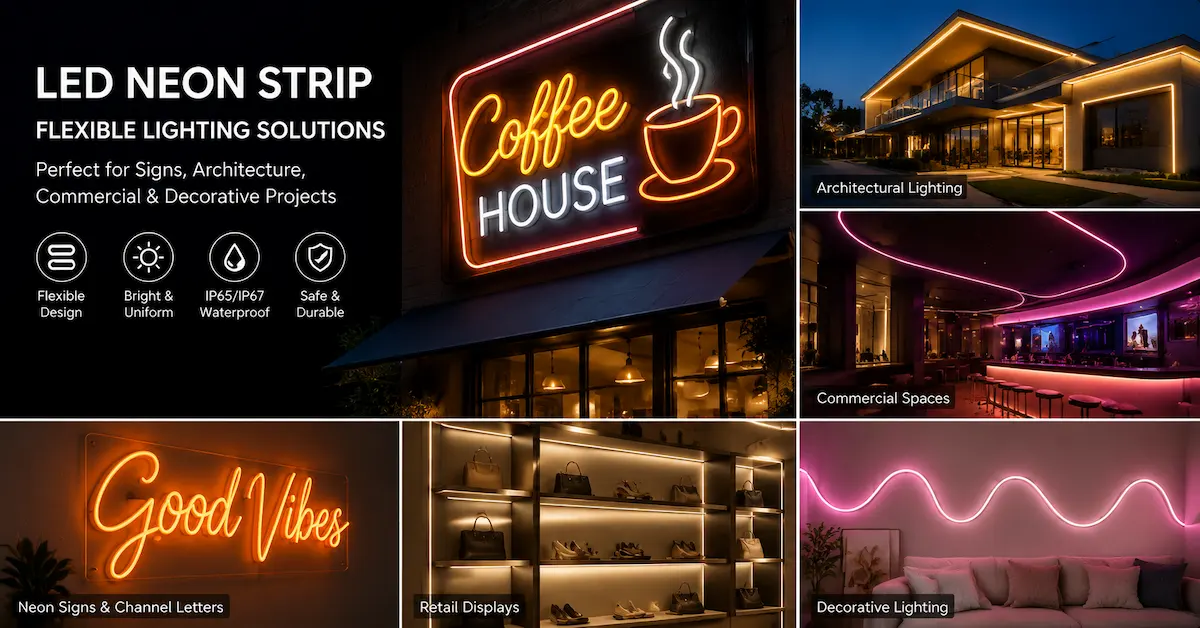


What Should an LED Neon Lighting Supplier Actually Provide?
A professional LED neon lighting supplier should provide more than a reel of flexible neon.
Commercial buyers usually need a complete lighting system that works after installation:
- The correct neon profile
- Suitable voltage
- Matching power supply
- Compatible controller
- Correct cable and connectors
- Mounting accessories
- Waterproof termination where required
- Project-specific lengths
- Stable color and brightness
- Repeatable production specifications
This distinction matters.
A product can perform perfectly on a factory test bench but still create problems on site if the cable position is wrong, the power supply is undersized, the controller is incompatible, or the neon profile cannot follow the required curve.
For signage manufacturers, lighting contractors, retail brands, hotel projects, and architectural companies, the more useful supplier is therefore not simply the company with the longest product list.
It is the company that can turn a project requirement into a complete, installable LED neon lighting configuration.
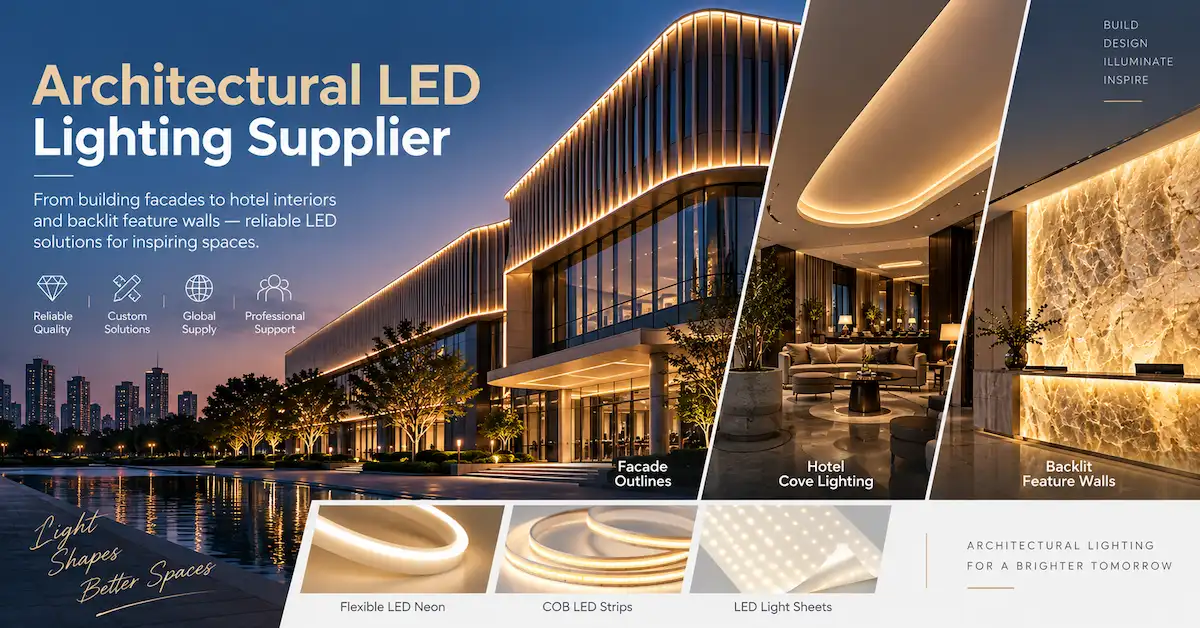
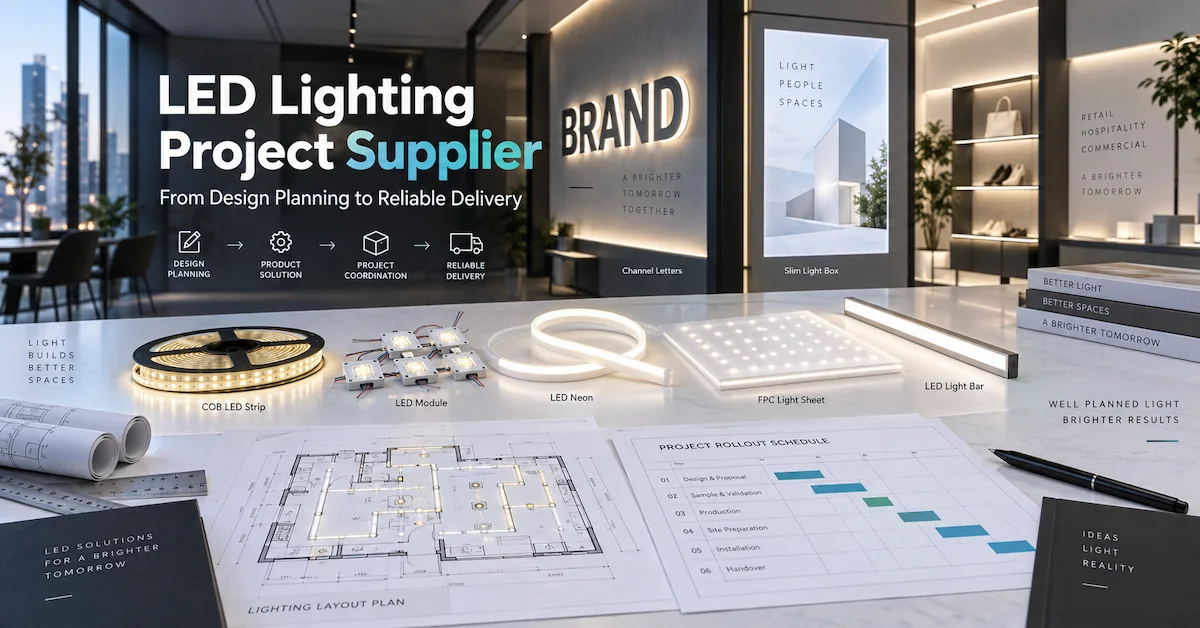
YESUN's current product portfolio includes silicone neon strips, Neon Art Series products, separable neon strips, customized neon signs, flexible linear strips, controllers, power supplies, and other commercial LED lighting products.
Start With the Project, Not the Supplier's Catalog
One of the fastest ways to receive an inaccurate quotation is to send only:
“Please quote LED neon lighting.”
A useful supplier needs to understand what the product is expected to do.
Before asking for a price, define the project around eight points.
| Project Information | Why It Matters |
|---|---|
| Application | Determines product structure |
| Indoor or outdoor | Defines protection requirements |
| Total length | Affects power and wiring |
| Shape or bend direction | Determines neon profile |
| Required color | Defines LED and controller |
| Voltage | Affects circuit design |
| Control method | Determines controller compatibility |
| Quantity | Determines production and quotation logic |
For shaped signs or architectural outlines, also provide a drawing.
A PDF, CAD file, dimensioned sketch, or even a clear installation photo can reduce several rounds of unnecessary communication.
Which Buyers Need a Complete Neon Lighting Supplier?
Different buyers expect different things from the same product category.
Signage Manufacturers
Sign companies normally care about:
- Small bending radius
- Clean continuous illumination
- Cut length
- Cable exit position
- Easy mounting
- Repeatable colors
For them, installation time can be as important as product price.
Lighting Contractors
Contractors usually focus more on the entire system:
- Total wattage
- Driver location
- Voltage drop
- Circuit zoning
- IP protection
- Maintenance access
- Project delivery schedule
Architects and Lighting Designers
Design teams may prioritize:
- Profile dimensions
- Light-emitting direction
- CCT
- RGB/RGBW effects
- Visual continuity
- Integration with architectural surfaces
Distributors
Distributors need products that can be reordered without specification drift.
Their concerns include:
- SKU structure
- Packaging
- Labels
- Repeat-order consistency
- Certifications
- After-sales risk
OEM and Private-Label Brands
These buyers may require:
- Custom product specifications
- Brand packaging
- Custom labeling
- Special cables
- Exclusive product combinations
- Repeatable production standards
This is why one generic “neon strip” is rarely sufficient for every B2B customer.
Build the LED Neon Lighting System in Five Parts
A commercial neon project is easier to manage when the system is separated into five purchasing decisions.
1. Select the Neon Profile
The physical profile determines:
- Width
- Height
- Light-emitting direction
- Bending direction
- Mounting method
- Visual line thickness
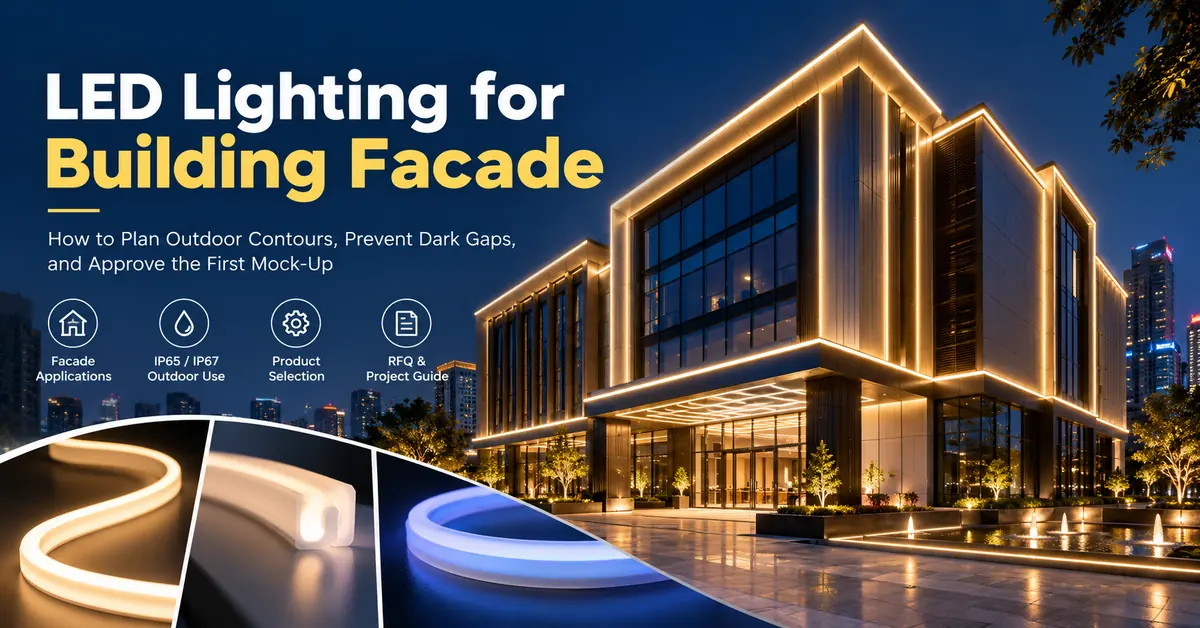
YESUN's current neon range includes different structures rather than one universal profile. For example, its Neon Art Series includes 6 × 12 mm IP67 products for channel letters, facade lighting, bridge edges, canopies, courtyards, and landscape applications.
A small sign may need a narrow profile.
A building outline may need a larger profile with stronger mechanical support.
Trying to use one profile for both usually creates compromises.
2. Decide the Light Type
Common options include:
- Single color
- Tunable white
- RGB
- RGBW
- Pixel/addressable lighting
The correct choice depends on the user experience.
Single Color
Best when the lighting should remain stable.
Typical applications:
- Facades
- Logos
- Retail architecture
- Permanent decorative lines
RGB or RGBW
Useful for:
- Bars
- Clubs
- Entertainment venues
- Event spaces
- Dynamic brand installations
Addressable Lighting
Suitable when individual sections or pixels need independent control.
However, dynamic lighting also increases system complexity.
It may require:
- Additional controllers
- Signal wiring
- More programming
- More commissioning
Do not specify addressable neon simply because it looks impressive in a product demonstration.
Use it when the application actually needs programmable effects.
3. Choose the Electrical Architecture
The neon product, voltage, cable length, power supply, and controller should be planned together.
A long architectural project might look like one continuous line while electrically being divided into several zones.
That is often preferable.
Zoning can reduce:
- Voltage drop
- Cable loading
- Controller overload
- Maintenance difficulty
The project drawing should therefore show both:
visual layout and electrical layout.
4. Match the Controller
Controller selection depends on the neon type.
| Neon Type | Typical Control Need |
|---|---|
| Single Color | On/off or dimming |
| Tunable White | CCT controller |
| RGB | RGB controller |
| RGBW | RGBW controller |
| Addressable | Compatible digital controller |
Mixing incompatible control protocols is a common project mistake.
The controller's output capacity must also be checked against the connected load.
YESUN's broader product range includes LED controllers and power supplies that can be considered when building complete commercial LED systems.
View YESUN Commercial LED Products
5. Specify Mounting and Connections
Small installation details frequently become large site problems.
Confirm:
- Mounting clips or channel
- Cable exit direction
- Cable length
- Connector type
- End caps
- Junction position
- Power-feed location
- Waterproof sealing method
For repeated installations such as chain stores, these details should be standardized.
Doing so can significantly reduce installation variation between locations.
Match the Neon Lighting Solution to the Application
The same LED neon product should not automatically be specified for every project.
| Application | Main Buyer Concern | Supplier Should Confirm |
|---|---|---|
| Storefront sign | Clean visual line | Bend, color, cable exit |
| Building outline | Long runs | Voltage, zoning, mounting |
| Hotel interior | Appearance | CCT, dimming, profile |
| Bar/KTV | Dynamic effects | RGB/RGBW/controller |
| Retail display | Visual consistency | Color and brightness |
| Outdoor facade | Weather exposure | IP protection and sealing |
| Custom logo | Detailed geometry | Cut length and bend radius |
| Distributor stock | Repeatability | SKU and batch consistency |
A supplier that immediately recommends a model without asking about the application is giving the buyer very little engineering value.
What Technical Specifications Should Be Locked Before Quotation?
For serious commercial sourcing, the quotation should reference a defined specification.
At minimum, confirm:
Mechanical
- Profile dimensions
- Bend direction
- Minimum bend radius
- Cut interval
- Standard reel or finished length
Electrical
- Input voltage
- Watts per meter
- Maximum run
- Cable specification
- Power-feed arrangement
Optical
- CCT or color
- RGB/RGBW configuration
- LED density
- Light-emitting direction
- Brightness requirement
Environmental
- Indoor/outdoor
- Required IP rating
- Temperature conditions
- UV exposure if relevant
Commercial
- Quantity
- Packaging
- Labeling
- Certification requirements
- Sample requirements
- Delivery schedule
Locking these parameters turns the quotation into something buyers can genuinely compare.
Without them, Supplier A and Supplier B may appear to quote the same product while actually quoting different constructions.
Do Not Treat IP67 or IP68 as a Marketing Label
Outdoor buyers frequently ask:
“Is this neon IP67?”
That is useful, but incomplete.
IP classifications are defined under IEC 60529 as degrees of protection provided by enclosures.
A project buyer should therefore verify not only the advertised rating but also the actual configuration covered.
Ask:
- Does the rating apply to the finished product?
- What happens after field cutting?
- How are cable entries sealed?
- How are end caps installed?
- Does customization change the tested structure?
The cut end and cable connection can be more vulnerable than the main silicone body.
For outdoor projects, the entire finished assembly matters.
Certification Requirements Depend on the Final Market
Certification should be discussed early, especially for OEM and import programs.
YESUN currently references CE, UL, RoHS, and UKCA across its company and product documentation, but buyers should verify which documents apply to the exact model being purchased.
For low-voltage lighting systems in the United States, UL 2108 is one relevant standard, while the applicable requirement ultimately depends on the product and end-use system.
Do not wait until the order is packed before asking for compliance documentation.
Include destination market and required certificates directly in the RFQ.
Sample Testing Should Reproduce the Real Project
A neon sample glowing on a desk proves very little about an architectural installation.
A useful sample test should reproduce the real use condition.
Check:
- Mounting surface
- Curve
- Cable position
- Controller
- Power supply
- Viewing distance
- Ambient light
- Outdoor exposure where relevant
For RGB or addressable products, test:
- Color transitions
- Controller response
- Signal stability
- Program behavior
For long runs, test voltage behavior over the planned distance.
Create a Golden Sample
Before mass production, record the approved sample specification.
Include:
- Model
- Profile size
- Voltage
- Color
- Cable
- Connector
- End treatment
- Packaging
- Approved appearance
This gives both buyer and supplier a clearer quality reference for bulk production.
How a Good Supplier Reduces Installation Cost
Purchase price is visible.
Installation cost is often hidden.
A slightly cheaper product may become more expensive if installers must:
- Resolder cables
- Replace connectors
- Correct cable direction
- Modify mounting clips
- Add unexpected power feeds
- Troubleshoot controller incompatibility
For project buyers, supplier value should therefore include installation readiness.
Useful support can include:
- Wiring diagram
- Recommended maximum run
- Driver sizing
- Controller compatibility
- Mounting guidance
- Cutting instructions
- Connection drawings
These items can reduce errors before the product reaches the jobsite.
OEM LED Neon Lighting Should Begin With the Problem
OEM does not necessarily mean creating a completely new product.
Many high-value customizations solve a specific installation problem.
Examples include:
Custom Cable Length
Useful when:
- Junction boxes are positioned far from the neon
- Visible cable connections need to be avoided
Custom Cable Exit
Useful for:
- Logos
- Furniture
- Recessed architecture
- Narrow signage structures
Custom Finished Lengths
Useful when installers repeatedly cut standard reels into the same dimensions.
Factory-prepared lengths can reduce:
- Material waste
- On-site labor
- Cutting errors
Custom Packaging
Useful for:
- Distributors
- Private-label brands
- Multi-location projects
The best OEM discussion therefore begins with:
What problem are we trying to eliminate?
not:
What can you customize?
What Quality Control Matters for Project Buyers?
QC should focus on failure modes that affect the actual project.
Important checks include:
- Electrical operation
- Color consistency
- Brightness uniformity
- Silicone appearance
- Cable connection
- Waterproof termination
- Aging performance
- Packaging condition
YESUN states that its Shenzhen operation includes a 5,000㎡ automated production facility, six dedicated SMT lines, full-cycle QC, and R&D resources focused on signage optical design and color consistency.
For buyers, the important question is how those capabilities are applied to the specific order.
Before production, agree on:
- Specification
- Sample
- Inspection criteria
- Packaging
- Quantity
- Delivery requirement
That is much more useful than asking whether a factory has “strict QC.”
Lead Time Should Be Split Into Three Stages
Instead of asking only:
“What is your lead time?”
separate it into:
Sampling Time
How long until the buyer can test the proposed configuration?
Approval and Customization Time
Does packaging, cable customization, or a special profile require additional preparation?
Mass Production Time
How long after final approval until shipment?
This distinction is particularly important when the neon is part of a larger project with:
- Shopfitting
- Sign fabrication
- Electrical installation
- Construction deadlines
The LED neon delivery date must fit the overall project schedule.
Compare Suppliers by Total Project Risk, Not Unit Price
Consider two quotations.
Supplier A
- Lower price
- Generic cable
- No wiring diagram
- Limited customization
- Separate controller sourcing
Supplier B
- Slightly higher price
- Correct cable location
- Matching controller
- Defined sample
- Project-specific configuration
Supplier A may look cheaper on the quotation.
Supplier B may cost less after installation.
A better procurement calculation includes:
Product cost + installation labor + rework + replacement + project delay + after-sales cost
For commercial buyers, this is the real cost of neon lighting.
A High-Conversion RFQ Checklist for LED Neon Lighting
If you want an accurate proposal instead of a generic price list, send the following information.
Project Information
- Application
- Destination market
- Indoor/outdoor
- Drawing or photo
Neon Specification
- Total length
- Profile size if known
- Color/CCT
- RGB/RGBW/addressable if required
- Voltage
- IP requirement
Installation
- Bend direction
- Cable exit
- Cable length
- Mounting method
- Power location
Commercial Information
- Quantity
- Sample quantity
- Packaging requirement
- Certification requirement
- Required delivery date
For OEM Buyers
Also include:
- Brand label
- Packaging
- Barcode
- Manual
- Repeat-order forecast
The more complete the RFQ, the more useful the supplier's response will be.
What Should You Expect From a Project-Focused LED Neon Lighting Supplier?
Before choosing a partner, ask whether the supplier can provide these seven outputs:
- Recommended neon configuration
- Technical specification
- Power and controller recommendation
- Sample
- Connection or installation guidance
- Bulk production plan
- Commercial quotation
If the project is complex, a supplier should also identify risks before production.
For example:
- Run too long
- Bend too tight
- Wrong control system
- Insufficient power capacity
- Incorrect protection level
- Cable exit conflicts with installation
Finding these issues during quotation is inexpensive.
Finding them after installation is not.
Why Work With YESUN for Commercial LED Neon Lighting?
YESUN focuses on signage and commercial LED lighting rather than general consumer decorative lighting.
Its current range includes:
- Silicone neon LED strips
- Neon Art Series
- Separable neon strips
- Customized neon signs
- Flexible linear strips
- LED controllers
- LED power supplies
- Additional signage and commercial LED products
YESUN states that it was founded in 2013 and supports OEM/ODM projects with automated manufacturing, dedicated SMT production, R&D support, and full-cycle quality control.
This makes YESUN particularly relevant when the requirement goes beyond purchasing standard neon by the reel and instead involves:
- Product configuration
- Project quantities
- OEM customization
- Power/control matching
- Repeat production
- Commercial project support
If your requirement is specifically about comparing flexible neon strip vendors, you can also read the existing LED Neon Strip Supplier guide on the YESUN Blog. For broader projects, this page focuses on the complete lighting-system relationship rather than one strip product.
Frequently Asked Questions About LED Neon Lighting Suppliers
What does an LED neon lighting supplier provide?
A project-focused supplier can provide neon products, power supplies, controllers, connections, customization, technical recommendations, samples, and production support.
What information should I send for an LED neon lighting quotation?
Send the application, dimensions, total length, color, voltage, IP requirement, control method, quantity, destination market, and installation drawing where possible.
Can an LED neon lighting supplier provide a complete system?
Yes. Depending on the supplier's product range, a complete system may include neon, controllers, power supplies, wiring, connectors, and mounting accessories.
How do I choose the right neon profile?
Choose according to visual width, emitting direction, bend direction, mounting space, and the geometry of the project.
Should I choose 12V or 24V neon lighting?
The correct voltage depends on product design, run length, cutting interval, current, and installation architecture. Do not choose voltage independently from the complete circuit.
How do I know if LED neon is suitable for outdoor use?
Check the actual finished product's IP protection, end sealing, cable entry, environmental requirements, and supporting documentation.
Can LED neon lighting be customized for architectural projects?
Yes. Common project customizations include finished length, color, cable position, connectors, mounting configuration, and control system.
Can YESUN provide RGB or dynamic LED neon lighting?
YESUN's current product range includes RGB and pixel/dynamic LED solutions alongside single-color neon products.
Should I request a sample before bulk production?
Yes, particularly for custom signs, outdoor applications, architectural projects, or repeat-order programs. Test the sample under realistic installation conditions.
How can I get a more accurate quote from YESUN?
Provide application drawings, length, profile requirements, voltage, color, environment, control method, quantity, packaging needs, destination market, and delivery target.
Use the YESUN contact page to send your project information and request a configuration and quotation.
Conclusion
Choosing an LED neon lighting supplier should be treated as a system-sourcing decision rather than a simple price comparison.
The neon profile, light type, voltage, controller, power supply, cable configuration, mounting, waterproof protection, and project schedule all need to work together.
For B2B buyers, the strongest supplier is the one that can identify these requirements before production and convert them into a repeatable specification.
That reduces installation problems, rework, maintenance risk, and unexpected project costs.
For your next signage, architectural, retail, hotel, or commercial neon project, prepare the drawing and technical requirements first.
Then ask the supplier to recommend the complete neon lighting configuration—not only a price per meter.