

What Should an LED Lighting Distributor Supplier Provide?
Choosing an LED lighting distributor supplier is fundamentally different from buying LEDs for a single installation. A contractor needs the right products for a defined project. A distributor needs products that can be sold repeatedly, stocked economically, identified accurately, and replaced with compatible versions when customers reorder.
That difference changes almost every purchasing decision.
A sample LED strip may perform perfectly in a showroom, but the distributor still needs to know whether the same voltage, color temperature, PCB width, connector arrangement, and packaging will be available six months later. A competitive factory quotation may appear attractive, yet freight, import charges, unsold inventory, customer returns, and technical support can significantly reduce the actual profit.
The question is not simply whether a supplier manufactures reliable LEDs.
It is whether that manufacturer can support a sustainable distribution business.
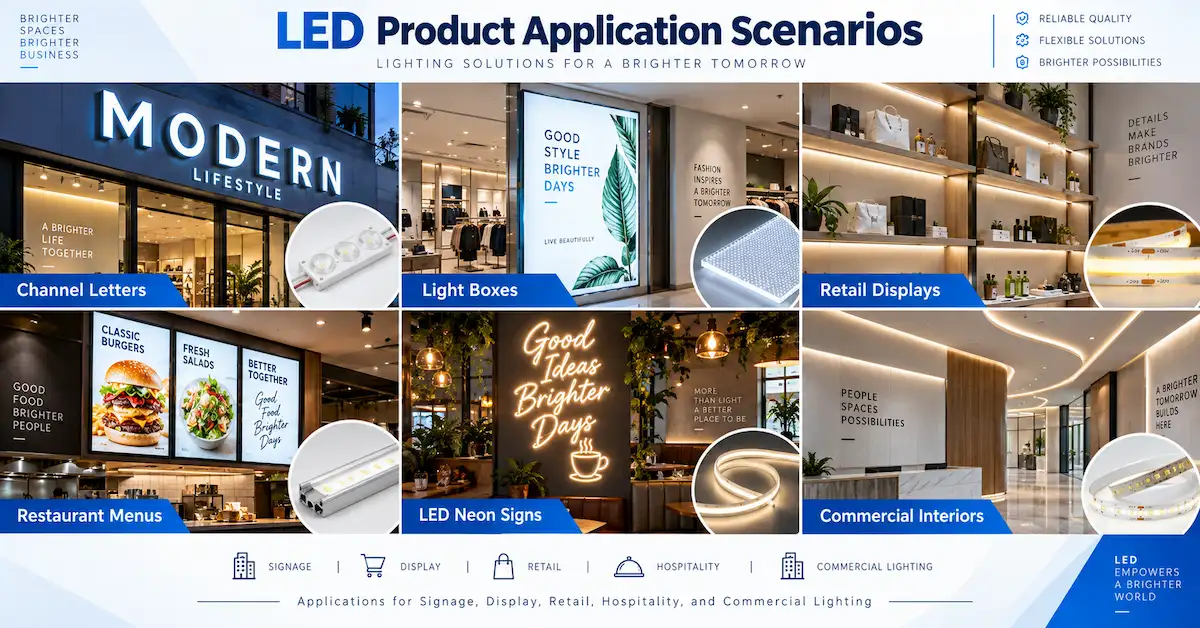
For distributors serving advertising signage, retail displays, light boxes, and commercial installations, a suitable supplier should provide a combination of product breadth, controlled specifications, manufacturing consistency, OEM possibilities, relevant documentation, and predictable replenishment.
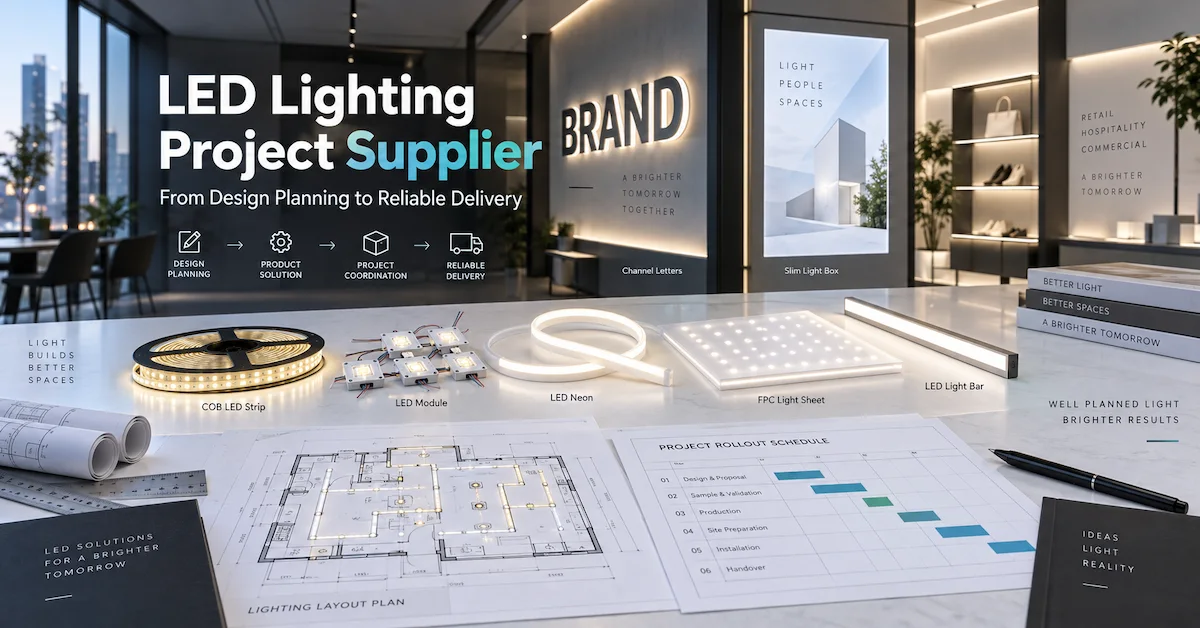
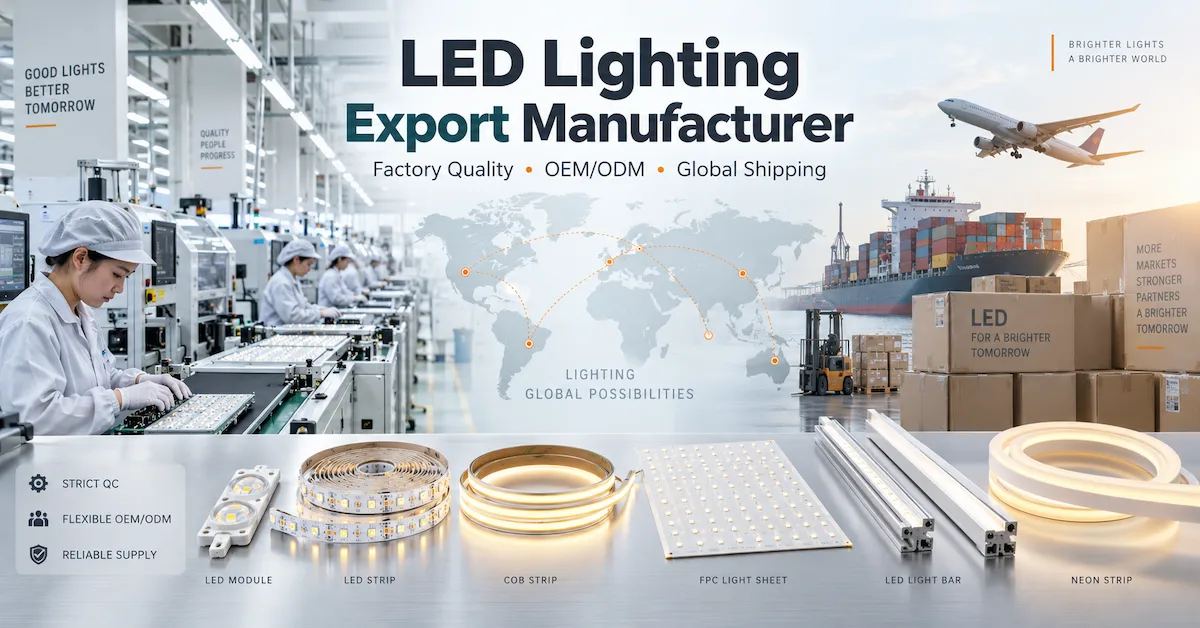
YESUN specializes in LED lighting products for signage and commercial applications. Its commercial LED product portfolio includes LED modules, SMD and COB strips, FPC light sheets, LED light bars, neon strips, power supplies, controllers, and accessories.
These product categories can form the basis of a focused wholesale offering for businesses selling to sign manufacturers, electrical contractors, retail-display producers, and commercial lighting installers.
However, a wide catalog is only a starting point. A profitable distributor needs a deliberate product strategy.
Quick Answer: How Do You Choose a Reliable LED Lighting Distributor Supplier?
A suitable wholesale supplier should help distributors answer eight practical questions:
-
Product fit: Can the manufacturer's products serve the applications and customer groups your business targets?
-
SKU control: Can each item be identified through stable technical specifications, product codes, labels, and revisions?
-
Wholesale economics: Are purchase prices, minimum quantities, customization costs, and freight requirements compatible with your target margins?
-
Quality consistency: Can the manufacturer reproduce approved electrical, optical, and mechanical characteristics across production batches?
-
Inventory planning: Can you obtain realistic lead times, repeat-order information, and clear availability updates?
-
Market compliance: Can the supplier provide documentation appropriate to the exact model and destination market?
-
Brand development: Can it support labeling, packaging, and technically feasible OEM/ODM customization?
-
After-sales support: Are warranty scope, defect reporting, replacement procedures, and technical communication clearly defined?
A reliable relationship should satisfy these requirements together.
For most distributors, long-term profitability depends more on repeatable specifications, inventory discipline, and customer retention than on negotiating the lowest possible price for an individual order.
Why Distributor Supply Is Different From Project-Based LED Purchasing
A project contractor purchases lighting to complete a specific job. Once the installation is accepted, the principal purchasing requirement may end.
A distributor operates continuously.
New stock must match existing product descriptions. Customers expect replacement components to remain compatible. Sales staff need product information they can understand. Warehouse employees must distinguish visually similar models. Procurement managers must calculate reorder quantities before popular items sell out.
The distributor also carries inventory risk.
An unpopular LED configuration may occupy warehouse space for months. A model change can make older stock difficult to sell. A product with insufficient technical documentation can create repeated questions from installers, increasing the distributor's service costs.
These problems are not always visible during the first purchase.
This is why an LED lighting distributor supplier should be assessed as a long-term product partner rather than merely an exporter of individual orders.
Who benefits most from a distribution-focused supply relationship?
Typical buyers include:
-
Regional LED lighting wholesalers
-
Electrical and lighting distributors
-
Advertising signage material distributors
-
LED importers and trading businesses
-
Commercial lighting dealers
-
Retail fixture suppliers
-
Light box component wholesalers
-
Professional B2B online sellers
-
OEM and private-label lighting brands
-
Architectural and decorative lighting suppliers
Businesses purchasing only a few LED components for personal use generally do not need a wholesale supply program.
Similarly, companies looking exclusively for turnkey building-wide electrical design and installation should engage qualified engineering and contracting partners rather than assume a component manufacturer provides those services.
A specialized manufacturer is most useful when the business requires repeatable LED products and related sourcing support.
Build a Wholesale Product Portfolio Around Customer Demand
One of the most expensive mistakes a new distributor can make is importing too many product variations before understanding the local market.
An LED manufacturer may offer hundreds of SKUs. That does not mean a distributor should stock every one.
Different colors, voltages, LED densities, waterproof versions, PCB widths, and controllers can create dozens of inventory variations within a single product family.
Each additional SKU consumes purchasing capital, warehouse capacity, product-management time, and technical support resources.
A better approach begins with customers.
Identify the applications generating consistent demand in your market, then build a product range around those applications.
A practical LED distributor product matrix
| Product Family | Typical Wholesale Customers | Main Commercial Value | Stocking Considerations |
|---|---|---|---|
| LED Modules | Channel-letter makers and sign factories | Reliable sign illumination | Voltage, color, lens, IP protection |
| Standard LED Strips | Installers and commercial lighting dealers | Versatile linear lighting | Voltage, CCT, width, reel length |
| COB LED Strips | Retail fixture and interior contractors | Smooth, continuous light | Density, width, CCT, IP version |
| LED Neon Strips | Sign makers and architectural suppliers | Flexible visible lighting | Profile, bending direction, color |
| FPC LED Light Sheets | Light box and display manufacturers | Thin, uniform backlighting | Sheet size, power, optical layout |
| LED Light Bars | Advertising cabinet manufacturers | Efficient large-area installation | Bar dimensions, beam angle, voltage |
| Power Supplies | Electrical contractors and sign makers | System compatibility | Input/output voltage, power, IP |
| LED Controllers | Dynamic-lighting installers | Dimming and color control | Channel count, signal, load rating |
| Connectors | Installers and distributors | Installation convenience | Strip width, pins, IP compatibility |
This is an application-based assortment framework. It does not imply that every configuration is stocked or immediately available from the manufacturer.
For buyers supplying professional sign-making customers, YESUN LED modules provide a useful starting category.
For retail displays and architectural installations, COB LED strips and FPC light sheets provide additional product directions.
The important commercial decision is how to combine these technologies without creating unnecessary inventory overlap.
Separate Core Stock, Growth Products, and Special-Order Items
Not all LED products deserve the same inventory commitment.
A mature distribution program should distinguish three groups.
Core stock: products customers purchase repeatedly
Core stock should cover the distributor's most predictable demand.
For a signage-focused business, this might include commonly requested module configurations, standard LED strips, compatible power supplies, and frequently used connectors.
A retail-lighting distributor may instead prioritize selected COB strips, standard CCT options, and matching drivers.
These items should receive the most attention in demand forecasting and replenishment planning.
Growth products: items that expand customer opportunities
Growth products serve emerging or increasingly valuable applications.
Examples may include:
-
Tunable-white COB strips
-
Specialized neon profiles
-
Waterproof commercial lighting
-
High-efficiency modules
-
RGBW lighting systems
-
Flexible backlighting sheets
These products can differentiate the distributor, but demand should be tested before large stock commitments.
Special-order products: application-specific configurations
Certain products are better sourced against confirmed orders.
For example, a custom-width FPC sheet or unusually configured neon strip may require project drawings, specific materials, or engineering approval.
Stocking many specialized variants without confirmed demand can tie up capital unnecessarily.
The central rule is straightforward:
Stock what sells repeatedly. Source unusual configurations against qualified demand.
A capable supplier should understand this distinction and discuss order quantities accordingly.
How to Build an LED SKU System That Prevents Inventory Errors
A distributor's internal SKU system is more important than it first appears.
Consider a 24V LED strip available in several CCTs, IP constructions, PCB widths, and packaging formats.
Two reels may look almost identical while having different electrical or mechanical requirements.
If product codes are unclear, warehouse employees can ship the wrong version even when the manufacturer's production is correct.
A reliable SKU master should record the specifications that distinguish one saleable item from another.
| SKU Field | Example Information |
|---|---|
| Distributor SKU | Internal stock reference |
| Manufacturer Model | Exact supplier model and revision |
| Product Family | Module, COB strip, neon, power supply |
| Operating Voltage | DC12V, DC24V, or applicable AC version |
| Electrical Rating | W/unit or W/m |
| Color | CCT, RGB, RGBW, or other |
| Optical Characteristics | Beam angle, CRI, density where applicable |
| Physical Dimensions | Width, length, profile, connector |
| IP Rating | Model-specific protection classification |
| Sales Unit | Piece, reel, meter, kit |
| Pack Quantity | Units per inner pack/carton |
| Compliance Record | Relevant document identifier |
| Warranty Record | Model-specific terms |
| Revision | Approved product and packaging version |
A clean SKU structure helps procurement, sales, warehousing, technical support, and accounting work from the same information.
Why manufacturer model numbers should be retained
A distributor can create its own commercial SKU, but the manufacturer's model designation should remain traceable.
When a customer requests replacement stock, the distributor needs to determine which original configuration was supplied.
The cross-reference should also identify changes in connectors, color bins, PCB construction, or packaging.
A new label does not make two technically different products interchangeable.
This is particularly important when supplying professional installers who design their work around exact component dimensions and electrical ratings.
Technical Compatibility: Sell Complete Solutions, Not Isolated Components
A good wholesale catalog should make it easy for customers to select compatible products.
Consider a customer purchasing 24V LED strips for a commercial display.
The customer may also need a suitable driver, dimmer, connectors, and extension cable.
If the distributor offers these items without compatibility information, the installer must solve the system design independently.
This can result in incorrectly matched voltages, overloaded controllers, unsuitable power supplies, and unnecessary returns.
YESUN offers LED power supplies and lighting controllers alongside its lighting components.
For distributors, this creates an opportunity to build application-specific product bundles.
However, products should only be described as compatible after the exact electrical and control requirements have been checked.
A basic technical compatibility checklist
Before listing a recommended product combination, verify:
-
AC input requirements
-
DC output voltage
-
LED operating voltage
-
Connected power
-
Maximum output current
-
Controller channels
-
Dimming method
-
Connector configuration
-
Recommended wiring arrangement
-
Permitted run length
-
Environmental protection
For example, a 24V strip and a 24V driver share a nominal output voltage, but that alone does not establish compatibility.
The driver must supply sufficient power, the wiring must handle the load, and the circuit must stay within the product's installation limits.
For RGBW systems, the controller must also support the correct channels and output capacity.
A distributor that maintains tested product combinations can make purchasing easier for installers and reduce avoidable service questions.
LED Product Quality: What Should Distributors Verify?
Product quality must remain consistent after the first sample order.
For distributors, a defect can affect many end customers rather than one installation.
A lighting strip supplied to twenty separate contractors can generate twenty complaints if an entire batch has the same problem.
Reliable quality control should therefore cover both product performance and batch consistency.
Incoming materials and manufacturing processes
Useful factory information includes:
-
LED and electronic component selection
-
PCB/FPC inspection
-
Solder paste control
-
SMT assembly
-
Reflow and post-reflow inspection
-
Cable and connector assembly
-
Waterproof processing
-
Electrical inspection
-
Optical testing
-
Aging or reliability screening
-
Final packaging verification
According to its published company information, YESUN operates an approximately 5,000-square-meter production facility with six SMT lines, more than 100 employees, and an R&D team of over ten engineers.
The company describes engineering, quality-control, environmental-testing, and production-traceability capabilities.
These factory-level statements provide useful qualification information. Buyers should still confirm how the relevant controls apply to their specific products and orders.
Sample testing for distributors
An approved sample should be tested under conditions representative of the intended customer application.
| Test Area | Practical Distributor Question |
|---|---|
| Voltage/current | Does the product operate within its published rating? |
| Power consumption | Does measured input align with the specification? |
| Brightness | Is output appropriate for the intended installation? |
| CCT consistency | Do samples have an acceptable color match? |
| Electrical stability | Is performance consistent over the permitted run? |
| Thermal behavior | Does installation allow suitable heat management? |
| Connectors | Are mating components correct and secure? |
| Waterproof construction | Does the design suit the stated environment? |
| Control compatibility | Do dimming and color functions operate correctly? |
| Packaging | Will products survive distribution and be identified accurately? |
Some tests require specialized equipment.
An integrating sphere, for example, can be used in appropriate optical measurement arrangements, while environmental tests assess defined conditions.
Buyers should ask for documented test methods and acceptance criteria rather than assuming that every laboratory result proves performance in every installation.
Batch Consistency Is a Long-Term Distribution Requirement
A sample approved in January may not tell a distributor everything about a shipment delivered in September.
The manufacturer must control production characteristics over time.
For LED products, changes in component selection, LED binning, circuitry, or optics can affect performance.
The most important controlled characteristics may include:
-
Color temperature
-
Luminous output
-
Electrical rating
-
PCB/FPC dimensions
-
Cutting interval
-
Connector arrangement
-
Waterproof design
-
Product identification
-
Packaging quantity
When these characteristics change, the distributor may need to update its catalog, inventory system, installation instructions, or compatibility records.
A professional supplier relationship should therefore include a change-notification and approval process for commercially or technically significant modifications.
This is especially important when a distributor supplies a retail chain or sign manufacturer that needs compatible products across repeated installations.
For such customers, stable specifications can be more valuable than a small temporary price reduction.
Certifications and Compliance: Protect the Distributor's Market Access
International distributors must distinguish between manufacturer claims, product-level documentation, and the legal obligations that apply in their destination markets.
The relevant requirements depend on the product, electrical configuration, intended use, destination country, and applicable legislation.
A certificate covering one LED module does not automatically cover every LED strip, controller, or customized assembly sold by the same manufacturer.
YESUN publishes certification and testing resources for selected LED product categories.
These include materials relating to CE, RoHS, UKCA, UL, and waterproof testing.
Buyers should verify the scope of the actual documents before including certification claims in their own catalogs.
European markets
For products within the applicable EU legislation, importers and distributors have responsibilities concerning conformity, markings, documentation, identification, and safety information.
The European Commission's guidance on importers and distributors explains that these businesses should verify relevant conformity obligations rather than relying solely on a supplier's assurances.
A distributor marketing products under its own name may also take on additional manufacturer responsibilities under applicable legislation.
Consequently, private-label development should include a review of compliance responsibilities before branded products enter the market.
North American markets
Buyers should distinguish between UL Listed products, UL Recognized Components, and other certification categories.
Certification claims can be checked through UL Solutions' Product iQ records where applicable.
The model designation, certification category, and conditions of use matter.
A component recognition is not automatically equivalent to certification of a finished lighting installation.
Outdoor products
IEC 60529 provides the IP Code framework for degrees of protection provided by enclosures.
However, an IP67 LED component does not guarantee that a finished outdoor sign is IP67.
Field connections, power supplies, cable exits, mounting details, and enclosure construction must also be addressed.
A distributor should communicate those limits clearly instead of promoting a component's IP rating as proof of complete-system waterproofing.
How Wholesale Pricing Affects Distributor Profitability
A distributor should distinguish purchase price, landed cost, markup, and gross margin.
These terms are related but not interchangeable.
Suppose an importer buys an LED lighting product under the following hypothetical cost structure:
| Cost Component | Amount per Unit |
|---|---|
| Factory purchase price | $8.50 |
| Allocated international freight | $0.90 |
| Import duties and applicable charges | $0.45 |
| Allocated receiving and handling | $0.35 |
| Illustrative landed cost | $10.20 |
| Wholesale selling price | $16.00 |
Gross profit before other business expenses:
$16.00 − $10.20 = $5.80
Gross margin:
$5.80 ÷ $16.00 × 100 = 36.25%
Markup on landed cost:
$5.80 ÷ $10.20 × 100 ≈ 56.86%
The figures are hypothetical and do not represent YESUN pricing or a guaranteed distributor margin.
They illustrate why buyers must distinguish margin from markup.
The calculation also excludes operating expenses such as sales salaries, financing, general warehousing overhead, bad debts, and some after-sales costs.
If the distributor budgets an additional $0.20 per unit for expected warranty and returns-related expenses, the illustrative contribution before other operating costs falls to $5.60, or 35% of the selling price.
Actual accounting treatment depends on the business and jurisdiction.
Why the cheapest LED supplier may not be the most profitable
A cheaper product can become costly when it causes:
-
Frequent customer returns
-
Installation complaints
-
Unclear specifications
-
Incorrect replacement shipments
-
Higher technical support workloads
-
Product obsolescence
-
Excessive inventory
-
Unpredictable replenishment
Conversely, a higher factory price is not automatically justified.
The distributor should evaluate whether an alternative genuinely improves reliability, sales conversion, inventory turnover, or customer retention.
The strongest buying decisions use total commercial performance rather than unit price alone.
Inventory Management: Avoid Stockouts Without Creating Dead Stock
Inventory is where distribution businesses frequently lose profit.
Popular items may sell out during a busy installation period, while slower variants remain on shelves.
An LED lighting distributor supplier should provide realistic production and order information so buyers can develop their own inventory plans.
The supplier cannot reliably forecast every regional customer's demand. The distributor must contribute actual sales history, seasonality, pipeline information, and expected customer activity.
Classify products by commercial importance
An ABC framework can help identify where inventory-management effort should be concentrated.
A items are the products contributing the greatest commercial value or facing the highest business impact if unavailable.
B items generate meaningful but less critical demand.
C items are typically lower-volume or lower-impact products.
These categories should be calculated from the distributor's own data rather than assigned solely by product type.
A commonly ordered LED module may be an A item for a sign-material wholesaler but a C item for a distributor specializing in decorative interior lighting.
Consider demand variability
Two products can have identical annual sales but very different demand patterns.
One may sell steadily every week.
Another may sell almost entirely through occasional project orders.
The first can be suitable for regular replenishment.
The second may be better managed through confirmed orders or selective safety stock.
This is why distributor inventory planning should consider both sales volume and demand variability.
How to Calculate a Reorder Point for LED Wholesale Products
A simple reorder-point calculation makes stock planning more systematic.
For stable demand, an illustrative formula is:
Reorder point = Expected demand during replenishment lead time + Safety stock
Suppose a distributor sells an average of 80 units per week.
Assume its planning lead time for the complete procurement and delivery process is six weeks, and it has chosen a safety-stock allowance equivalent to two weeks of average demand.
Expected lead-time demand:
80 × 6 = 480 units.
Illustrative safety stock:
80 × 2 = 160 units.
Reorder point:
480 + 160 = 640 units.
Under these simplified assumptions, the distributor would review replenishment when its inventory position approaches 640 units.
Inventory position should account for available stock, outstanding purchase orders, and backorders—not merely the quantity physically present.
This example is not a claim about YESUN's production lead time. Actual planning should use the product's confirmed supply schedule, shipping arrangements, demand variability, and desired service level.
For custom OEM products, longer material or production preparation may require a different inventory policy.
What to ask the manufacturer
Before agreeing on regular replenishment, confirm:
-
MOQ by product and variant
-
Typical and order-specific production lead times
-
Packaging preparation requirements
-
Material-dependent constraints
-
Mixed-SKU order options
-
Availability of repeat-order specifications
-
Forecast communication procedures
-
Shipment consolidation possibilities
-
Changes to product revisions or availability
A manufacturer that communicates early about production constraints helps distributors make better purchasing decisions.
MOQ and Mixed-SKU Orders: Balance Flexibility With Production Efficiency
Distributors often ask whether they can mix products in one purchase order.
This can be commercially useful, but flexibility varies by product and factory.
A standard product already supported by established production processes may have different minimum requirements from a newly customized model requiring special materials or packaging.
Consider a new distributor testing three different COB strip configurations.
Requiring a large quantity of each version before the distributor understands local demand could create unnecessary inventory risk.
A limited trial order may be more appropriate, if commercially feasible.
Once demand becomes predictable, larger repeat orders may provide better purchasing efficiency.
For an LED lighting distributor supplier, a useful commercial discussion should distinguish:
Sample quantity: Used for technical evaluation.
Trial order: Used to test market acceptance and operational procedures.
Regular wholesale order: Based on established sales demand.
OEM order: May involve custom material, packaging, or tooling requirements.
Forecast-based repeat order: Planned around replenishment needs.
Distributors should request clear MOQ and pricing information for each relevant order type rather than assuming every catalog product follows identical terms.
OEM and Private-Label LED Lighting for Distributors
Private-label development can strengthen a distributor's market position when it creates a recognizable, consistent product line.
However, placing a logo on a box is only one part of the process.
A useful private-label program may require:
-
Distributor product codes
-
Branded reel or product labels
-
Customized retail packaging
-
Master carton identification
-
Barcode or GTIN arrangements
-
Technical specification sheets
-
Installation instructions
-
Warranty information
-
Relevant market warnings
-
Product photographs
-
Consistent replacement identification
Depending on the selected platform and engineering feasibility, customization may also involve electrical or mechanical changes.
YESUN describes OEM/ODM capabilities for commercial LED applications in its company profile.
Buyers should confirm customization feasibility, MOQ, development cost, sample approval, and documentation requirements for their intended products.
Control technical revisions
A private-label range should have a controlled technical specification.
If the manufacturer changes LED packages, PCB dimensions, power characteristics, or connector design, the distributor may need to update its own product documentation.
For substantial changes, revised sampling or compliance review may be appropriate.
Agree on commercial rights separately
Private labeling does not automatically provide exclusivity, territorial protection, intellectual-property ownership, or guaranteed access to a particular product.
These matters should be negotiated and documented separately where relevant.
A distributor seeking regional exclusivity should define the products, geographic territory, sales expectations, contract term, permitted sales channels, and conditions for continuation.
Do not assume that OEM packaging alone establishes an exclusive distribution relationship.
Build Distributor Sales Materials That Reduce Technical Questions
A manufacturer that supplies consistent product information can help distributors reduce their own catalog-maintenance workload.
A professional wholesale product page should answer the questions an installer is likely to ask before purchase.
For LED modules, useful information includes voltage, power, dimensions, beam angle, color, recommended connections, and environmental rating.
For LED strips, include the width, cutting interval, LED density, rated power, voltage, color options, permitted run length, and mounting considerations.
For power supplies, distinguish input-voltage versions, output voltage, wattage, dimming, and protection rating.
For controllers, specify the supported technology, channels, load limits, and compatible electrical conditions.
Distributors should also maintain:
-
Accurate product photographs
-
Datasheets
-
Installation guidance
-
Packaging quantities
-
Model cross-references
-
Applicable compliance records
-
Approved accessory combinations
-
Version-controlled documentation
YESUN publishes technical and company material through its resources center.
Distributors can use available manufacturer documentation as a starting point, subject to appropriate permissions and verification.
The final local-market product information remains the distributor's responsibility.
Why Accessories Increase Commercial Value
Selling only an LED light source can leave customers looking elsewhere for the components needed to complete their installation.
A sign manufacturer purchasing LED modules may also require a power supply and connectors.
A retailer installing RGBW lighting may need a controller and compatible electrical components.
Offering these products together can increase order completeness and reduce the likelihood of installation errors caused by mismatched parts.
The commercial advantage is not simply selling more items.
It is making the distributor easier to buy from.
For example, a customer purchasing a selected LED strip can be shown the corresponding driver requirements and compatible controller options.
This should be based on verified technical compatibility rather than an automatically generated bundle.
Distributors can review the YESUN accessory range when considering related product categories.
A well-designed accessory strategy can also simplify repeat purchasing.
Customers who know which power supplies, connectors, and controllers work with the distributor's standard lighting products are less likely to rebuild the component selection process for every job.
How Distributor Needs Differ Across Regional Markets
There is no universal product mix for every region.
The best assortment depends on customer industries, electrical requirements, climate, installation practices, and market regulations.
Signage-oriented distributors
These businesses may emphasize:
-
Channel-letter LED modules
-
Waterproof modules
-
LED strips with suitable optical designs
-
Light box backlighting
-
Neon products
-
Compatible power supplies
-
Installation connectors
The central selling proposition is reliable, repeatable sign illumination.
Retail-display suppliers
These distributors may prioritize:
-
COB strips
-
FPC light sheets
-
High-quality white lighting
-
Compact drivers
-
Dimming options
-
Thin illuminated panels
Their customers are likely to care about visual uniformity, color consistency, and installation appearance.
Architectural and hospitality distributors
These businesses may need:
-
Flexible neon
-
Tunable-white strips
-
RGB/RGBW products
-
Dimming controllers
-
Long-run lighting
-
Waterproof variants where appropriate
Here, lighting effects and installation compatibility can matter as much as product cost.
Advertising light box distributors
These businesses may focus on:
-
LED modules
-
Wide-angle optics
-
Light bars
-
Flexible light sheets
-
Drivers
-
Efficient mounting and wiring
For larger commercial cabinets, installation labor and surface uniformity may be major decision factors.
The manufacturer's overall product range can support several of these segments, but the distributor should launch only the combinations justified by local demand.
After-Sales Support: Design a Clear RMA Process
Warranty support is frequently discussed during negotiations but often poorly defined.
A distributor needs a repeatable method for receiving, evaluating, and resolving customer complaints.
Without clear procedures, a relatively small defect can consume considerable time across sales, warehouse, technical, and purchasing teams.
An RMA process should identify:
-
Customer order or invoice
-
Distributor SKU
-
Manufacturer model
-
Batch or production reference
-
Quantity affected
-
Reported failure
-
Photographs or technical evidence
-
Installation and operating conditions
-
Requested remedy
-
Final resolution
Where an electrical failure is reported, ask for relevant information about the connected driver, voltage, wiring, environment, and operating conditions.
This helps distinguish potential manufacturing defects from installation or compatibility issues.
Warranty terms must be model-specific
YESUN's company information refers to minimum company-level warranty terms, while individual products may list different warranty periods.
Distributors should not advertise a uniform warranty for all products without reviewing the actual applicable terms.
Before signing a supply agreement, clarify:
-
Defect coverage
-
Warranty period
-
Exclusions
-
Required evidence
-
Replacement or credit procedures
-
Freight responsibilities
-
Handling of discontinued models
-
Responsibilities for installation labor
A strong after-sales agreement defines what happens when something goes wrong instead of simply advertising a long warranty period.
Manufacturer, Trading Company, or Multi-Source Distributor Partner?
The ideal sourcing model depends on the buyer's business.
A direct manufacturer may provide stronger access to product engineering, process control, and customization.
A trading company may provide broader sourcing across unrelated brands and categories, as well as consolidation services.
Neither business model is automatically superior.
For a distributor selling specialized LED signage products, direct manufacturing capability can be especially relevant when specifications must remain consistent across repeat orders.
However, even a manufacturer may source certain accessories or components externally.
The most important questions are:
-
Which products are made in-house?
-
Which products are sourced from external partners?
-
Who controls technical specifications?
-
Who manages inspection?
-
Who approves design changes?
-
Who handles warranty claims?
-
Who is responsible for delivery commitments?
A credible supplier should be able to explain these responsibilities.
This level of transparency is more valuable than treating the phrase "factory direct" as proof of every aspect of quality.
How to Evaluate an LED Lighting Distributor Supplier
A structured supplier scorecard can improve purchasing consistency.
The following weighting is an illustrative evaluation method, not an official industry certification.
| Evaluation Area | Suggested Weight | Evidence to Request |
|---|---|---|
| Product-market fit | 20% | Portfolio and application suitability |
| Manufacturing and QC | 20% | Factory capabilities, test plans, sample results |
| Repeat-order consistency | 20% | Specification and revision control |
| Pricing and inventory support | 15% | MOQ, quotations, replenishment information |
| Certifications and documentation | 10% | Model-specific documents |
| OEM and packaging support | 10% | Samples, labeling and customization scope |
| After-sales support | 5% | Warranty and RMA procedures |
| Total | 100% |
Critical requirements should be evaluated before applying the score.
For example, a supplier that cannot provide the documentation required for the intended market should not be approved solely because it offers excellent prices.
Likewise, a product with an incompatible electrical configuration is unsuitable regardless of the manufacturer's overall score.
Test the partnership with a controlled first order
A pilot purchase can reveal operational problems that are difficult to detect through emails.
Evaluate the accuracy of:
-
Product identification
-
Technical specifications
-
Sample matching
-
Packaging
-
Labeling
-
Delivery communication
-
Documentation
-
Commercial invoice
-
Quantity and carton details
Record any discrepancies and agree on corrective actions before increasing order volume.
A first order should validate the purchasing process as well as the product.
A Practical 90-Day Launch Framework for New LED Distributors
The following timetable is an illustrative planning framework. Actual product development, shipping, regulatory, and customer-validation requirements may take longer.
Days 1–30: Market analysis and supplier qualification
Identify the main customer types and existing market demand.
Build a shortlist of LED product families and establish required technical specifications.
Review factory information, product documents, sample availability, market requirements, and quotation structures.
Avoid committing to a large assortment at this stage.
Days 31–60: Sample approval and trial assortment
Test selected products.
Build internal SKU records and confirm compatibility with relevant accessories.
Review packaging and product labels.
Calculate estimated landed costs and target selling prices.
Prepare product descriptions and technical materials.
Where appropriate, begin a controlled trial order after the product and commercial approvals have been completed.
Days 61–90: Pilot sales and replenishment planning
Introduce the approved products to a limited group of professional customers.
Collect installation feedback, sales inquiries, and demand information.
Monitor which products generate repeat interest.
Review the supplier's documentation, communication, and delivery performance.
Use actual results to determine whether to expand the assortment or increase regular orders.
The purpose of the initial period is not to maximize the number of products launched.
It is to create an assortment that customers understand, trust, and are willing to purchase repeatedly.
What Should Be Included in a Wholesale LED Lighting RFQ?
A professional RFQ allows the manufacturer to prepare a more useful quotation.
For an LED lighting distributor supplier, the inquiry should explain both the product requirements and the intended commercial relationship.
| RFQ Field | Information to Provide |
|---|---|
| Company type | Distributor, importer, wholesaler, OEM brand |
| Target market | Countries and customer segments |
| Product categories | Modules, strips, COB, neon, sheets, bars, accessories |
| Specifications | Voltage, wattage, dimensions, CCT, IP, control |
| Initial order | Quantity per SKU |
| Forecast | Expected replenishment volume, if known |
| Packaging | Standard, wholesale, or private-label |
| Certifications | Documents required for the destination market |
| MOQ | Required trial and repeat-order options |
| Samples | Models and sample quantities |
| Shipping | Destination and preferred Incoterms rule |
| Commercial terms | Currency, payment, delivery expectations |
| Technical support | Documentation and compatibility requirements |
| After-sales | Warranty, RMA, replacement arrangements |
Distributors should clearly identify which requirements are mandatory and which are preferences.
For example, a specific voltage may be mandatory, while a preferred carton quantity could be negotiable.
A well-defined RFQ also helps buyers compare several suppliers under equivalent conditions.
Request a distributor-specific quotation from YESUN
If your business supplies illuminated signs, commercial displays, architectural lighting, or related LED products, explore YESUN's complete LED lighting range before preparing an initial assortment.
You can then contact YESUN for wholesale product and OEM discussions with your intended product categories, target market, technical requirements, estimated quantities, packaging preferences, and expected purchasing schedule.
For a more focused comparison of LED strip distribution, the related LED strip distributor supplier guide discusses the product-specific sourcing considerations in greater detail.
Frequently Asked Questions About LED Lighting Distributor Suppliers
1. What is an LED lighting distributor supplier?
An LED lighting distributor supplier is a manufacturer or wholesale supply partner serving businesses that resell LED products. Its role may include supplying repeatable product specifications, wholesale orders, technical documentation, customization, and commercial support. A distributor should evaluate the complete supply relationship rather than treating it as a one-time component purchase.
2. How do I choose an LED lighting distributor supplier in China?
Start by identifying manufacturers specializing in the applications your customers require. Evaluate product range, factory capability, sample performance, technical specifications, certifications, MOQ, replenishment arrangements, and after-sales procedures. Approve a representative trial order before committing to a large inventory program.
3. What LED lighting products should a new distributor stock first?
Begin with products supported by actual local demand. A signage distributor may prioritize LED modules, strips, power supplies, and connectors, while a retail-lighting distributor may focus on COB strips and related drivers. Avoid stocking too many similar variants before obtaining evidence of customer demand and repeat purchases.
4. Can LED lighting manufacturers support private-label distribution?
Many manufacturers can support branding and some technical customization, but options vary by product. Buyers should confirm label formats, packaging, MOQ, development charges, sample approval, intellectual-property arrangements, and compliance implications. Private labeling does not automatically provide territorial exclusivity or guaranteed product availability.
5. How can LED distributors maintain consistent quality across repeat orders?
Maintain approved samples, specifications, manufacturer model references, revision records, and agreed inspection criteria. Ask suppliers to notify the buyer of significant product or material changes. Evaluate representative units from new batches against the approved reference before releasing them into the distribution channel.
6. How should LED distributors calculate wholesale profit margins?
Calculate landed cost using relevant product, freight, import, and receiving costs, then compare that cost with the selling price. Gross margin is gross profit divided by selling price, while markup is gross profit divided by cost. Additional operating expenses and after-sales costs must be considered when evaluating overall profitability.
7. What is a reasonable MOQ for wholesale LED lighting?
There is no universal MOQ. Requirements depend on product design, standardization, color, voltage, packaging, tooling, and production arrangements. Distributors should request separate quotations for samples, trial quantities, regular wholesale orders, and OEM configurations, rather than assuming identical minimums across the product range.
8. How can distributors reduce LED lighting stockouts?
Monitor demand by SKU, maintain accurate inventory records, and use realistic replenishment lead times. A reorder-point system can help identify when to purchase more stock. Demand variability, existing purchase orders, seasonality, and safety-stock requirements should also be included in planning.
9. What certifications should an LED lighting distributor request?
The necessary documents depend on the destination market, product, and application. Relevant documentation may include applicable CE conformity materials, RoHS information, UL certification or recognition records, UKCA documentation, and environmental test reports. Verify that the documents apply to each specific model instead of relying on broad company-level statements.
10. What information should I send when requesting wholesale prices from YESUN?
Provide your company type, destination market, requested product categories, technical specifications, estimated quantities, packaging or OEM requirements, required documentation, and expected purchasing schedule. Include details of your target customers and applications so the proposed product assortment can be evaluated against your distribution needs. Submit your inquiry through the YESUN contact page.
Conclusion
Choosing the right LED lighting distributor supplier requires more than competitive pricing. A sustainable wholesale business depends on selecting products that fit local demand, controlling SKU specifications, maintaining consistent quality, managing inventory intelligently, and securing dependable repeat-order arrangements.
For distributors, importers, electrical wholesalers, signage suppliers, and private-label brands, the strongest sourcing strategy combines technical product selection with commercial discipline. A carefully structured assortment, clear quality requirements, accurate landed-cost calculations, reliable replenishment planning, and defined after-sales procedures can reduce purchasing risks and support long-term customer relationships.
YESUN provides LED modules, strips, COB lighting, light sheets, light bars, neon products, and related accessories for signage and commercial lighting applications. If you are developing a wholesale product range or evaluating a manufacturing partner, contact YESUN with your product requirements and purchasing plan to discuss suitable models, samples, OEM possibilities, and a tailored B2B quotation.