

What Should Global Buyers Expect From an LED Lighting Export Manufacturer?
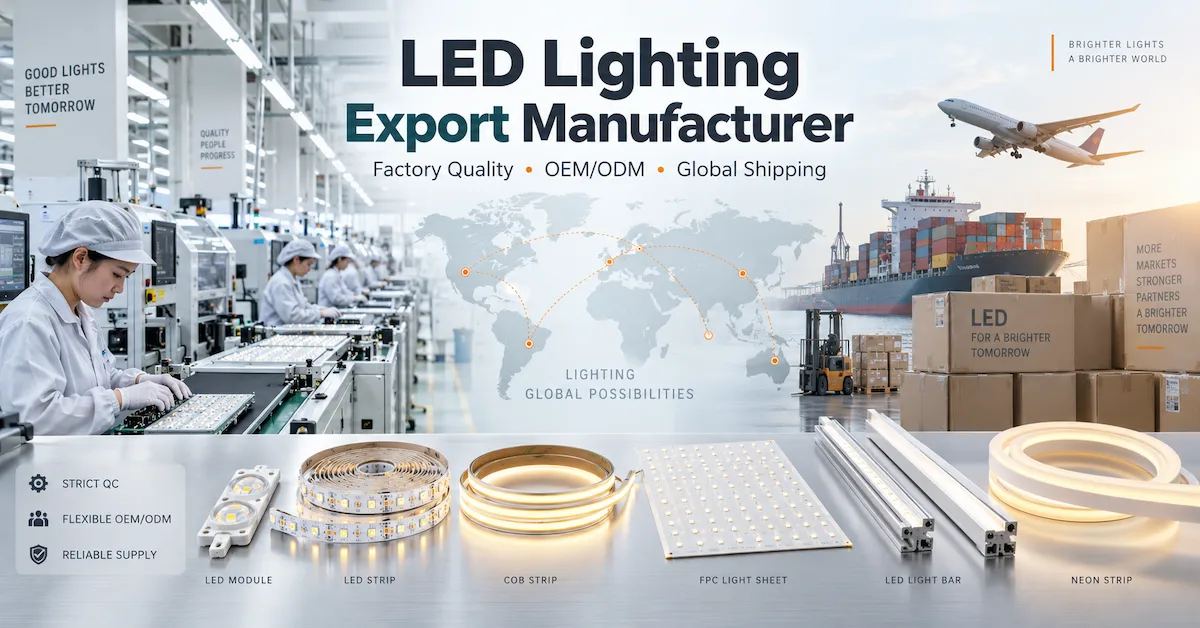
An LED lighting export manufacturer should do more than produce lighting components and arrange international shipments. For professional importers, distributors, signage manufacturers, OEM brands, and commercial project contractors, a dependable export partner must combine manufacturing capability with technical accuracy, product consistency, documentation, and reliable delivery.
The challenge is that two suppliers offering similar-looking LED products may operate very differently.
One may manufacture its own PCB assemblies, maintain internal inspection procedures, support engineering changes, and control production batches. Another may purchase finished products from several factories and consolidate them for export. Both business models can be legitimate, but they offer different levels of production control, customization, traceability, and supply-chain visibility.
For international buyers, the distinction matters.
A poorly specified LED module may create uneven illumination in a channel letter. A flexible LED strip with inadequate conductor capacity may produce noticeable voltage drop. A product supplied with inappropriate documentation may be delayed at customs or rejected by a commercial customer. Even a technically acceptable product can become expensive when packing problems, incorrect labels, unstable lead times, or difficult warranty claims interrupt a project.
The goal is therefore not simply to find the lowest-priced manufacturer in China.
It is to identify a supplier whose manufacturing processes, technical capabilities, export experience, and product range match the buyer's actual business requirements.
This guide focuses on professional LED components and systems for signage, light boxes, commercial displays, decorative architectural lighting, and related OEM applications—areas where specialized manufacturing knowledge is particularly valuable.
Quick Answer: How Do You Choose a Reliable LED Lighting Export Manufacturer?
A reliable LED export manufacturer should be evaluated across six connected areas:
-
Application fit: Does the factory specialize in the LED technology your customers actually need?
-
Manufacturing control: Can it demonstrate production equipment, engineering resources, process control, and traceability?
-
Quality consistency: Are electrical, optical, environmental, and final inspections appropriate for the product?
-
Market compliance: Can the supplier provide documentation applicable to the exact product and destination market?
-
Commercial reliability: Are MOQ, pricing, customization, lead times, warranty conditions, and repeat orders clearly defined?
-
Export execution: Can the supplier coordinate packaging, shipment documentation, transport arrangements, and after-sales communication?
A practical sourcing decision should combine factory evaluation, technical sample approval, a written purchase specification, and commercial comparison based on total landed cost.
No certificate, factory photograph, product specification, or low quotation is sufficient by itself.
Why Specialization Matters More Than a Broad LED Product Catalog
The phrase "LED lighting manufacturer" describes an enormous industry.
It can include suppliers of residential bulbs, recessed downlights, floodlights, streetlights, high-bay luminaires, automotive lighting, LED signage modules, decorative strips, architectural systems, and complete commercial fixtures.
These categories do not require identical manufacturing expertise.
A factory producing residential LED bulbs may have strong driver assembly and automated luminaire production capabilities. That does not necessarily make it the best partner for custom backlighting in shallow channel letters.
Likewise, an LED signage specialist may understand optical lens distribution, narrow sign structures, flexible circuit layouts, IP-rated modules, and color consistency across retail displays without manufacturing every type of general-purpose luminaire.
For overseas buyers, specialization affects the quality of technical recommendations.
Consider a shallow advertising light box. A supplier familiar with signage may ask for cabinet depth, diffuser material, viewing distance, and target brightness before suggesting a product.
A less specialized supplier might recommend whichever strip or module is currently available.
Both may offer products described as high brightness. Only one approach begins with the actual application.
This distinction is especially relevant to YESUN LED.
According to its published company profile, YESUN specializes in LED lighting for advertising signage and commercial applications, including LED modules, flexible strips, FPC light sheets, light bars, neon lighting, and custom backlighting systems.
Its product positioning is more specific than that of a general-purpose lighting exporter.
For buyers developing signs, displays, illuminated brand elements, or related commercial installations, that specialization is worth evaluating.
Who Should Work With a Specialized LED Lighting Export Factory?
Different overseas customers purchase LED lighting for different commercial reasons. Their supplier-selection criteria should reflect those differences.
| Buyer Type | Typical Purchasing Requirements | Main Procurement Concerns |
|---|---|---|
| LED importers | Standard products and recurring shipments | Documentation, pricing stability, customs clearance |
| Lighting distributors | Multiple SKUs and replenishment | MOQ, margins, packaging, batch consistency |
| Sign manufacturers | LED modules and strips | Beam angle, brightness uniformity, installation efficiency |
| Light box manufacturers | Modules, light sheets, and light bars | Cabinet depth, optical distribution, power layout |
| OEM lighting brands | Customized lighting components | Product development, private labels, specifications |
| Retail display companies | COB strips and FPC light sheets | Color quality, slim construction, uniform illumination |
| Commercial contractors | Project-based LED systems | Electrical compatibility, delivery schedules, installation |
| Architectural lighting firms | Neon, strips, and control systems | Lighting effects, mechanical flexibility, dimming |
| Chain-store procurement teams | Standardized lighting solutions | Repeatability, replacement compatibility, long-term supply |
Importers and distributors
These buyers need products that can be purchased repeatedly without unexpected changes in electrical performance, appearance, packaging, or identification.
Their business depends on stable inventory and predictable supply.
Signage and display manufacturers
For these customers, the LED product becomes part of a larger manufactured assembly.
They need technical information about the final illuminated structure, not just the components inside it.
OEM and private-label brands
These buyers need control over specifications, branding, documentation, and future product revisions.
They may require customized cable lengths, connectors, packaging, lighting characteristics, or mechanical dimensions.
Project contractors
Their main risk is schedule disruption.
Late materials, incorrect voltage, incompatible accessories, and inconsistent lighting can affect installation labor, subcontractors, and customer acceptance.
A specialized manufacturer is particularly valuable when it can identify these risks before the purchase order is placed.
Manufacturer vs. Trading Company: What Is the Real Difference?
Many overseas buyers begin by asking whether a potential supplier is a factory or a trading company.
This is a useful question, but it should not become a simplistic rule that all manufacturers are good and all trading companies are bad.
A competent trading company may offer strong sourcing, consolidation, logistics, and communication services.
A manufacturer may offer stronger direct control over product design, production processes, component selection, and engineering changes.
The correct decision depends on what the buyer needs.
When direct manufacturing matters most
A direct manufacturer is especially valuable when a project involves:
-
Custom PCB or FPC dimensions
-
Specific LED chips or optical lenses
-
Tight color consistency requirements
-
Custom waterproof construction
-
Unusual connectors or cable exits
-
Repeated large-volume production
-
Engineering modifications
-
Production traceability
-
Long-term product standardization
If a customer requests a change in the PCB design, a trading company may need to consult an external factory.
A manufacturer with in-house engineering and appropriate production capability can often evaluate the change more directly.
How to verify factory claims
Ask for evidence related to the specific product family:
-
Production facility information
-
SMT line configuration
-
Manufacturing process descriptions
-
Quality-control procedures
-
Testing equipment
-
Engineering support
-
Sample development capability
-
Actual product documentation
-
Finished-product identification
-
Traceability methods
Video meetings, factory inspections, production photographs, and independent audits can provide additional confidence.
A factory visit is useful, but buyers should also review the product's technical documentation and production controls.
A large building alone does not guarantee consistent LED quality.
What LED Products Should a Commercial Lighting Export Manufacturer Offer?
A broad product portfolio can simplify procurement, provided that the manufacturer understands how the different technologies should be selected.
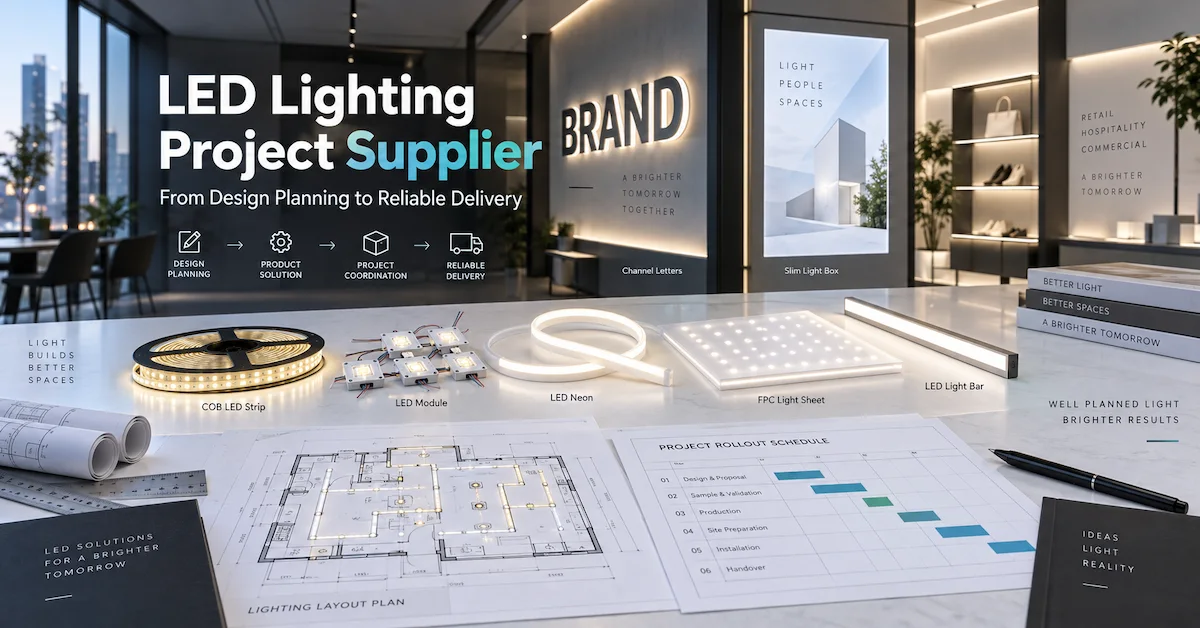
For professional signage and commercial applications, the most relevant product families include the following.
| Product Category | Main Applications | Important Buying Criteria |
|---|---|---|
| LED Modules | Channel letters, illuminated signs | Lens angle, lumen output, voltage, IP rating |
| Standard LED Strips | Linear lighting, outlines, displays | LED density, FPC design, voltage drop |
| COB LED Strips | Dot-free linear lighting, retail | Uniformity, thermal design, cutting length |
| LED Neon Strips | Logos, architectural contours | Bend radius, profile, diffusion, sealing |
| FPC LED Light Sheets | Slim displays, translucent panels | Uniformity, dimensions, LED layout |
| LED Light Bars | Large advertising light boxes | Beam distribution, length, mounting |
| LED Controllers | RGB, RGBW, tunable lighting | Compatibility, channels, output capacity |
| LED Power Supplies | Complete lighting systems | Output voltage, wattage, protection |
| Slim LED Light Boxes | Menus, posters, advertising | Dimensions, structure, illumination |
YESUN's commercial LED product catalog covers these main technologies.
For importers, this product combination provides a potential sourcing advantage: compatible lighting components and related accessories can be evaluated together rather than through several unrelated suppliers.
However, compatibility must still be confirmed for the actual models purchased.
LED modules for illuminated signage
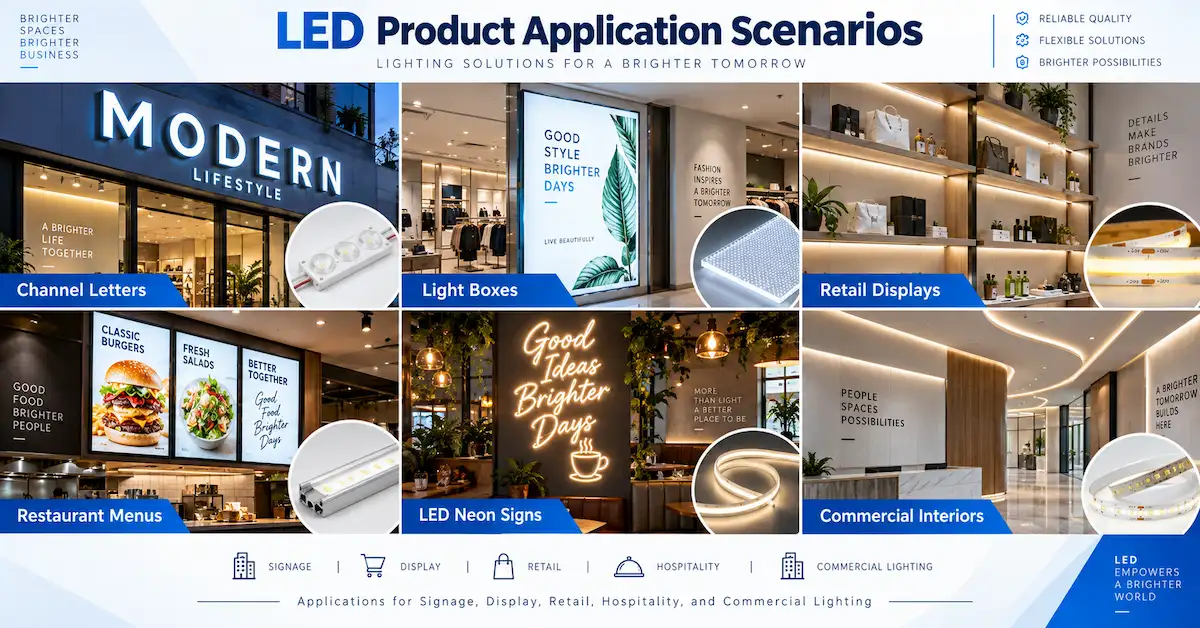
LED modules are widely used in channel letters, sign cabinets, light boxes, and outdoor advertising structures.
They are useful because installers can distribute individual lighting units according to the shape and dimensions of the sign.
Relevant product characteristics include:
-
SMD2835, SMD3030, or other LED packages
-
Optical lens design
-
Beam angles
-
Module dimensions
-
Power per module
-
Maximum recommended modules per chain
-
Mounting method
-
Waterproof construction
-
Color options
The YESUN LED module range includes mini, high-efficiency, wide-angle, RGB, side-lighting, high-voltage, and other configurations.
This allows buyers to evaluate modules according to sign depth, lighting direction, and project requirements.
Flexible LED strips and COB lighting
LED strips are useful for linear illumination, decorative profiles, shelves, contours, and architectural details.
COB strips are particularly relevant where a smooth visible light line is required.
For exporters and distributors, these products introduce additional technical considerations.
LED density alone is not enough to judge quality. PCB thickness, conductor dimensions, heat dissipation, current loading, cutting intervals, color consistency, and waterproof construction all affect performance.
A factory should be able to explain these characteristics rather than relying on a simple LEDs-per-meter figure.
FPC LED light sheets
For shallow light boxes and illuminated panels, traditional strips or modules may create hotspots.
An FPC LED light sheet distributes LEDs across a flexible surface and can be useful for slim backlighting, retail displays, brand walls, and irregular shapes.
These applications require careful coordination between the LED layout and the finished panel structure.
Buyers should supply panel dimensions, installation depth, diffuser information, and target brightness before requesting an engineered recommendation.
LED light bars
Large advertising cabinets may benefit from rigid or flexible light-bar structures.
Compared with mounting many individual modules, a purpose-designed LED light bar can simplify certain large-area installations.
The correct choice depends on cabinet depth, spacing, mounting details, power distribution, and maintenance requirements.
Neon-style lighting
LED neon strips serve a different visual function.
Instead of being hidden behind a sign face, the illuminated line is often visible.
Buyers should evaluate silicone profile quality, diffusion, bending direction, minimum bend radius, mounting accessories, color consistency, and end sealing.
These details are particularly important for custom brand logos and exposed outdoor installations.
How Should Export Buyers Define LED Technical Specifications?
A professional purchase order should identify measurable product requirements.
Descriptions such as "high brightness," "good waterproofing," or "premium quality" leave too much room for interpretation.
For international sourcing, specifications should be precise enough that both supplier and buyer can independently verify the delivered goods.
| Specification | Why It Matters | What the Buyer Should Confirm |
|---|---|---|
| Operating voltage | Electrical compatibility | DC12V, DC24V, or applicable AC configuration |
| Power consumption | Driver sizing and energy use | Watts per module or meter |
| Luminous flux | Actual light output | Lumens per unit or meter |
| Luminous efficacy | Performance efficiency | lm/W under stated conditions |
| CCT | White-light appearance | Target Kelvin range and tolerance |
| CRI | Color rendering | Required performance for the application |
| Beam angle | Surface uniformity | Optical distribution |
| IP rating | Environmental protection | Rating and test scope |
| PCB/FPC | Electrical and thermal performance | Material, structure, dimensions |
| LED density | Light continuity | LEDs per meter or module spacing |
| Cascade length | Installation design | Permitted loading and connection limits |
| Control system | Dynamic lighting compatibility | Channels, protocol, controller |
| Operating temperature | Environmental suitability | Manufacturer's rated limits |
| Warranty | Commercial risk allocation | Model-specific coverage and exclusions |
These parameters should be tied to the application.
For example, a channel-letter factory may prioritize optical distribution and module dimensions. A retail display manufacturer may place greater weight on color rendering and light uniformity.
A distributor supplying several industries may need different product standards for different customers.
The key principle is to define requirements based on the final installation—not merely the general product category.
Real Product Data Is More Useful Than Generic Performance Claims
International buyers should favor verifiable product information over broad marketing statements.
Consider two product directions within YESUN's LED module portfolio.
The YS-MA2321 is presented as a high-efficiency LED module using two SMD2835 LEDs, with a published output of up to 122 lumens, approximately 170 lm/W efficacy, a wide 175° beam, and IP67-rated construction.
Another product, the YS-MB6331, is described as a three-LED backlighting module offering approximately 200 lumens per module, 140 lm/W efficacy, and a 175° beam.
These figures describe different performance priorities.
Higher lumen output per module may help reduce installation points in a suitable design. Higher efficacy may reduce electrical demand for a given lighting requirement.
Neither characteristic independently determines the best result.
The correct comparison also requires sign depth, diffuser characteristics, module spacing, power architecture, price, and installation labor.
For a project-specific analysis, buyers can review product information such as the YS-MA2321 high-efficiency LED module and request an application layout.
This approach is substantially more useful than accepting claims such as "super bright" without measurable specifications.
Factory Production Capability: Which Evidence Actually Matters?
Factory capacity is important, but headline numbers should be interpreted carefully.
YESUN states in its published company information that it was established in 2013 and operates an approximately 5,000-square-meter production facility with six SMT lines.
The company also reports a monthly output exceeding 1.5 million LED products, more than 100 employees, and an R&D team with over ten engineers.
These figures indicate the scale of its stated manufacturing operation.
They do not, by themselves, guarantee capacity for every product, every customized configuration, or every delivery date.
A buyer planning a large purchase should verify:
-
Available capacity for the required product family
-
Material availability
-
Existing production commitments
-
Production-line compatibility
-
Engineering workload
-
Special tooling requirements
-
Testing and aging-test capacity
-
Packaging preparation
-
Export shipment scheduling
A factory may have significant total production capacity while a particular customized product still requires additional development or materials.
Buyers should therefore ask for an order-specific production schedule.
A confirmed production plan is more useful than an impressive annual or monthly capacity figure.
Manufacturing Processes That Influence LED Product Quality
LED manufacturing quality begins long before the finished product is packed.
For PCB- and FPC-based products, process control matters because electrical, thermal, and mechanical defects may not be visible during a quick lighting demonstration.
A typical production sequence can include:
Incoming material inspection: Check LEDs, circuit boards, resistors, cables, lenses, and other components against the approved specification.
Solder paste application: Control solder deposition before component placement.
SMT placement: Position LEDs and electronic components accurately.
Reflow soldering: Establish solder connections under controlled processing conditions.
Post-reflow inspection: Identify visible assembly and soldering defects.
Secondary assembly: Install cables, connectors, optical parts, housings, or other components.
Waterproof processing: Apply the specified encapsulation, molding, or sealing method where required.
Electrical and lighting inspection: Check that assembled products operate within specified limits.
Aging or reliability screening: Conduct defined tests appropriate to the product.
Final inspection and packing: Verify appearance, identification, quantity, and packaging.
YESUN's published materials describe SMT production, injection molding, glue dispensing, electrical testing, lighting inspection, aging tests, integrating sphere testing, and environmental testing.
For export buyers, the important question is how these processes are applied to the particular ordered product.
Ask for the inspection plan, acceptance criteria, test records, and traceability approach where appropriate.
Quality Control: How Can Buyers Reduce Defects Before Shipment?
A reliable QC process should catch problems at several production stages rather than relying entirely on a final inspection.
Four areas deserve particular attention.
1. Incoming component consistency
Different LED bins, PCB materials, resistors, or cable components can influence performance.
For repeat orders, buyers should ask how approved components are identified and how substitutions are controlled.
A small component change may affect brightness, color, thermal behavior, or electrical compatibility.
2. In-process inspection
Early inspection can prevent defects from moving through the entire production cycle.
SMT soldering defects, reversed components, damaged circuits, or incorrect cable connections are easier to correct before final assembly.
3. Functional and performance testing
Depending on the LED product, relevant checks may include:
-
Electrical input
-
Current and voltage
-
Power consumption
-
Luminous output
-
CCT and color consistency
-
Dimmer or controller behavior
-
Visual uniformity
-
Waterproof construction
-
Thermal performance
4. Final outgoing inspection
Before shipment, confirm model numbers, quantities, labels, connectors, packaging, and the agreed performance criteria.
If a sampling inspection system such as an agreed AQL plan is used, the inspection level, defect classifications, and acceptance limits should be documented.
An AQL sampling plan does not mean every unit has been tested or that every possible defect has been eliminated.
For critical projects, buyers may also request a third-party pre-shipment inspection.
Why Sample Approval Is Essential Before Bulk LED Exports
A sample should serve as a technical reference, not merely a sales demonstration.
Before approving mass production, test the product under conditions representative of the intended application.
A channel-letter module should ideally be evaluated inside a representative letter.
A flexible LED strip should be installed in the intended channel or mounting profile.
An FPC light sheet should be examined behind the actual or equivalent diffuser.
A neon strip should be checked against the required bending geometry and mounting method.
The sample evaluation should record:
-
Product model and revision
-
Operating voltage
-
Power consumption
-
Physical dimensions
-
Cable and connector arrangement
-
Optical appearance
-
CCT or color target
-
Electrical behavior
-
Installation characteristics
-
Packaging requirements
For more demanding projects, evaluate thermal performance and environmental behavior under a documented procedure.
Once accepted, the approved sample can become a golden-sample reference.
The manufacturer and buyer should agree which characteristics must remain unchanged during production.
This is especially important for distributors supplying repeat customers and chain brands installing the same lighting across many locations.
A successful first shipment is valuable. Reproducing that quality in the tenth shipment is what creates a dependable supply relationship.
Export Certifications: What Should International Buyers Verify?
International compliance is one of the most misunderstood parts of LED sourcing.
Buyers frequently ask whether a manufacturer has CE, RoHS, UL, or UKCA documentation.
That is a reasonable starting point, but the next question should always be:
Does the available documentation apply to the exact product, configuration, and destination-market requirements?
Different requirements address different issues.
CE marking for European markets
For products subject to applicable EU harmonization legislation, CE marking indicates a manufacturer's declaration that the product meets the relevant requirements.
The specific obligations depend on the product's electrical characteristics and applicable legislation.
A low-voltage LED component, an AC-powered lighting system, and a complete commercial luminaire may not have identical regulatory obligations.
Buyers should request the relevant EU Declaration of Conformity and supporting documentation where applicable.
RoHS
EU RoHS requirements concern restrictions on certain hazardous substances in electrical and electronic equipment within their scope.
A general RoHS statement is not a substitute for checking the documentation relevant to the purchased product and its components.
UL documentation
UL-related approvals and listings may be relevant to North American projects, depending on the product and application.
Buyers should distinguish between finished-product certification and recognized components, and confirm the applicable listing or recognition scope.
YESUN's certification resource center lists UL documentation for LED modules and strips, including certificate reference E492820.
The existence of a certificate does not mean every product model or modified OEM variant is covered.
UKCA and other market requirements
For Great Britain, the applicable conformity-marking rules depend on the product, relevant regulations, and current government requirements.
Importers should check the rules applicable at the time of placing goods on the market.
Other destinations may involve national electrical standards, importer registrations, energy regulations, labeling obligations, or project-specific requirements.
IP ratings
IP ratings classify degrees of protection provided by enclosures against specified ingress conditions.
They are relevant to outdoor signage, humid environments, and certain commercial installations.
An IP-rated LED module does not automatically make the finished sign waterproof.
Connections, drivers, cable exits, mounting structures, and enclosure design remain important.
For product-specific approvals, reports, and current document availability, consult the YESUN certification section before finalizing an export order.
OEM and ODM Services: What Can Overseas Brands Customize?
An export manufacturer becomes particularly valuable when it can support product adaptation.
OEM and ODM projects may involve different levels of design participation.
In an OEM arrangement, the buyer typically provides specifications or branding requirements for manufacture.
In an ODM arrangement, the manufacturer may play a larger role in developing or adapting the underlying product design.
The exact commercial meaning should be defined in the agreement.
For commercial LED products, possible customization areas include:
Electrical specifications
Voltage, power, current configuration, LED density, and control requirements.
Optical characteristics
Beam angle, brightness, CCT, RGB configuration, and LED package selection.
Mechanical specifications
PCB dimensions, FPC width, product length, shape, housing, cable exit, and connector layout.
Environmental construction
Waterproof design, insulation, sealing, and installation characteristics.
Commercial presentation
Private-label packaging, product identification, instruction sheets, and carton markings.
YESUN supports product-oriented OEM and customization work for signage and commercial lighting applications.
Its existing article on OEM LED lighting manufacturing provides additional background on custom commercial lighting projects.
A buyer should still confirm which modifications are available for the selected platform, whether tooling is required, and whether changes affect documentation or certification.
Not every catalog product supports every possible modification.
How to Protect OEM Specifications and Repeat-Order Consistency
A common concern in international sourcing is that a successful sample may not perfectly match later production.
The solution is not merely asking the factory to "keep the same quality."
It is controlling the approved product definition.
An OEM purchase specification should identify:
-
Product drawing and revision
-
Bill of materials or agreed critical components
-
Approved LED characteristics
-
PCB/FPC construction
-
Cable and connector details
-
Optical requirements
-
Packaging artwork
-
Label content
-
Inspection procedures
-
Relevant test requirements
-
Permitted tolerances
-
Change-approval procedure
For proprietary designs, buyers should also address confidentiality, intellectual property, tooling ownership, and restrictions on unauthorized substitutions through appropriate commercial agreements.
This is especially important when moving from a standard product to an exclusive private-label design.
A documented engineering-change process reduces the risk of unexpected modifications between purchase orders.
MOQ and Lead Time: Why Export Buyers Need Clear Definitions
Minimum order quantity is often one of the first questions overseas buyers ask.
However, MOQ is not always a single number for the entire factory.
It may depend on:
-
Product family
-
Standard or customized design
-
LED color
-
Voltage
-
PCB version
-
Packaging
-
Special materials
-
Tooling
-
Order frequency
A distributor ordering several standard products may have different commercial requirements from a private-label customer requesting a newly developed assembly.
Likewise, lead time must be defined carefully.
Sample lead time is not the same as mass-production lead time.
Mass-production lead time is not the same as international transit time.
A complete project timeline may include:
Engineering review → sample production → sample approval → material preparation → production → inspection → packaging → shipment → customs clearance → domestic delivery.
If the buyer needs stock available in a warehouse by a fixed date, the purchase plan should work backward from that required arrival date.
It is also important to clarify what starts the quoted production lead time.
Does it begin when the purchase order is placed, when the deposit is received, when artwork is approved, or when all specifications are frozen?
The answer can materially change the delivery schedule.
Export Packaging: An Often-Overlooked Source of Loss
Packaging is not a minor issue for LED lighting exports.
Small LED modules may be shipped in large quantities. Long strips, light bars, silicone neon, controllers, and power supplies have different protection requirements.
Poor packing can cause:
-
Broken electrical connections
-
Damaged optical lenses
-
Bent circuit boards
-
Crushed product housings
-
Damaged silicone profiles
-
Moisture exposure
-
Mixed or mislabeled SKUs
-
Difficult warehouse receiving
The appropriate packaging design depends on product weight, geometry, fragility, and shipping method.
For LED strips, buyers may need to consider reel size, bend limitations, bag sealing, and product identification.
For rigid light bars, protection against bending and impact may be more important.
For mixed-SKU shipments, carton labeling and packing-list accuracy are essential.
A professional export order should specify:
-
Units per bag or reel
-
Units per carton
-
Carton dimensions and gross weight
-
Product labels
-
Carton identification
-
Protection requirements
-
Pallet requirements where applicable
-
Handling or moisture precautions
-
Shipping marks
Distributors with automated warehouses should also verify barcode and inventory-label requirements before production.
Good packaging reduces damage, receiving errors, and unnecessary handling costs.
EXW, FOB, FCA, CIF, DAP, and DDP: Which Shipping Term Is Best?
International buyers should understand the agreed Incoterms rule before comparing export quotations.
Common options include:
| Trade Term | General Commercial Meaning | Buyer Consideration |
|---|---|---|
| EXW | Seller makes goods available at a named place | Buyer has substantial collection and export responsibilities |
| FCA | Seller delivers to the agreed carrier or location under the specified rule | Useful for clearly defined handover arrangements |
| FOB | Seller delivers goods on board a vessel at the named port | Relevant to sea or inland-waterway transport |
| CIF | Seller pays specified freight and insurance to destination port | Risk transfer and destination costs still need attention |
| DAP | Seller delivers to the named destination ready for unloading | Import clearance and duties generally remain with buyer |
| DDP | Seller delivers under broader seller responsibility including import duties | Importer-of-record feasibility and tax arrangements must be verified |
These descriptions are simplified. The named place, transport method, and applicable Incoterms 2020 provisions determine the precise allocation of obligations.
FOB and CIF are not interchangeable with terms intended for multimodal shipping.
DDP may appear convenient, but it should not be requested without confirming that the seller can lawfully and practically manage import formalities in the destination country.
A quotation should state:
Incoterms rule + named place + version.
For example, a buyer should be able to identify whether the offer covers only factory release, port delivery, international freight, destination clearance, or final delivery.
Without that clarity, comparing two unit prices can be misleading.
How to Calculate the Total Landed Cost of Imported LED Lighting
The lowest factory quotation is not necessarily the lowest purchasing cost.
International buyers should calculate the cost of getting usable products into their own warehouse or project.
A practical landed-cost model may include:
Product value + packaging charges + origin transport + export handling + international freight + insurance + customs duties + import taxes + clearance charges + destination transport + other applicable fees.
The exact treatment of taxes and recoverable VAT depends on the importing business and jurisdiction.
For an illustrative comparison, consider two factories quoting 20,000 LED modules.
Supplier A offers a price that is $0.03 lower per module.
The apparent product saving is:
20,000 × $0.03 = $600.
Now suppose the lower-priced option requires additional packaging, creates higher installation labor, or produces more rework because the specified optical layout is less suitable.
An additional $600 in total downstream costs would erase the initial unit-price advantage.
This is only a hypothetical calculation, not a claim about YESUN's prices or failure rates.
The principle is important: small differences in product price should be compared with the total cost of the finished supply system.
For signage projects, installation cost may be more significant than many buyers expect.
An LED module with a suitable wide-angle lens may allow a different spacing arrangement than a conventional module. If the validated design reduces installation points, it may also reduce wiring and labor.
However, such savings should be demonstrated through layout testing rather than assumed from marketing claims.
Customs Documentation and Import Compliance
Shipping arrangements are only one part of export execution.
Depending on the destination, buyer requirements, and shipment, relevant documents may include:
-
Commercial invoice
-
Packing list
-
Bill of lading or air waybill
-
Certificate of origin where required
-
Applicable product conformity documentation
-
Insurance documentation
-
Product identification and labels
-
Other customs or regulatory documents
Importers must also establish the correct customs classification.
HS classification can depend on the product's actual function and construction.
A finished lighting fixture, an LED module, a power supply, and certain electronic control devices should not automatically be assigned the same tariff classification.
Destination-specific tariff codes and duties should be verified with a qualified customs professional or the relevant customs authority.
Buyers should also consider whether local rules impose obligations relating to product labeling, electrical safety, hazardous substances, packaging, or end-of-life electrical equipment.
The manufacturer can supply supporting technical documents, but the importer may still have independent legal responsibilities.
A professional procurement process clarifies these matters before shipment, not when the cargo arrives.
How to Compare LED Lighting Export Manufacturers Objectively
A structured scorecard helps prevent sourcing decisions from being driven by price alone.
The following model is a suggested buyer evaluation framework, not an official industry certification system.
| Evaluation Area | Suggested Weight | Evidence to Review |
|---|---|---|
| Product and application fit | 25% | Specifications, samples, engineering support |
| Quality and manufacturing control | 20% | Process records, tests, inspection plan |
| Certification and documentation | 15% | Model-specific documents and validity |
| Repeat-order consistency | 15% | Revision control, component control, traceability |
| Export and delivery capability | 15% | Packaging, lead times, shipping arrangements |
| Commercial terms and support | 10% | MOQ, pricing, warranty, communication |
| Total | 100% |
Buyers can rate each category from 1 to 5 and multiply it by the assigned weight to create a consistent comparison.
This does not eliminate the need for judgment.
A supplier with a strong total score may still be unsuitable if it cannot meet a mandatory certification or application requirement.
Mandatory requirements should be treated as pass-or-fail conditions before the weighted comparison.
For critical supply programs, include a sample audit or pilot order before approving full-scale purchasing.
What Are the Biggest Risks When Importing LED Lighting?
Several recurring risks deserve attention.
Product mismatch
The supplied product works electrically but does not fit the intended lighting structure.
Prevention: Share drawings and application details before selecting the model.
Inconsistent color
Different production batches produce visible CCT or color variation.
Prevention: Specify acceptable tolerances, sample references, and change control.
Inadequate documentation
The supplier provides a general company certificate rather than evidence applicable to the ordered configuration.
Prevention: Review document scope before purchase-order approval.
Unstable delivery
Production is delayed by special components, tooling, material shortages, or unclear approvals.
Prevention: Confirm the production schedule and responsibility for each milestone.
Poor export packing
Goods arrive damaged or warehouse personnel cannot identify the correct SKUs.
Prevention: Approve packaging specifications and labeling.
Difficult warranty resolution
The buyer and supplier disagree about defect evidence, installation conditions, or replacement responsibilities.
Prevention: Define warranty scope, exclusions, claim procedures, and remedies in writing.
Specification drift
Later orders differ from an approved sample.
Prevention: Maintain golden samples, revision records, and approved critical components.
Risk reduction is usually more valuable than attempting to recover losses after a large shipment has already arrived.
Why Warranty Terms Need Careful Review
Warranty claims can be difficult to interpret when suppliers advertise a single warranty period across a broad product range.
Different lighting products may carry different warranty terms.
YESUN's company information describes a minimum three-year warranty, while several LED module product pages list five-year warranty terms.
Therefore, international buyers should verify the warranty for the exact model and order.
Important questions include:
Does the warranty cover manufacturing defects only?
What are the rated operating conditions?
How are installation-related failures handled?
What evidence must be provided for a claim?
Will replacements be shipped with the next order or separately?
Who is responsible for transport costs?
Are labor and on-site replacement costs excluded?
Is coverage affected by an OEM modification?
A useful warranty agreement should explain the remedy, not merely state a number of years.
For repeat importers, a clearly defined failure-reporting and replacement process can be more valuable than an impressive but ambiguous warranty statement.
Two Practical Sourcing Scenarios
Scenario A: A Sign Manufacturer Importing LED Modules for Channel Letters
Consider a signage company producing illuminated channel letters for regional retail customers.
Its existing supplier offers a low-cost module, but installers regularly adjust spacing to reduce hotspots in shallow letters.
The company wants to import an alternative product.
A weak sourcing process would compare unit prices and order a container.
A stronger process begins with the actual sign design.
The buyer provides letter depth, stroke width, face material, target appearance, and representative dimensions.
The manufacturer recommends one or more suitable LED module configurations.
The buyer then builds a sample letter using each option.
The comparison evaluates:
-
Uniformity
-
Module count
-
Installed power
-
Installation labor
-
Cable arrangement
-
Color consistency
-
Product price
-
Total installed cost
The winning option may not be the cheapest LED module.
It may be the solution that delivers the required appearance with predictable installation time and fewer adjustments.
This hypothetical scenario demonstrates how application engineering can create real procurement value.
Scenario B: A Distributor Building a Private-Label LED Strip Range
Now consider a distributor entering a regional commercial lighting market.
The distributor wants to sell several strip types under its own brand.
The intended portfolio includes standard white strips, COB strips, outdoor-rated products, and RGB configurations.
A weak approach would order unrelated products with different packaging and inconsistent specifications.
A stronger sourcing process establishes a product matrix.
For every SKU, the distributor defines:
-
Voltage
-
LED density
-
CCT or color
-
Power consumption
-
Width
-
IP rating
-
Cutting interval
-
Reel length
-
Packaging
-
Label format
-
Documentation requirements
It also checks power-supply and controller compatibility.
A pilot order is used to verify packaging, customer acceptance, and warehouse processes.
Only after the pilot is approved does the distributor increase purchasing volume.
The result is not simply a collection of imported LED products.
It is a controlled commercial product range that can be supported and replenished.
How YESUN Supports International Signage and Commercial Lighting Buyers
YESUN LED is positioned as a Shenzhen-based manufacturer specializing in professional LED lighting components and solutions for signage and commercial applications.
The company states that it was established in 2013 and serves customers across more than 100 countries.
Its manufacturing information highlights automated production, multiple SMT lines, an engineering team, and quality-control processes.
The main sourcing advantages for relevant buyers include:
Specialized product focus: LED modules, strips, COB, neon, light sheets, light bars, and associated commercial lighting components.
Application-oriented selection: Products for channel letters, light boxes, retail displays, advertising structures, and custom commercial installations.
OEM/ODM support: Project-dependent customization of specifications, dimensions, electrical configurations, and branding.
Manufacturing and QC resources: Factory production and testing processes described in the company's public materials.
Related system components: Power supplies, LED controllers, and accessories available within the broader portfolio.
For buyers comparing export partners, these capabilities provide useful starting points for an RFQ and technical discussion.
They should still be evaluated against the individual order requirements.
A manufacturer is a strong fit only when it can deliver the required product, documentation, quality, schedule, and commercial terms.
How to Prepare an Effective RFQ for an LED Lighting Export Manufacturer
One of the easiest ways to improve supplier quotations is to improve the first inquiry.
A message such as "Please send your best LED price" provides very little information.
The supplier may respond with a generic catalog, a broad price range, or repeated questions.
A stronger RFQ includes the technical and commercial information needed to prepare a meaningful offer.
Recommended RFQ checklist
Project and application
-
Buyer company and destination market
-
Intended application
-
Signage or display dimensions
-
Indoor or outdoor installation
-
Expected operating conditions
Product requirements
-
Product category or preferred model
-
Voltage and power
-
CCT, CRI, or color requirements
-
Brightness and beam angle
-
IP rating
-
Dimensions and installation method
-
Cable and connector specifications
Order requirements
-
Sample quantity
-
Initial bulk quantity
-
Estimated repeat-order volume
-
Standard or OEM/ODM requirements
-
Private-label packaging
-
Required documentation
-
Target delivery date
Export and commercial requirements
-
Destination city, port, or warehouse
-
Preferred transport method
-
Requested Incoterms rule and named place
-
Packaging requirements
-
Warranty expectations
-
Required quotation currency
-
Payment terms to be agreed
When possible, attach technical drawings, photographs, approved samples, or an existing product specification.
The more clearly the project is defined, the easier it becomes to compare offers on an equivalent basis.
You can submit this information through the YESUN contact page for product selection or quotation discussions.
What Should Happen After the First Quotation?
Receiving a quotation should not immediately trigger a mass-production order.
A more reliable sourcing process follows defined approval stages.
Stage 1: Technical review
Confirm the proposed model, application suitability, electrical parameters, dimensions, and documentation requirements.
Stage 2: Commercial comparison
Review price, MOQ, customization charges, tooling if applicable, packaging, shipping terms, lead times, and warranty.
Stage 3: Sample evaluation
Test representative products and record the results.
Stage 4: Specification approval
Freeze the model, critical components, revision, packaging, and agreed acceptance criteria.
Stage 5: Purchase order confirmation
Confirm commercial terms, inspection arrangements, payment conditions, and shipping responsibilities.
Stage 6: Production monitoring
Request agreed updates for critical milestones.
Stage 7: Pre-shipment review
Verify product identity, quantities, inspection results, packaging, and shipping documents.
Stage 8: Receipt and performance feedback
Inspect received goods, record any discrepancies, and use the information to improve future orders.
This process may appear more detailed than simply ordering from a product listing.
For repeat international purchases, it creates a much stronger foundation for reliable supply.
Frequently Asked Questions About LED Lighting Export Manufacturers
1. What is an LED lighting export manufacturer?
An LED lighting export manufacturer produces LED lighting products for overseas customers and supports their international purchasing requirements. Depending on the company, services may include engineering, manufacturing, product customization, quality inspection, packaging, export documentation, and shipment coordination. Buyers should verify which activities are performed in-house and which are outsourced.
2. How do I find a reliable LED lighting manufacturer in China?
Begin by identifying manufacturers specializing in the products you need. Compare factory capability, technical documentation, sample quality, certification scope, manufacturing control, export communication, and delivery performance. For high-value or recurring orders, consider an independent factory audit and a pilot purchase before committing to larger quantities.
3. Is buying directly from an LED factory always cheaper?
Not necessarily. Factory-direct purchasing may reduce certain intermediary costs and improve technical communication, but total cost also depends on MOQ, product design, freight, duties, inspection, packaging, and order-management expenses. Trading companies may offer useful consolidation services. Compare the complete sourcing arrangement rather than assuming one business model is always cheaper.
4. Can an LED lighting exporter provide OEM and private-label products?
Many specialized manufacturers support OEM or private-label work, but capabilities vary. Customization may include PCB/FPC dimensions, LED density, color temperature, voltage, wiring, connectors, labels, and packaging. More complex development may require engineering approval, tooling, prototype validation, additional testing, or updated compliance documentation.
5. What certifications should I request when importing LED lighting?
Requirements depend on the destination market, application, electrical configuration, and whether the purchased item is a component or finished product. Documents may relate to CE conformity, RoHS, UL, UKCA, environmental protection, or other applicable requirements. Always verify that documentation applies to the exact model rather than relying on company-level claims. YESUN provides a certification resources page for initial review.
6. How can I verify LED lighting quality before a bulk shipment?
Approve representative samples, establish measurable specifications, confirm a golden sample, and agree on inspection requirements. Relevant checks can include electrical performance, brightness, CCT, dimensions, functional operation, environmental protection, labeling, and packaging. Depending on the order's value and risk, buyers may also arrange an independent pre-shipment inspection.
7. What is the typical MOQ for exporting LED modules or LED strips?
There is no universal MOQ across all factories or LED product categories. Standard products, mixed-SKU orders, customized colors, special PCB designs, and private-label packaging may have different requirements. Ask the manufacturer to quote MOQ by SKU and identify any materials, tooling, or packaging constraints before planning the purchase.
8. How long does it take to manufacture and export LED lighting?
Lead time depends on whether the order uses existing products or requires new engineering, special components, sampling, certification work, or customized packaging. International transit and customs clearance add separate time. Request a milestone-based delivery schedule and confirm when the production lead time begins.
9. How can distributors reduce total landed cost when importing LED lighting?
Compare product prices together with packaging, freight, insurance, duties, taxes, customs charges, destination transport, and applicable service costs. Also consider inventory holding, installation labor, defects, replacements, and repeat-order stability. A higher-priced product may provide better commercial value if it reduces downstream work or operational risk.
10. Why choose a manufacturer specializing in signage and commercial LED lighting?
A specialized manufacturer may understand application-specific requirements such as channel-letter depth, optical beam distribution, LED module spacing, light-box uniformity, flexible light-sheet construction, voltage drop, and outdoor sealing. This knowledge can help buyers select suitable products, avoid engineering mistakes, and develop more repeatable commercial installations. The supplier should still demonstrate the relevant capabilities through samples, specifications, and project-level technical support.
Conclusion
Choosing an LED lighting export manufacturer is a long-term sourcing decision, not simply a search for the lowest unit price. The strongest manufacturing partnership combines application-specific product knowledge, verified quality controls, appropriate certification documentation, transparent commercial terms, and dependable export execution.
For importers, distributors, signage manufacturers, and OEM brands, defining technical requirements and validating samples before bulk production can significantly reduce avoidable procurement risks.
If your business needs LED modules, strips, light sheets, light bars, neon lighting, or customized commercial solutions, explore YESUN's product portfolio and contact its team with your project specifications to discuss suitable products, OEM options, export requirements, and a tailored quotation.