

What Wholesale Buyers Actually Need From an LED Neon Strip Order
Searching for LED neon strip wholesale usually means the buyer has moved beyond basic product research.
The real questions are more commercial:
- Which models should we stock?
- What quantity makes the order economical?
- Can multiple colors and profiles be combined?
- Will the next batch match the first one?
- Which products are suitable for indoor and outdoor customers?
- Can packaging carry our own brand?
- What happens if a project needs a non-standard cable or length?
- How should we balance purchase price against warranty and replacement risk?
These questions matter because a bulk order can fail even when the sample looks good.
For distributors and commercial project buyers, the goal should be to build a repeatable supply program: the right products, consistent specifications, predictable quality, manageable inventory, and reliable replenishment.
YESUN's current neon portfolio includes Silicone Neon LED Strips, Separable Neon LED Strips, Flexible Linear LED Strips, Neon Art Series, and customized neon solutions, giving wholesale buyers several product directions rather than a single generic neon profile.
Who Is LED Neon Strip Wholesale Best For?
Bulk purchasing is especially suitable for buyers with repeated demand.
LED Distributors and Importers
Their priority is usually a balanced product range that can serve multiple customers without creating excessive inventory.
They need:
- Popular voltages and colors
- Repeatable specifications
- Clear labeling
- Efficient carton quantities
- Stable replenishment
- Private-label options
Signage Companies
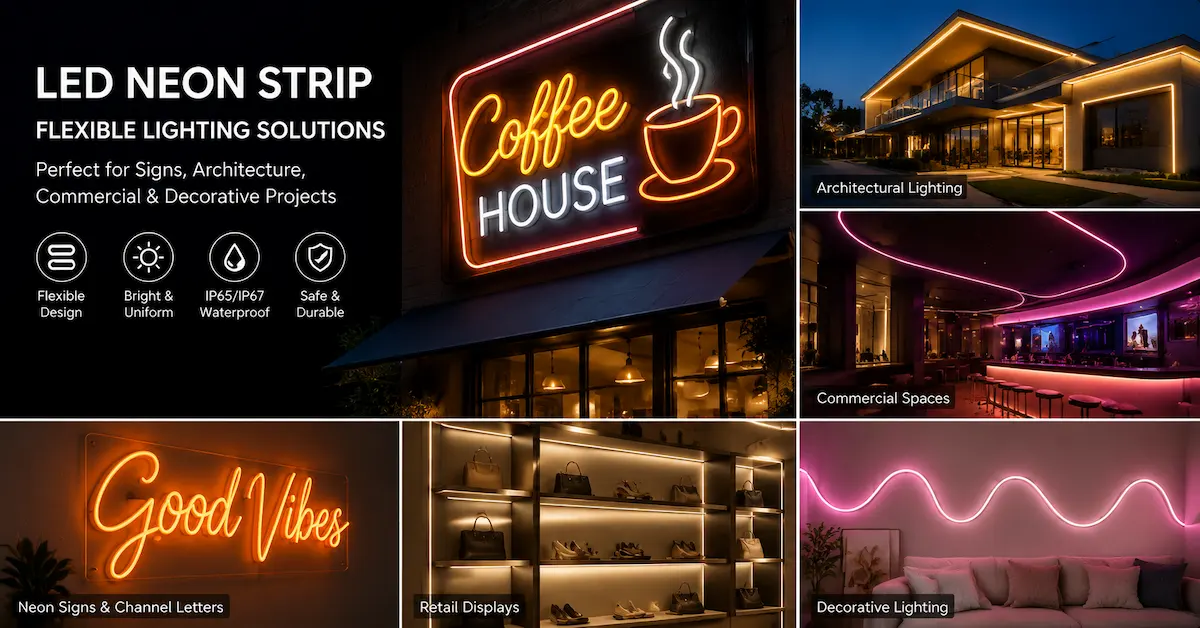
Sign manufacturers often need flexible neon for:
- Logo outlines
- Storefront signs
- Decorative lettering
- Custom commercial signs
Their biggest concerns are bendability, cutting structure, cable position, brightness consistency, and installation reliability.
Lighting Contractors
Contractors tend to buy around project requirements rather than retail assortment.
They may prioritize:
- IP protection
- Long-run stability
- CCT consistency
- Controllers and power matching
- Delivery schedule
- Installation accessories
Architectural and Hospitality Projects
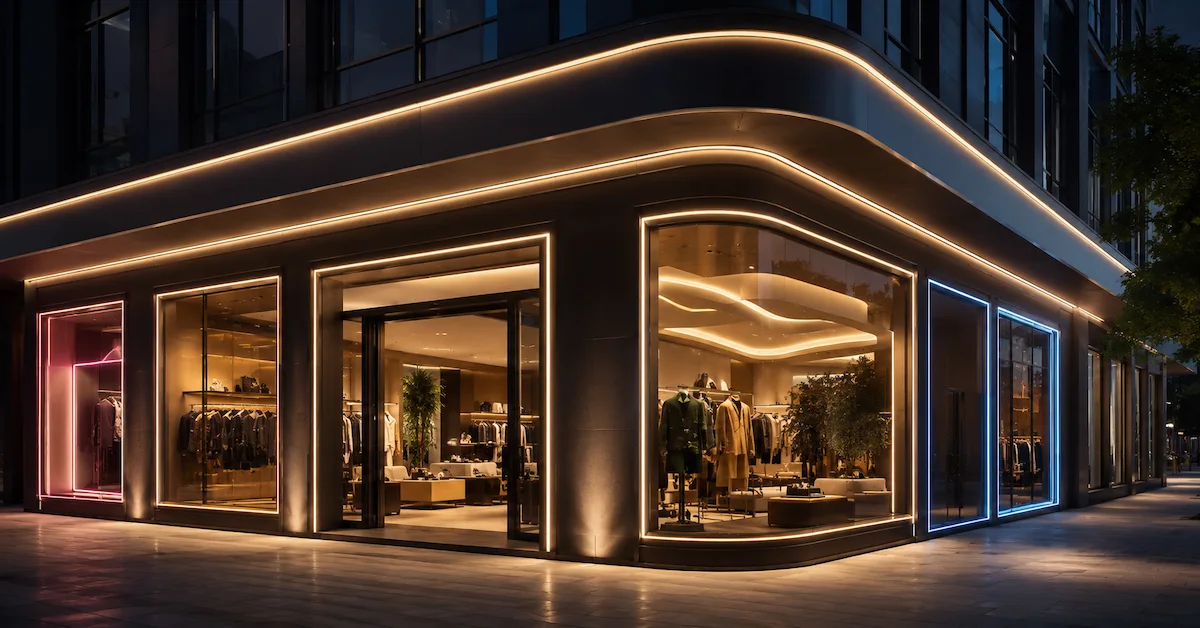
Hotels, restaurants, bars, shopping centers, and building projects often require customized lengths, color temperatures, mounting methods, or electrical zones.
Private-Label Lighting Brands
These buyers need more than a product.
They may require:
- Custom labels
- Branded packaging
- Product documentation
- Defined inspection standards
- Repeat production
- OEM/ODM development
If you only need one or two decorative pieces for a personal installation, wholesale purchasing is usually unnecessary. Bulk procurement makes the most sense when the order must support resale, multiple projects, repeat installation, or brand development.
Build the Product Mix Before Asking for a Wholesale Price
One of the most common purchasing mistakes is sending a supplier only this message:
“Please send your best wholesale price for LED neon strip.”
There is no meaningful single wholesale price because the specification changes the product cost.
Before requesting a quotation, define your initial SKU structure.
Start With the Light Type
A wholesale range may include:
| Product Type | Buyer Value | Typical Market |
|---|---|---|
| Single Color | Simple, stable, easy to sell | Signage, architecture |
| Tunable White | Adjustable warm/cool output | Hospitality, interiors |
| RGB | Color-changing effects | Bars, entertainment |
| RGBW | Dynamic colors plus dedicated white | Premium commercial projects |
| Addressable | Pixel/dynamic effects | Creative and experiential lighting |
If your customers mainly make commercial signs, stocking every dynamic control type may create unnecessary inventory.
If your customers serve bars, gaming spaces, entertainment venues, and event projects, RGB or addressable products may deserve more inventory.
Choose Profiles Around Real Applications
Profile size affects:
- Visual thickness
- Bend direction
- Installation channel
- Light-emitting surface
- Minimum curve
- Project appearance
A distributor should avoid building a catalog with ten almost-identical profiles simply because the factory can produce them.
A better starting assortment usually covers clearly different use cases.
For example:
- Compact neon for detailed signs
- Standard profile for general commercial work
- Side-emitting profile for architectural curves
- Waterproof profile for outdoor projects
- Special-angle or wide-view neon for premium projects
YESUN currently lists neon products including a 16.8 × 15.5 mm, 270° light model using SMD2835, 24V input, and a 5 m standard cascade configuration, illustrating how profile geometry, voltage, LED type, and run structure can vary significantly between models.
What Determines LED Neon Strip Wholesale Price?
Wholesale pricing should be evaluated as a specification-based cost, not simply cost per meter.
Several variables influence quotation levels.
LED Density and Chip Configuration
More LEDs or more complex RGB/RGBW configurations can increase:
- Material cost
- Power requirement
- Controller requirements
- Manufacturing complexity
Silicone Structure
Profile size, silicone volume, extrusion design, and waterproof construction affect material and processing cost.
Voltage and Circuit Design
12V, 24V, and special circuit structures may use different components and cutting units.
Waterproof Construction
Outdoor products may require additional:
- Sealing
- End treatment
- Cable protection
- Testing
Customized Cable and Connector Requirements
A standard cable is usually easier to produce than:
- Multiple cable exits
- Special connector systems
- Extended lead wires
- Project-specific terminals
Packaging
Bulk industrial packaging may cost less than individually branded retail packaging.
Private-label boxes, barcodes, manuals, and custom inserts add value but also affect unit cost.
Order Quantity
Higher quantity may reduce per-unit manufacturing and packaging costs, but buyers should not order unnecessary inventory simply to achieve a lower unit price.
A cheaper unit price can become a more expensive purchase if slow-moving inventory remains unsold for a year.
MOQ: Ask for the Right Kind of Flexibility
MOQ is important, but the lowest MOQ is not automatically the best offer.
A more useful question is:
“How flexible is the MOQ across colors, profiles, packaging, and customization?”
YESUN's current About page states that its factory-direct model supports flexible MOQ and bulk orders for LED products and custom lighting projects.
For wholesale buyers, MOQ should be discussed at several levels.
Standard Product MOQ
Useful for:
- Testing a new market
- Adding new SKUs
- Small distributors
Mixed-SKU MOQ
Ask whether the order can combine:
- Different CCTs
- Different colors
- Different profiles
This can reduce initial inventory risk.
OEM MOQ
Custom products may require a higher quantity because of:
- Special packaging
- Custom labels
- Unique materials
- Production setup
- Custom tooling or development
The MOQ discussion should therefore happen after the product specification is clear.
Sample Approval Should Be Treated as a Purchasing Standard
A wholesale buyer should never approve a product only because it turns on and looks bright.
A sample should be used to establish what mass production is expected to match.
Evaluate:
- Color
- Brightness
- Diffusion uniformity
- Silicone surface
- Bending behavior
- Cable connection
- End sealing
- Cutting points
- Controller compatibility
- Power consumption
- Installation method
For outdoor products, test the complete termination structure—not only the main neon body.
Record the Approved Sample
For repeat orders, retain:
- Model number
- Voltage
- CCT/color
- Profile dimensions
- Cable details
- Connector type
- Packaging
- Approved sample photos
- Production or bin information where applicable
This makes the next order much easier to verify.
Batch Consistency Is More Important Than One Perfect Sample
Wholesale buyers sell or install products over time.
That changes the quality requirement.
A one-time architectural project might only need one production batch.
A distributor may reorder the same item for several years.
Therefore, ask how the factory controls:
- LED binning
- CCT
- brightness
- silicone appearance
- profile dimensions
- cable configuration
- packaging
- labeling
YESUN's current company information states that it operates dedicated SMT lines and full-cycle quality control, with R&D resources focused in part on optical design and color consistency.
For repeat wholesale programs, this kind of process control is more commercially important than a small difference in the first quotation.
What QC Should Wholesale Buyers Ask About?
Your purchase specification should define quality before shipment.
A useful QC flow includes:
Incoming Material Control
Check critical inputs such as:
- LEDs
- FPC/PCB
- silicone materials
- wires
- electronic components
Production Inspection
Important stages can include:
- SMT placement
- soldering
- electrical checks
- extrusion
- connection processing
- visual inspection
Performance Testing
Depending on the product, verify:
- voltage
- current
- power
- brightness
- CCT/color
- control function
- aging performance
- waterproof performance
YESUN product pages currently show a QC process that includes SMT-related inspection, electrical performance testing, aging tests, and integrating-sphere testing across its LED production system.
For a high-value order, buyers should agree on inspection criteria before mass production rather than discussing acceptable defects after shipment.
Certifications Should Match the Destination Market
Do not ask only:
“Do you have certificates?”
Ask:
“Which certification or test report applies to this exact product and my destination market?”
YESUN's current company materials reference CE, UL, RoHS, and UKCA compliance across its product portfolio, while individual product pages may list additional compliance information.
Wholesale importers should confirm:
- Exact model covered
- Report validity
- Market requirement
- Electrical standard
- Packaging/label requirement
Certification needs differ between markets and project types, so documentation should be checked before the order is finalized.
Private Label LED Neon Strip: Where Wholesale Becomes a Brand Program
A wholesale order can remain generic, or it can become a private-label product line.
Possible customization includes:
- Brand label
- Reel label
- Carton mark
- Retail box
- Instruction sheet
- Barcode
- Cable length
- Connector
- Color
- CCT
- Product length
For distributors, private labeling can help:
- Differentiate the product
- Reduce direct price comparison
- Improve brand recognition
- Standardize customer experience
However, do not begin with packaging design before the product specification is stable.
A more efficient sequence is:
Product specification → sample → test → packaging → pilot order → scale
YESUN describes its project process as moving from sampling and customization toward scalable mass production, which aligns well with this approach.
How to Plan a First Wholesale Order Without Overbuying
New buyers often make one of two mistakes:
Order too little: freight and handling cost become inefficient.
Order too much: cash becomes trapped in slow-moving SKUs.
A better first-order strategy is to divide products by expected demand.
A-Level: Core Stock
Products expected to sell repeatedly.
Allocate the highest inventory.
Examples might include:
- Popular warm/neutral white
- Common 24V profiles
- Standard commercial sizes
B-Level: Project Stock
Products that sell regularly but are more application-specific.
Keep moderate inventory.
C-Level: Sample or Special Order
Examples:
- Unusual colors
- Addressable types
- Special profiles
- Custom connectors
Keep limited stock until demand is proven.
This approach usually creates healthier cash flow than buying equal quantities of every catalog item.
Wholesale Price vs Total Landed Cost
A quotation is only part of the cost.
Wholesale buyers should calculate:
Product + packaging + inspection + freight + import cost + local handling + expected replacement cost
For example, Supplier A may quote less per meter but require:
- Larger MOQ
- More expensive packaging
- Higher defect replacement
- More SKUs per carton
- Longer replenishment lead time
Supplier B may have a slightly higher unit price but lower inventory and after-sales risk.
For distributors, gross margin after landed cost and warranty loss matters more than purchase price alone.
Shipping and Packaging Questions to Confirm Before Payment
Before placing the order, ask:
- Meters per reel?
- Reels per carton?
- Net and gross weight?
- Carton dimensions?
- Anti-static protection?
- Individual labeling?
- Are connectors packed separately?
- Are cartons suitable for export shipping?
- Can mixed models be clearly identified?
YESUN already publishes packaging specifications on multiple LED product pages, including quantity-per-roll, carton quantity, weight, and carton dimensions, showing the type of logistics data wholesale buyers should request for freight calculations.
Accurate carton information helps buyers estimate:
- Air freight
- Sea freight
- Warehouse space
- Fulfillment cost
before confirming the purchase.
A Practical LED Neon Strip Wholesale RFQ Checklist
A strong RFQ gets a more useful quotation.
Send the supplier:
| RFQ Item | Information to Provide |
| Product | Neon profile/type |
| Quantity | Total meters / reels |
| Voltage | 12V / 24V / required specification |
| Color | CCT, RGB, RGBW, etc. |
| Environment | Indoor / outdoor |
| IP Requirement | Required protection level |
| Length | Reel or cut length |
| Cable | Length and exit position |
| Connector | Required type |
| Control | Dimming/RGB/addressable |
| Packaging | Bulk or private label |
| Market | Destination country/region |
| Certification | Required documents |
| Order Type | Trial / wholesale / project / repeat |
| Delivery | Required shipment date |
The more specific the RFQ, the easier it is to compare quotations accurately.
When Should You Request a Custom Wholesale Program?
Standard catalog products are usually sufficient when:
- Your market uses common profiles
- No special packaging is required
- Installation conditions are conventional
A customized wholesale program becomes useful when:
- You sell under your own brand
- Your customers repeatedly request the same modification
- A project needs special cable positions
- Standard lengths create waste
- Your market requires specific packaging or labels
- You need an exclusive product combination
YESUN's About Us page states that the company operates as a Shenzhen-based LED manufacturer with factory-direct bulk-order and custom-project support.
Why Source LED Neon Strip Wholesale From YESUN?
For a wholesale relationship, the most useful supplier is one that can move from initial samples to repeatable production.
YESUN's current factory information lists:
- 5,000㎡ automated production space
- 6 dedicated SMT lines
- More than 1.5 million LED products in monthly output
- 100+ export markets
- R&D and full-cycle QC capabilities
For wholesale buyers, these capabilities can support several important requirements:
- Standard neon product sourcing
- Bulk commercial orders
- OEM/ODM development
- Product and packaging customization
- Repeat production
- Technical coordination
You can review the current Neon LED Strip range, or compare this wholesale-focused guide with our earlier guide on evaluating an LED neon strip supplier.
For a quotation, send YESUN your target product, quantity, voltage, color, market, packaging requirement, and expected order schedule through the Contact Us page.
Frequently Asked Questions About LED Neon Strip Wholesale
What is the MOQ for LED neon strip wholesale?
MOQ depends on the model, color, packaging, and customization requirements. Standard products may support more flexible quantities, while OEM packaging or custom specifications may require a larger production quantity. Confirm MOQ after defining the exact SKU.
Is wholesale LED neon strip cheaper than small-quantity purchasing?
Bulk purchasing can lower unit manufacturing and packaging costs, but the real saving depends on freight, inventory turnover, defect rate, and landed cost. The lowest unit price is not always the lowest total procurement cost.
Can I mix different LED neon strip models in one wholesale order?
This depends on production and MOQ requirements. Ask whether different CCTs, colors, or profiles can be combined so you can build a broader initial assortment without overstocking each SKU.
Can YESUN provide private-label LED neon strips?
YESUN supports OEM/ODM and customized commercial LED projects. Private-label requirements such as labels, packaging, cable configuration, and product specifications should be confirmed during quotation and sampling.
What should I test before placing a bulk order?
Test brightness, color consistency, silicone appearance, bending behavior, electrical performance, cutting structure, cable connection, control compatibility, and the actual installation environment.
Should wholesalers choose 12V or 24V LED neon strips?
The right voltage depends on product design, run length, cutting requirements, and target applications. For many commercial projects, 24V can simplify current management over longer runs, but buyers should stock according to the needs of their actual customers.
How can I reduce color differences between repeat orders?
Use a defined product specification, retain an approved sample, document CCT/color requirements, and ask the manufacturer how LED binning and production batch consistency are controlled.
What packaging information should I request?
Ask for reel length, quantity per carton, carton dimensions, gross weight, labeling method, and any retail packaging requirements. This information is essential for calculating freight and warehouse costs.
What information is needed for an LED neon strip wholesale quote?
Provide product type, quantity, voltage, color, IP level, length, cable and connector requirements, packaging, destination market, certifications, and expected delivery date.
How do I start a wholesale order with YESUN?
Review the YESUN Neon LED Strip products, select the product direction, and send your quantity, target market, technical requirements, packaging needs, and expected delivery schedule through the YESUN contact page.
Conclusion
A successful LED neon strip wholesale program is not built around the lowest price per meter.
The strongest bulk purchasing strategy combines the right SKU mix, manageable MOQ, approved samples, repeatable batch quality, suitable certifications, efficient packaging, reliable delivery, and clear OEM requirements.
For distributors, signage companies, contractors, and private-label brands, these factors directly affect inventory turnover, installation efficiency, after-sales cost, and long-term profit.
Instead of asking only for a price list, send a structured RFQ that explains your products, market, quantity, application, packaging, and repeat-order expectations.
That gives YESUN the information needed to recommend a more suitable wholesale configuration and provides you with a quotation that can be evaluated on total procurement value—not price alone.